AI Object Recognition Training Simulator UX Design
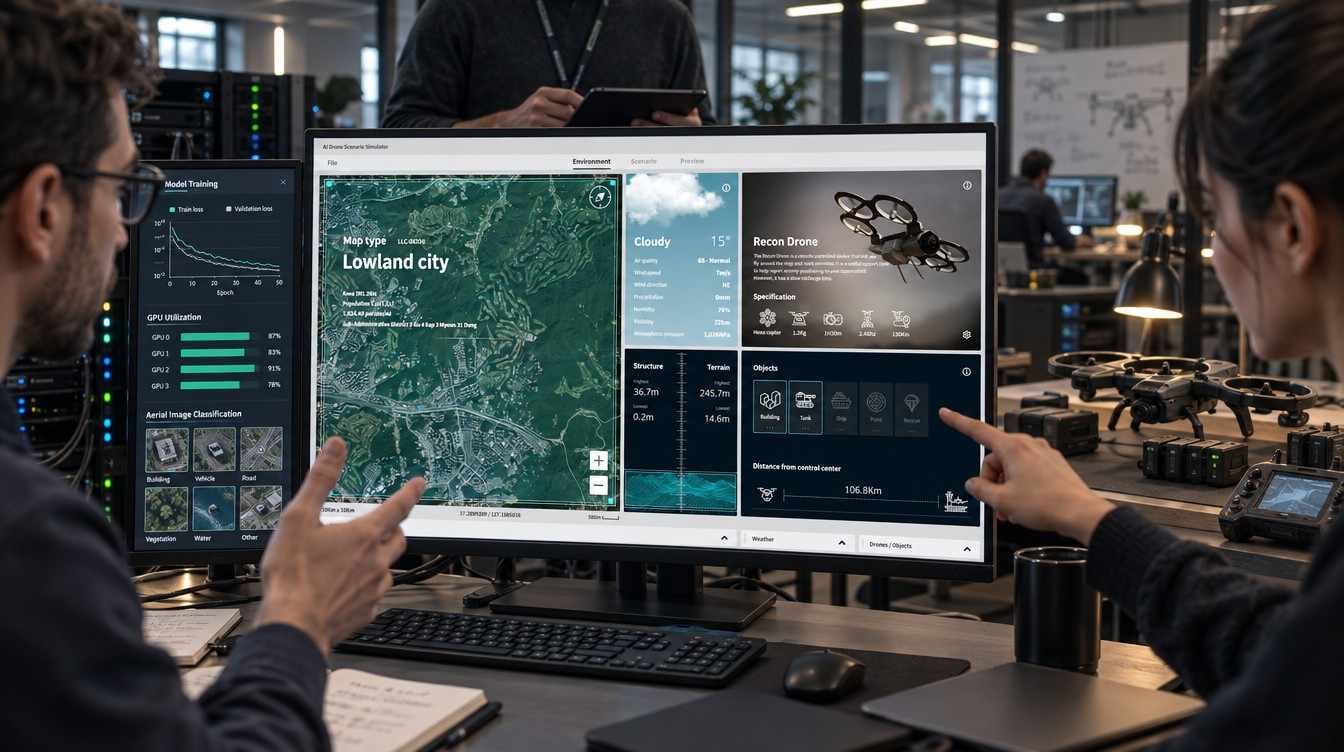
An AI object recognition training simulator is a system for training neural-network models to detect and classify objects, in this case by reinforcement learning running on a neural processing unit (NPU).
Object recognition models used in defence must learn to identify vehicles, vessels, aircraft and people from sensor imagery under widely varying conditions. Simulators allow such models to be trained and evaluated against generated scenes, and reinforcement learning lets a model improve through repeated interaction with a simulated environment. NPUs are processors designed to run neural-network workloads efficiently, which suits them to embedded and edge applications.
AEON carried out the UX design for a simulator for training object recognition by reinforcement learning on an NPU.
Technology trends
Written by AEON from public sources. It describes the field, not the project above.
The war in Ukraine has turned onboard machine vision from a research topic into a production requirement. Electronic warfare routinely cuts the link between a drone and its operator, so the drone itself must be able to recognise and hold a target. As of September 2026, Ukrainian forces were reported to be using more than 70 systems that apply AI and computer vision to navigation, object recognition and target engagement, although a presidential adviser warned in the same report that Russia had pulled ahead in running neural networks directly on board its drones.
Western products reflect the same priorities. Helsing's HX-2 strike drone uses onboard AI for camera-based navigation without satellite positioning, for automatic target recognition, and for terminal tracking that continues if the data link is disrupted, while the company says the engagement decision stays with a human. Autonomy for perception and guidance, with human authority over the use of force, is becoming the default Western design stance.
Running these models on a small airframe or a soldier-worn device is a hardware problem. General-purpose GPU modules have carried most of the load so far, but dedicated neural processing units promise comparable inference at lower power and heat, which matters wherever batteries and cooling are scarce. Korea has an active NPU sector, and in 2026 DEEPX said its chips would support AI-powered perimeter surveillance at Republic of Korea Air Force bases, an early sign of domestic edge-AI silicon moving into defence use.
The other bottleneck is data. Real imagery of military targets in every condition is scarce, sensitive and costly to label, so forces increasingly train on synthetic scenes. The US Air Force, for example, used an AFWERX contract to have Applied Intuition generate synthetic data to train an aided target recognition algorithm. Simulation also enables reinforcement learning, in which a model improves by acting in a virtual environment rather than by studying labelled examples. The open question is transfer: models that excel in simulation can falter against real sensor noise, camouflage and decoys, which keeps live testing essential.
For operators, on-device recognition changes the job from finding targets to judging the machine's findings. The interface has to convey what the model believes, how confident it is and, where possible, why, at a glance and under stress. Training matters as much as the interface: crews need to see where models fail, not only where they succeed, so that trust is calibrated rather than assumed. Simulators that expose both the AI and its human supervisor to the same difficult cases are likely to become as important as the models themselves.