Byxbyhome SDK portal UX
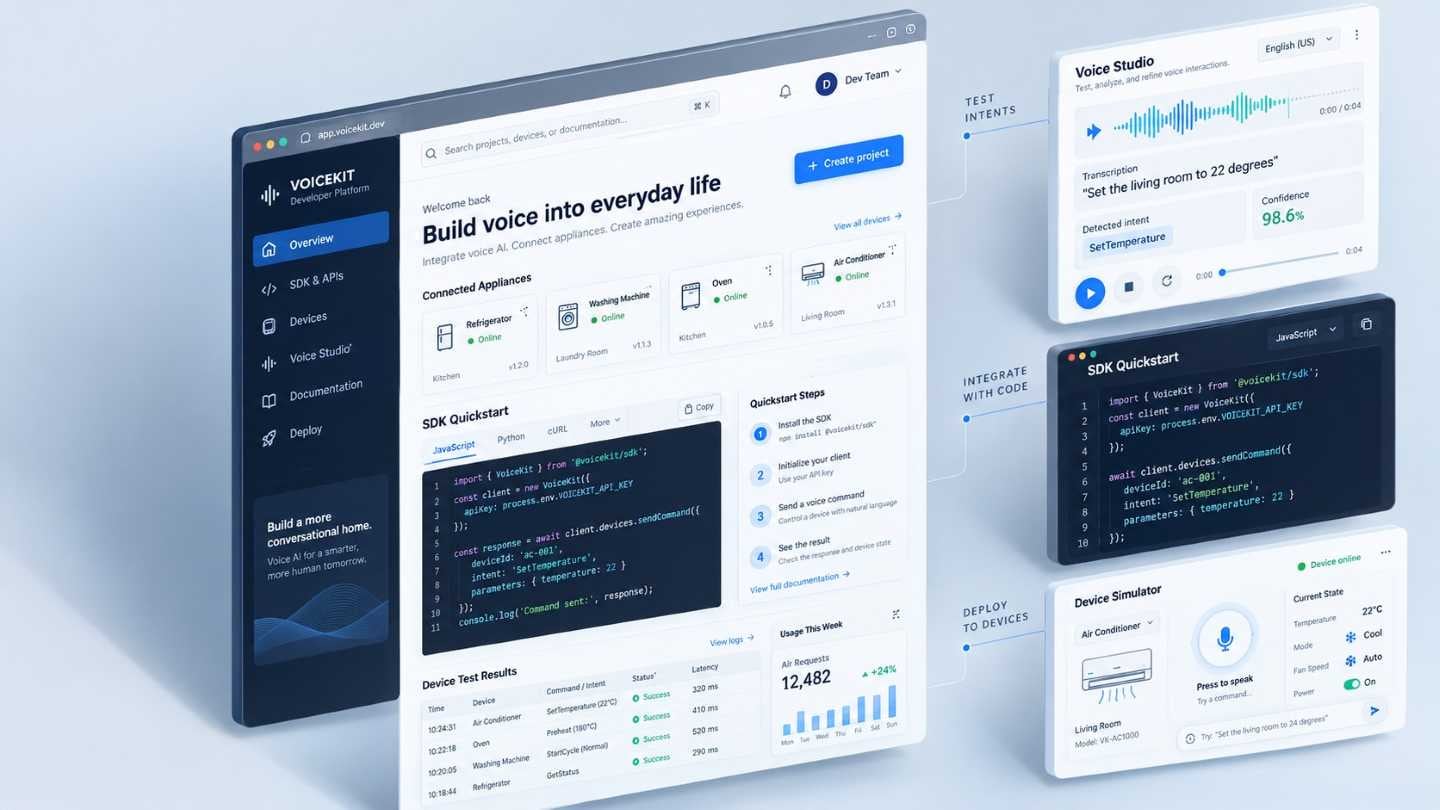
A guideline site for the developers writing the software inside Samsung's appliances.
Two rulebooks had to become one — Android's reference guidance and Samsung's own One UI policy — and the portal is where a developer finds out which of them applies to the thing in front of them. The scope grew twice during the work.
Technology trends
Written by AEON from public sources. It describes the field, not the project above.
Since the late 2010s, design guidance for software platforms has been changing from something people read into something tools consume. In 2017 a guideline portal was largely a collection of pages, diagrams and downloadable kits; designers and developers read it and translated it into their own work by hand. That model still exists, but the centre of gravity has moved towards structured, versioned data that design tools, build pipelines and now AI coding agents can read directly.
The scope of the guidance has widened at the same time. Samsung's One UI design guide now presents one system spanning phones, tablets, watches, earbuds and PCs, organised around four principles and backed by sections on layout, components, colour, iconography, motion, writing, accessibility, and large-screen and foldable devices. Google has kept evolving Material Design as well; in May 2025 details of Material 3 Expressive surfaced ahead of Google I/O, an iteration on Material You with bolder use of shape and colour that Google said was grounded in user research.
The more fundamental change is in the form guidance takes. In October 2025 the W3C Design Tokens Community Group released the first stable version of its Design Tokens specification, a vendor-neutral format for colour, typography and other design decisions. It supports light and dark modes, accessibility variants and multiple brands without duplicated files, and a single token file can generate platform code for iOS, Android, the web and Flutter. It is a community report rather than a formal W3C standard, but it gives tool makers a common format, so that a decision changed once can reach every platform that depends on it.
AI coding tools have added urgency. Figma's MCP server, introduced in beta in 2025, passes components, styles and variables from design files to coding agents and can produce a rules file describing a team's tokens and naming conventions, on the premise that generated code is only as consistent as the design-system context it is given. When a growing share of interface code is drafted by software, guidance that exists only as prose is guidance that will be missed.
None of this removes the need for a portal people can read. Developers still need intent, examples and the reasoning behind a rule, and they need to know when guidance has changed. What shifts is the portal's role: less a library of pages, more the explanatory front end to a body of machine-readable decisions, with version history and change notes treated as first-class content.
For the developers who rely on such guidance, the qualities that matter most are findability and currency: the right component for the right device, in its latest form, with the reasoning attached. For the people who eventually use the resulting products, the benefit is indirect but real. Interfaces behave consistently across a household of devices because the design decisions reached the code intact.