Conference — ASW Presentation Materials
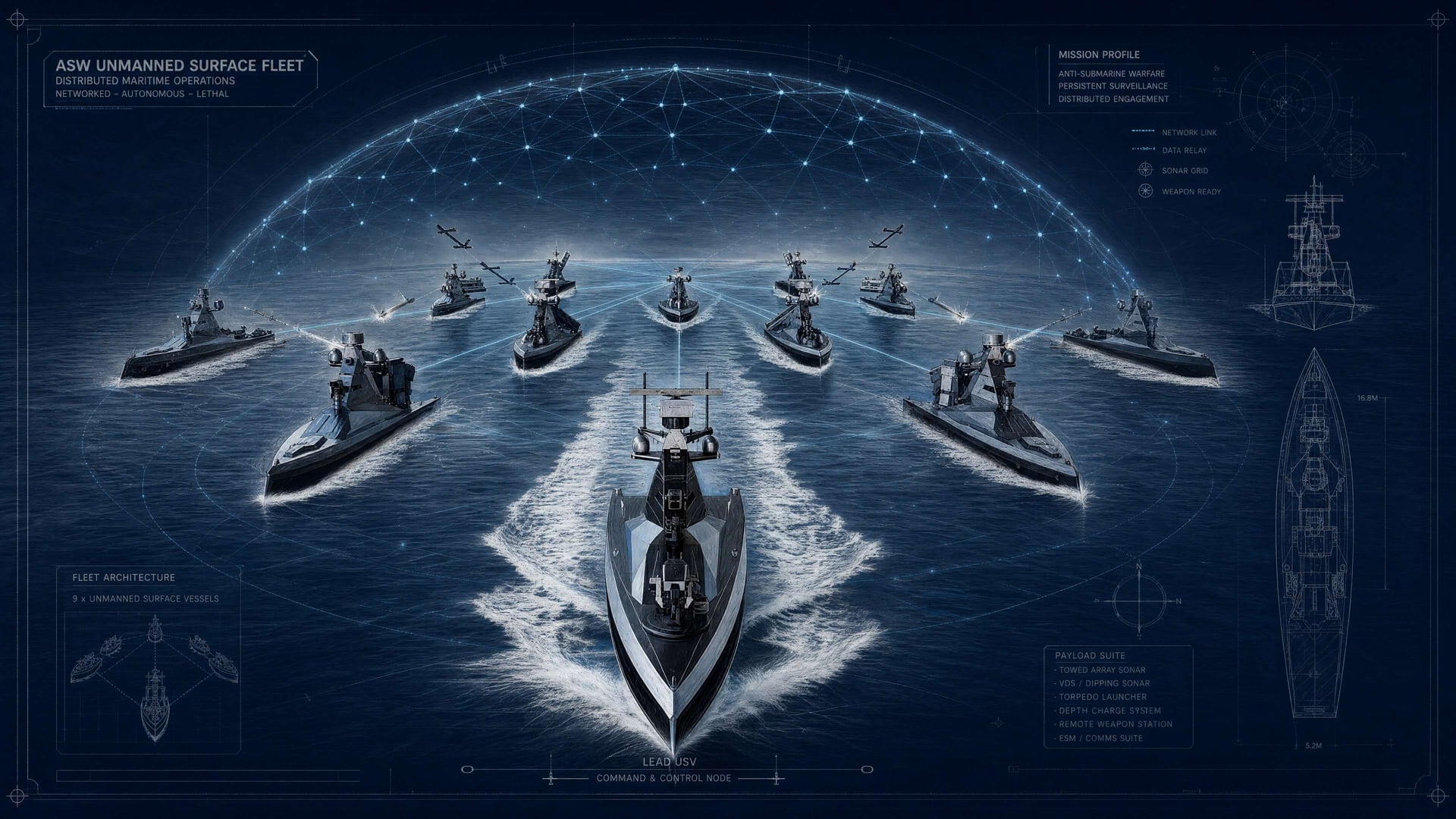
Anti-submarine warfare (ASW) is the branch of naval warfare that deals with detecting, tracking and, if necessary, attacking submarines.
Anti-submarine warfare draws on surface ships with hull-mounted and towed sonars, submarines, maritime patrol aircraft, helicopters and sonobuoys, and increasingly on unmanned surface and underwater vehicles. Because submarines are built to avoid detection, the mission depends on combining many sensors over large sea areas and sustaining coverage over time. The Republic of Korea Navy fields destroyers, frigates, submarines, maritime patrol aircraft and helicopters for the mission, and Korean industry develops ASW weapons and sensors.
AEON produced a multimedia conference presentation on how anti-submarine warfare is changing, how it would be operated, and its export prospects.
Technology trends
Written by AEON from public sources. It describes the field, not the project above.
Anti-submarine warfare is going through its biggest change since the end of the Cold War. Submarines are becoming quieter and more numerous in the Indo-Pacific, and they are being joined by unmanned underwater vehicles. Navies are responding by shifting from a few high-end hunters towards wide networks of sensors, many of them uncrewed, tied together by data processing that would have been impossible a generation ago.
The airborne layer shows the direction clearly. Multistatic active sonar separates the source of a sonar pulse from its receivers: one buoy transmits and a field of others listens for echoes from different angles, which makes a quiet target harder to hide. In April 2026 the US Navy ordered low-rate production of Ultra Maritime's AN/SSQ-125B, a coherent source buoy for the P-8A whose pings are recorded by other buoys in a multistatic field. South Korea sits inside this ecosystem: its navy took delivery of six P-8A Poseidons in June 2024, joining the same family of aircraft, sonobuoys and processing used by the United States, Australia, the United Kingdom and other operators.
Unmanned systems are moving into the barrier role. The UK's Project CABOT envisages commercially operated uncrewed platforms gathering acoustic data in the North Atlantic, with Royal Navy personnel analysing it using AI- and machine-learning-assisted tools, before a second phase brings government-owned uncrewed surface vessels and extra-large underwater vehicles under direct naval control. Similar thinking runs through Australian and US programmes for large autonomous undersea vehicles. The common logic is persistence: drones can stay on station for weeks with a fraction of the crew burden of a frigate.
Exports are the third trend. Korean ASW weapons have already found buyers in Southeast Asia; the Philippine Navy chose to arm its AW159 helicopters with the Blue Shark lightweight torpedo jointly developed by ADD and LIG Nex1. As Korean shipbuilders compete for frigate and submarine programmes abroad, ASW sensors, weapons and combat systems increasingly travel as part of a package rather than as standalone items, and buyers want to know how the whole system will be operated, trained for and supported, not only what each component can do.
For operators, the change is from listening to managing. An acoustic analyst once worked a single array; now the picture is fused from buoys, towed arrays, hull sonars, aircraft and drones, with algorithms doing the first pass. The human role shifts towards deciding which detections deserve attention, allocating scarce assets and explaining a classification to a commander under time pressure. Interfaces that show where each detection came from and how uncertain it is, and that let crews from different services and nations share one picture without confusion, will matter as much as the sensors themselves.