DICEVIEW UX Development
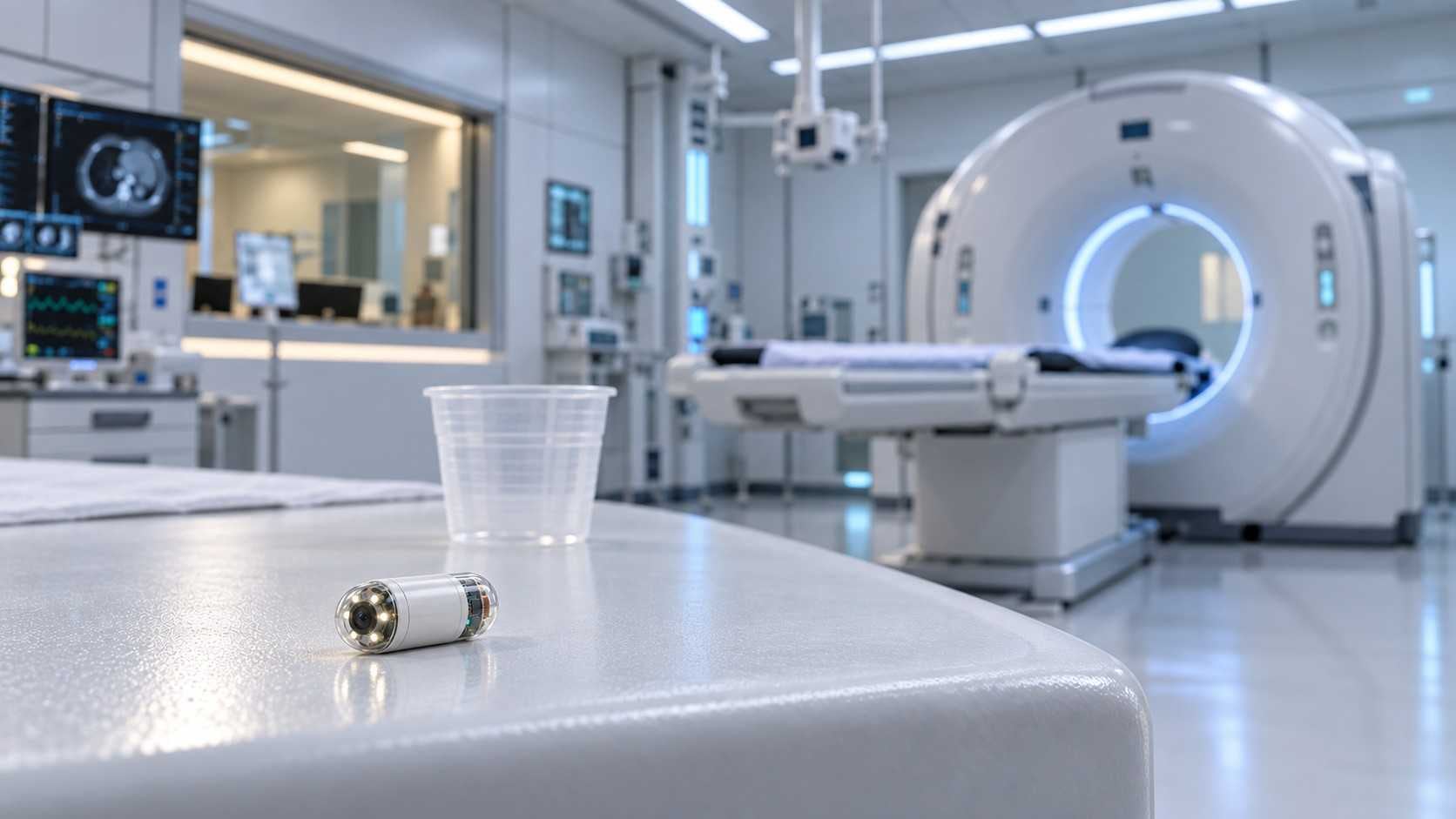
The endoscope is swallowed. From then on the doctor is working something they cannot see, in a room built around a machine the size of a scanner.
A capsule endoscope is not a smaller endoscope. The doctor drives it with a control in one hand while reading live video with the other, and the whole procedure has to be recorded precisely as it happens.
The design question is the room, not the screen — when the view has to change, and how the patient's data moves between the instrument and the record without anyone entering it twice.
We looked at the space and the procedure before drawing anything, then designed the graphics for the monitoring software.
Technology trends
Written by AEON from public sources. It describes the field, not the project above.
Capsule endoscopy has been in clinical use since the first device was cleared in the United States in 2001, and for most of that time its strengths and weaknesses stayed the same. A swallowed camera can reach parts of the small bowel that a conventional scope cannot, without sedation. But the capsule moves passively with the gut, and it returns hours of footage that a specialist must review frame by frame. The past several years have brought sustained work on both of those limits.
Reading time was the first target for machine learning. A widely cited study in Gastroenterology in 2019 trained a convolutional neural network on small-bowel capsule images and reported that AI-assisted reading reached about 99.9 per cent sensitivity against roughly 75 per cent for conventional reading, while cutting average review time from about 97 minutes to about 6. Results of that kind have since been tested in many settings, with more modest figures in some, and AI tools for the digestive tract have moved into regulated products. The US Food and Drug Administration's list of AI-enabled medical devices now carries a growing set of gastroenterology entries, among them software named Deep Capsule cleared in March 2026.
Movement was the second target. In May 2020 the FDA granted a De Novo authorisation for the NaviCam system and created a new classification for magnetically steered capsule endoscopy. An external magnet guides the capsule through the stomach, turning a passive recorder into an instrument that can be directed at a region of interest. Steering brings the examination closer to conventional endoscopy in what it can see, while keeping the patient free of a tube and, in most cases, of sedation.
Taken together, these developments change where the work happens. Reading can be partly automated and done remotely; the examination itself can be planned and adjusted in real time rather than simply recorded. Research groups and manufacturers are also exploring capsules for the colon and for wider screening programmes, where the capacity of endoscopy units is a persistent constraint. The open questions are less about whether the technology works than about how it fits into referral pathways, staffing and quality assurance.
For clinicians, the shift is from watching to verifying. When software proposes which frames matter, the reader's task becomes judging candidates and remaining alert to what the model might have passed over, a setting in which automation bias is a known risk. Interfaces that show why a frame was flagged, make it easy to review surrounding context and track what has and has not been inspected help keep human judgement engaged. For steered systems, the familiar challenges of remote manipulation, including orientation, feedback and fatigue, come to the fore.