Donghae City Briefing Materials
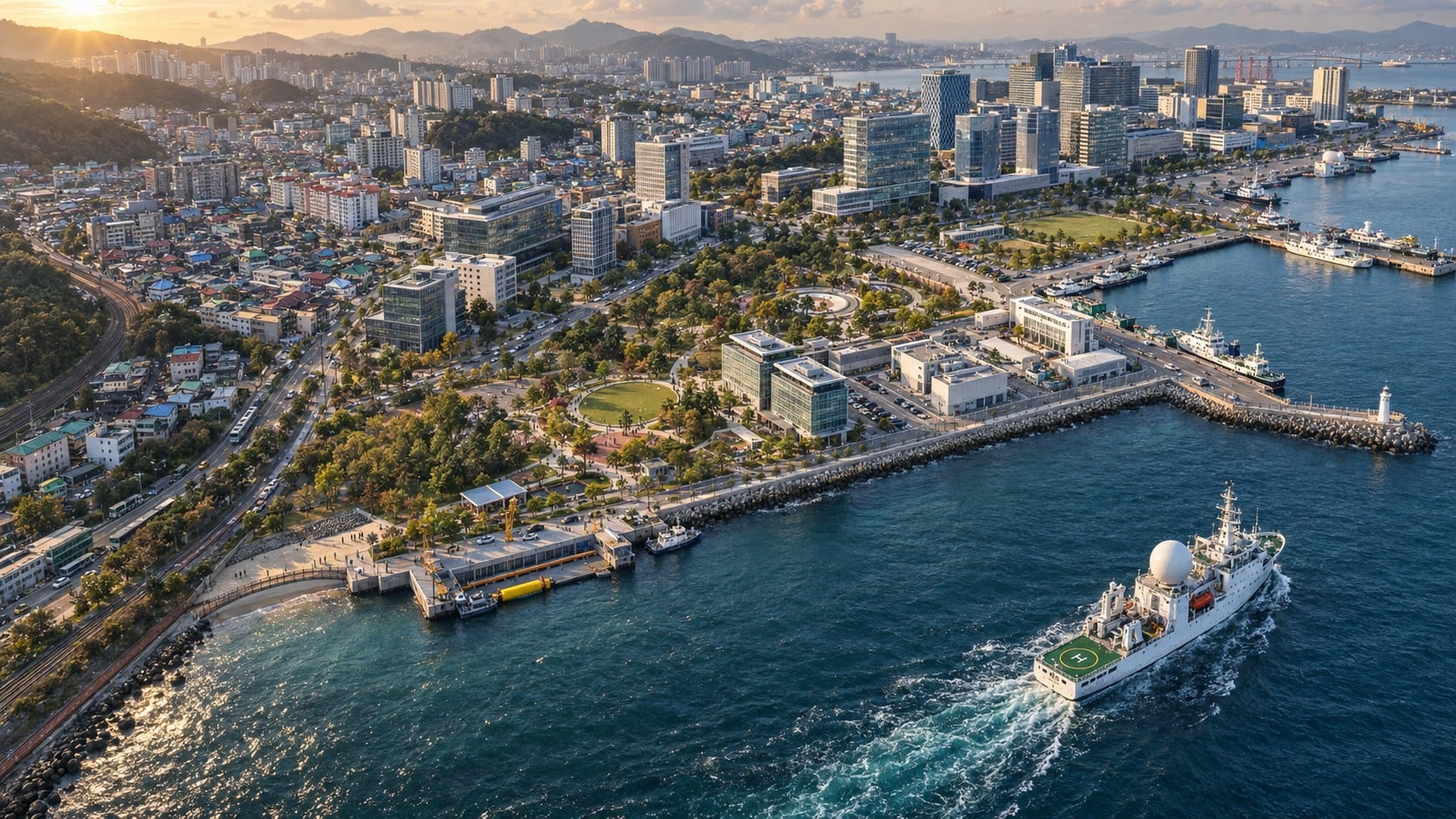
The Donghae project was a plan by South Korea's Agency for Defense Development (ADD) to build a research institute for advanced unmanned systems on the coast at Donghae, Gangwon Province.
The Agency for Defense Development is South Korea's government agency for defence research and development, headquartered in Daejeon. Research on unmanned systems, particularly unmanned surface and underwater vehicles, typically relies on facilities with access to open water for trials, and the plan proposed such an institute on the east coast at Donghae.
AEON produced the presentation materials used by the Mayor of Donghae in briefings to residents on the plan.
Technology trends
Written by AEON from public sources. It describes the field, not the project above.
Unmanned maritime systems are easy to draw and hard to prove. Autonomy software, sensors and data links have to be tested in real water, with real weather, currents and traffic, and that has made coastal test ranges and research clusters strategic assets in their own right. Countries that can run frequent, well-instrumented trials close to their engineers move faster from prototype to fielded capability.
Australia offers a clear example of a range used as an innovation hub. Jervis Bay on the New South Wales coast hosts the Royal Australian Navy's Autonomous Warrior exercises; the 2023 edition spent two weeks trialling autonomous undersea warfare systems on and below the surface. In 2024 the same waters were used by Australia, the UK and the US to test unmanned maritime systems under AUKUS Pillar 2, including the Ghost Shark extra-large autonomous undersea vehicle. The model of a controlled sea area, a naval host and open access for industry and allies shortens the loop between prototype and operational feedback.
South Korea has been building its own version of this infrastructure. In November 2025 ADD completed Donghaegwan, a research building in the Jinhae district of Changwon (despite the name, not in Donghae), dedicated to manned-unmanned maritime combat systems and unmanned surface and underwater vehicles, with laboratories for autonomy, data links, sensor fusion and combat-system integration. Weeks later DAPA, ADD and the Korea Institute of Ocean Science and Technology agreed to share test facilities and jointly develop test procedures and standards for maritime unmanned systems. The emphasis on shared standards matters: autonomous systems cannot be certified in the same way as conventional ships, and the methods for testing them are still being worked out.
Across these efforts the pattern is consistent. Governments co-locate research agencies, universities and companies near the water, invest in instrumented ranges and treat test data as a shared resource. Regions compete to host such facilities for the skilled jobs and industrial spin-offs they bring, while military users value the ability to run frequent small trials rather than rare set-piece tests. Civilian ocean science and defence research often share the same vessels, sensors and seabed infrastructure.
For the people who will operate these systems, test sites are where the human side takes shape. Early trials decide how much an operator is expected to supervise, how mission plans are handed to an autonomous vehicle, and what information comes back when communications drop. Ranges that put sailors alongside engineers from the start tend to produce systems whose interfaces reflect real watchkeeping rather than laboratory assumptions, and that difference shows when the systems reach the fleet.