for AI UX Scenario Film Development
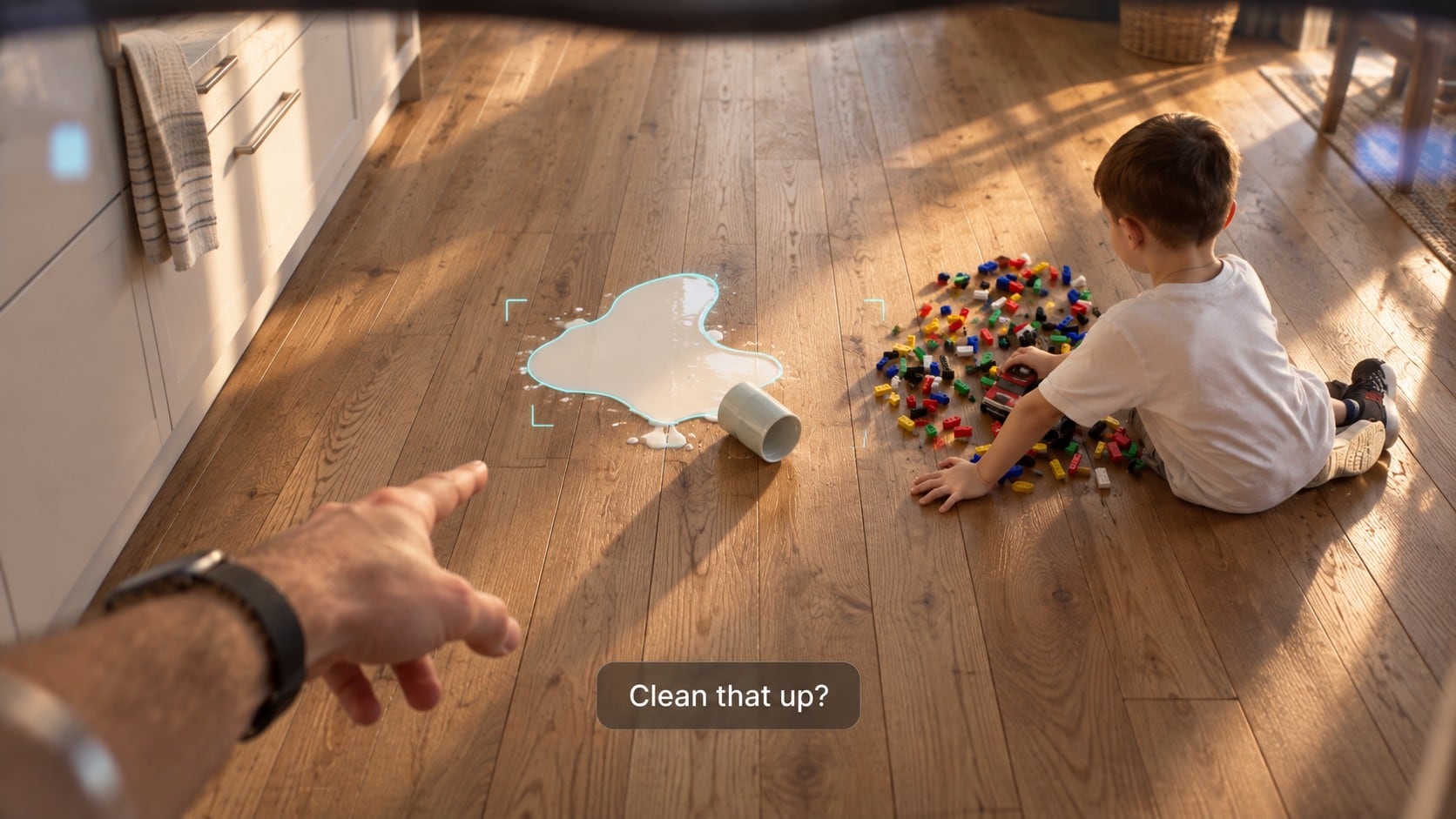
Every advance costs somebody something. The film had to show who, and what an assistant could take off them.
The word is technostress, and it does not fall evenly. It lands hardest on people the ordinary path already excludes — a deaf user, an older user, anyone for whom the obvious way in does not open.
The argument lives or dies on which people and which moments you choose to show. Pick the wrong scene and inclusive AI reads as a feature list; pick the right one and it needs no explaining.
So we wrote scenarios in which a multimodal assistant — one that can see the screen, hear the room and act on the device — takes the difficulty off the person instead of adding to it.
Then we built what the film needed in order to be true rather than illustrated: the key screens, the assistant's own graphics, the micro-interaction motion, and the composite that puts all of it back into the footage with sound.
Technology trends
Written by AEON from public sources. It describes the field, not the project above.
Assistive technology has always been a larger field than the products marketed under that name. The WHO and UNICEF's global report on assistive technology, published in May 2022, estimated that more than 2.5 billion people need at least one assistive product, a figure expected to reach 3.5 billion by 2050 as populations age. The report counts software and apps that support communication and cognition alongside wheelchairs and hearing aids. Since then, general-purpose AI has begun to blur the line between an assistive product and an ordinary phone.
An early sign came from Be My Eyes, a service that connects blind and low-vision people with sighted volunteers over video. In March 2023 it introduced a Virtual Volunteer built on OpenAI's GPT-4, later renamed Be My AI, which lets a user send a photo and ask questions about it, with the option of reaching a human volunteer when the model cannot help. The design choice is telling: the model did not replace the human network, it became the first line in front of it.
Platform makers, meanwhile, built narrower capabilities into the device itself. In May 2024 Apple announced Eye Tracking, which lets people with physical disabilities control an iPhone or iPad with their gaze using the front camera, with setup data kept on the device. It came alongside Listen for Atypical Speech, which adapts recognition to people with conditions such as cerebral palsy, ALS or stroke, and Music Haptics, which renders songs as taps and vibrations for deaf and hard-of-hearing users. These are dependable, bounded functions rather than open-ended assistants.
The next step is assistants that watch and listen continuously. Google DeepMind has developed a Visual Interpreter prototype of Project Astra with the visual interpreting service Aira, describing surroundings as the camera moves and drawing on Maps, Photos and Lens. Notably, it is offered through a trusted-tester programme with live professional human oversight. That caution reflects the open questions: a model that describes a street confidently but wrongly can do more harm than one that stays silent, and an always-on camera raises privacy issues for bystanders as well as users.
For people who rely on these tools, the shift is from learning a device's interface to stating a goal and letting the system find the route. That can remove a great deal of everyday friction, but only if the assistant is honest about uncertainty, easy to interrupt and able to hand over to a person. Designers now have to decide when an assistant should act and when it should ask, and how someone who cannot see or hear the screen can tell what has just been done on their behalf.