G-Sword (UGV) — Promotional Film
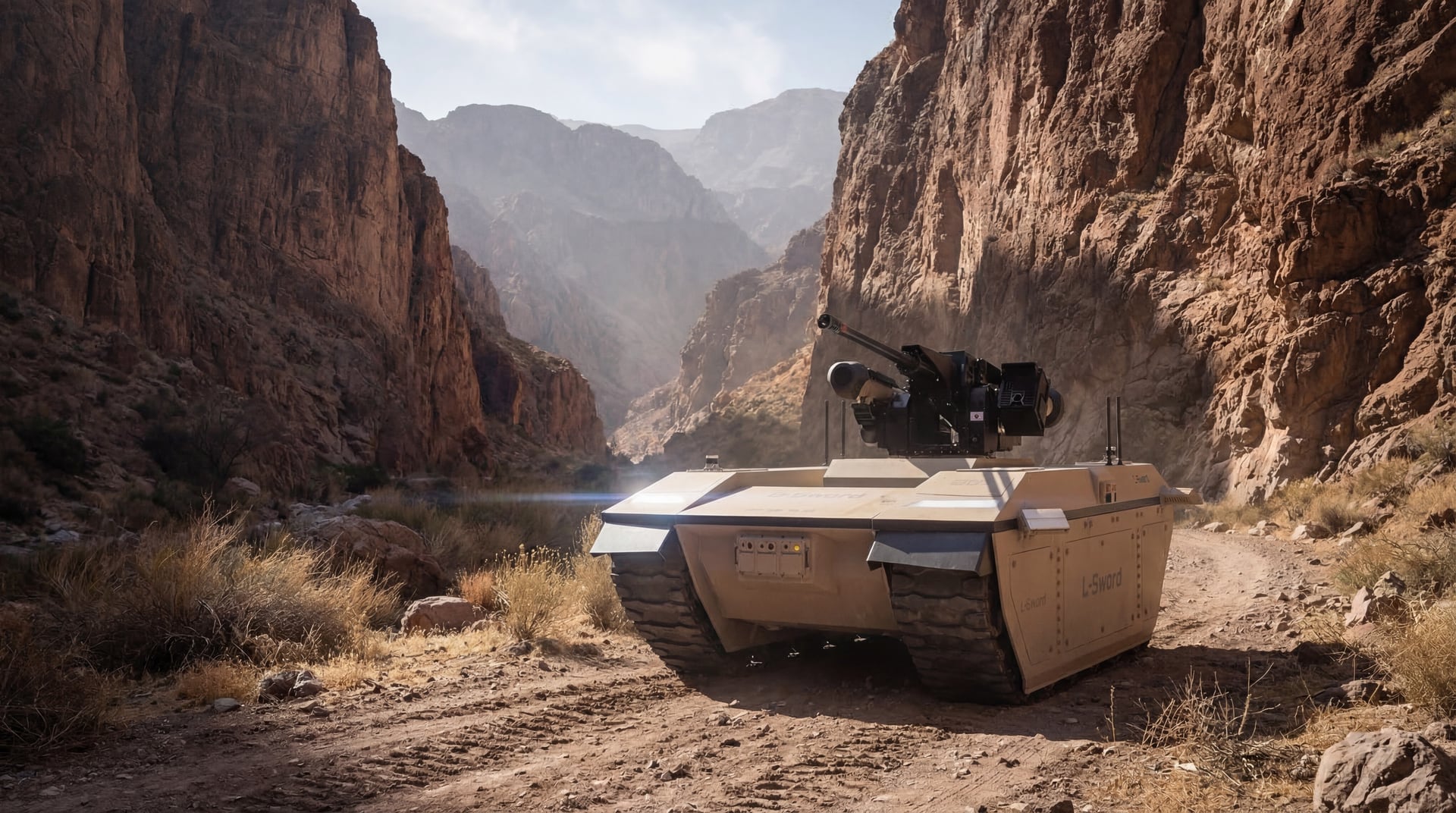
G-Sword is LIG D&A's tracked combat unmanned ground vehicle, unveiled at ADEX 2025.
G-Sword is a tracked combat unmanned ground vehicle (UGV) from LIG D&A, the South Korean defence company formerly known as LIG Nex1, first shown publicly at ADEX 2025 in Seoul. It can be driven remotely from a control console or follow pre-planned routes autonomously, and is offered with modular payloads for roles such as reconnaissance, fire support, close-in air defence and the surveillance of coasts and critical infrastructure.
AEON planned and produced the brand film for LIG D&A's unmanned ground vehicle family, featuring G-Sword.
Technology trends
Written by AEON from public sources. It describes the field, not the project above.
For years tracked unmanned ground vehicles were a demonstration item at defence shows. The war in Ukraine has turned them into a supply line. By 20 August 2026 Ukrainian units had logged more than 100,000 ground-robot missions since the start of the year, mostly carrying ammunition, food and water forward and bringing wounded soldiers back, and more than 22,000 UGVs had been contracted in the same period. Monthly mission counts rose steadily through the year, a sign that ground robots are becoming routine rather than experimental.
Among established designs, Milrem Robotics' THeMIS remains the reference point for a modular tracked UGV. In October 2025 the Netherlands funded more than 150 THeMIS vehicles for Ukraine, and Milrem reports that 19 countries now use the platform or include it in robotics programmes. Europe is also trying to standardise the layer above the vehicle. The European Defence Fund's iMUGS2 project, launched in Brussels in November 2025 under Estonian leadership, aims at a secure, interoperable architecture for crewed and uncrewed ground platforms, with a possible European unmanned battalion as a long-term goal.
The United States has taken a less direct route. The Army's Robotic Combat Vehicle programme began with light, medium and heavy variants and was narrowed to a single class. In March 2025 Breaking Defense reported that Textron's Ripsaw M3 had been chosen to deliver prototypes, with open questions about autonomy, crew ratios and payloads. Weeks later the Army halted the expected award. The Congressional Research Service reads this as a move towards a cheaper approach involving several vendors, not an end to robotic vehicles, and notes industry criticism of the in-house autonomy software.
The direction is fairly consistent. Bespoke robotic tanks are giving way to common tracked chassis that carry interchangeable payloads: cargo beds, casualty litters, remote weapon stations, anti-tank missiles, sensors, electronic warfare kits or communications relays. Hybrid-electric drives are common, both for quiet running and to power those payloads. Autonomy is arriving in stages, from remote driving to follow-me and waypoint navigation, while open architectures are meant to let armies change software and payloads without changing the vehicle. Ukraine's experience adds a further requirement: the vehicles must be cheap enough to lose.
For operators, the practical questions concern ratios and links. How many soldiers does each vehicle need, and can one operator manage several at once? What happens when jamming cuts the radio link in the middle of a run, and how does the operator know what the vehicle will do next? Control stations that show autonomy state clearly, let payload and mobility tasks be split between people, and keep working in degraded conditions will decide how far these vehicles can be pushed into the most dangerous ground.