Hanwha Precision Machinery - Welding Robot SW Resource Artwork Development
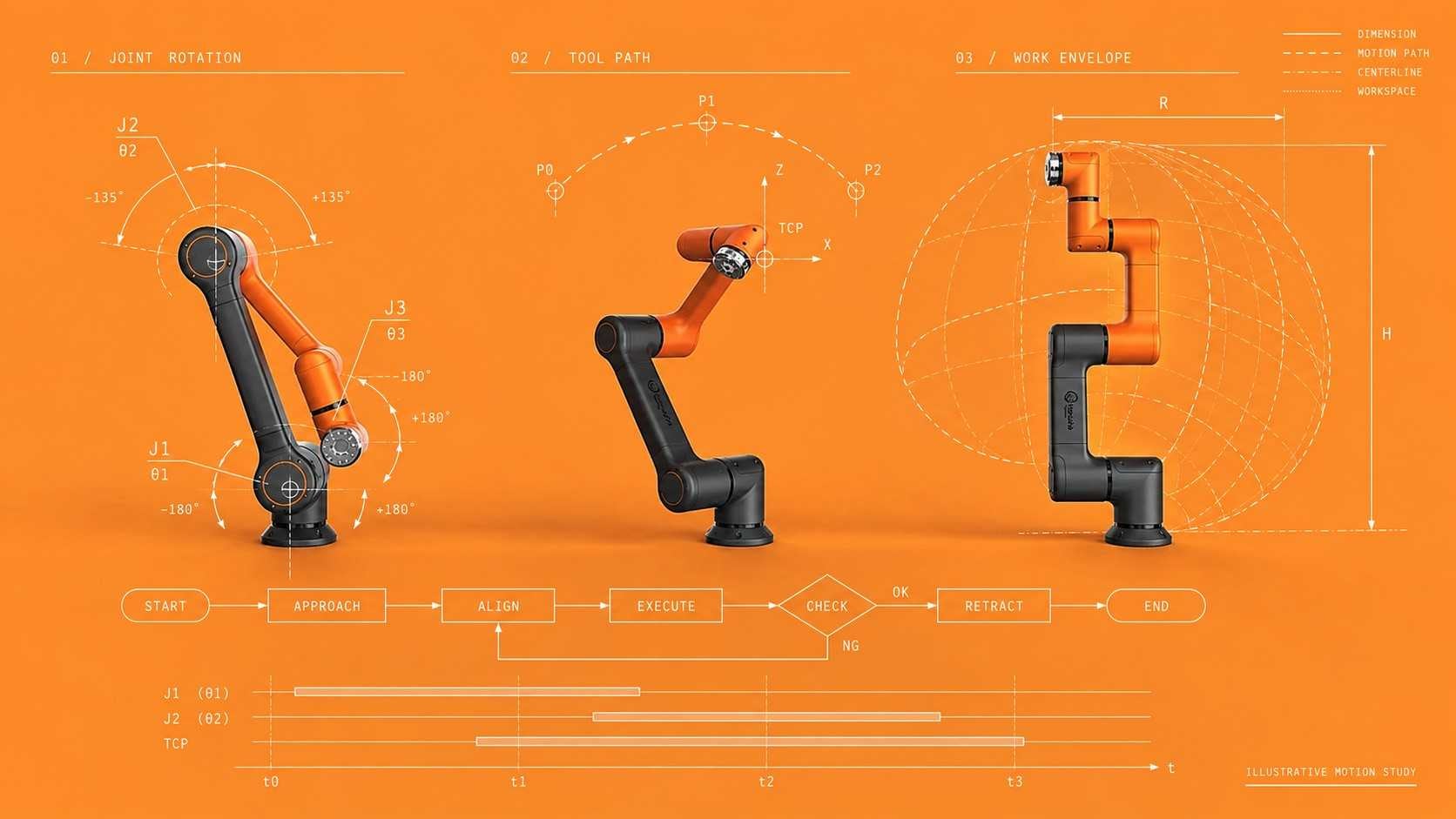
A collaborative robot is sold on the idea that the person on the floor can set it up themselves. The programming screen is where that claim gets tested.
Hanwha's industrial collaborative robots are driven from a single panel that controls the cell. Before the robot does anything it has to be taught the job, and in the software as it stood that teaching had been cut into steps that each demanded a decision. The operator was making a great many selections and entering a great many values before the first weld happened.
That cost is easy to overlook because it is paid before the work starts, and it falls on someone whose trade is welding rather than robotics. Each input is also a place to be wrong, on a machine that then moves.
So the work was to take steps out rather than to make them look better. Which decisions the software could reach on its own, which ones belong together on one screen, and which had only ever been separate because that is how the code had grown. Interface, screen design and graphics for the control panel.
Technology trends
Written by AEON from public sources. It describes the field, not the project above.
Welding has become one of the clearest cases for collaborative robots, and the reason is people as much as machines. Experienced welders are retiring faster than new ones are trained; in the United States the AWS Foundation, affiliated with the American Welding Society, projects that more than 300,000 new welding professionals will be needed by 2029. For fabricators that cannot hire enough skilled hands, a robot that shares the floor with the people they do have is an attractive proposition.
Cobots grew up as the option for smaller shops: lighter arms, less fencing, and teaching by hand-guiding instead of specialist programming. Korean industry took part early, and Hanwha spun its collaborative robot and factory automation businesses out into a separate company, Hanwha Robotics, in October 2023. Growth has since become steadier rather than explosive. The International Federation of Robotics reports that cobots accounted for about 11% of industrial robot installations in 2025 and grew more slowly than the robot market as a whole, a sign that the easy early applications have been taken and the remaining ones demand more.
Safety rules have moved alongside the technology. A comparative review of the 2011 and 2025 editions of ISO 10218, the core standard for industrial robots, finds that the new edition brings the collaborative-robot specification ISO/TS 15066 into its normative text, introduces new classifications for collaborative applications and adds cybersecurity requirements. The practical message is that collaboration is assessed as a whole application, including tool, workpiece and surroundings, rather than claimed for an arm alone. In welding, where the torch, the arc and the fumes carry their own hazards, that distinction is concrete.
The largest change is in how robots are told what to do. The teach pendant, with its waypoints and parameter fields, is giving ground to methods that start from data a shop already holds. An IFR case study describes an Italian sheet-metal fabricator whose software reads a part's 3D CAD model, identifies the weld joints and generates the robot's positions and transitions automatically, with the program checked offline for collisions before it reaches the cell. Vision systems that locate seams on the part, and research into instructing robots in plain language, push in the same direction: less specifying of motion, more describing of the result.
For operators, that shifts the work from authoring a program to judging one. When software proposes a path, the person at the cell needs to see clearly what the robot intends to do, in what order and why, before the arc is struck, and to correct a single step without starting again. Previews, simulation and plain explanations of automatically generated programs therefore matter more than ever. The interfaces that earn trust on a shop floor will be those that make a machine's intentions legible at a glance, to seasoned tradespeople and newcomers alike.