Hyundai MN Navigation UI Design
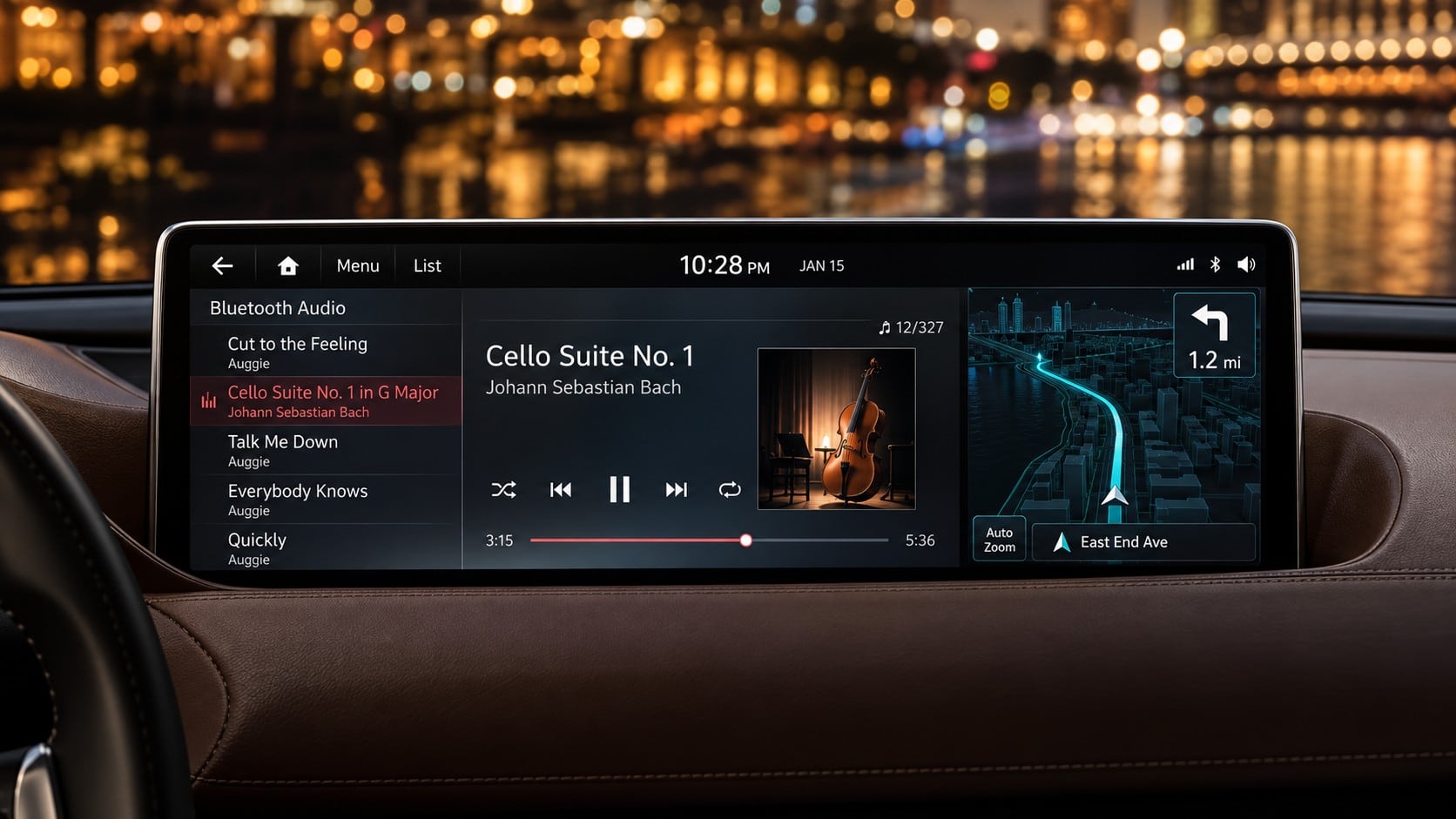
Features keep arriving. The menu they arrive into was settled years ago.
A premium navigation system carries a great deal and appears in many different cars. The driver glances and decides.
So the real work is finding where a new function fits without moving anything the driver already knows. An extension that disturbs the screen's rules costs more than the function is worth.
A yearly engagement, revising the specification alongside the planning team. Each time a function was added we checked first where it collided with the existing rules.
Technology trends
Written by AEON from public sources. It describes the field, not the project above.
In 2020 a car's navigation system was, in most cases, still a product of its own: the carmaker's software, updated rarely, sitting beside a phone that did much of the same work. Since then the two have converged from both sides. On the carmaker side, Android Automotive OS has become a common base. Unlike Android Auto, which projects a phone's apps onto the car's display, it runs directly on the vehicle's own infotainment hardware, and manufacturers can choose to license Google's apps and services on top of it.
On the phone side, Apple has pushed deeper into the car. CarPlay Ultra, which began rolling out with Aston Martin in May 2025, supplies content for every screen in front of the driver, including the instrument cluster, and reaches vehicle functions such as climate and radio as well as car-specific settings. The phone platform is no longer a guest window inside the carmaker's interface; it can be the interface.
Hyundai's own answer arrived in 2026. Its Pleos Connect system, which debuted in the Grandeur in Korea in May, is based on Android Automotive and adds Gleo AI, an assistant built on a large language model that handles navigation, climate, web searches and the owner's manual and can process several commands in one request. A third-party app market lets drivers install software, with services such as YouTube and Spotify running on the car's screen without a phone. Buttons on the wheel and below the display remain for common functions.
Together these changes alter how new functions reach the driver. In a closed head unit, the manufacturer alone decided where everything lived. On a platform, functions arrive as apps, as voice requests or as panels competing for space on shared screens, often built by developers who have never designed for a moving vehicle. Navigation becomes one service among several, sometimes from the carmaker, sometimes from a phone ecosystem, sometimes both in the same car. What holds the experience together is increasingly the platform's layout rules, its driving-mode restrictions and its assistant.
For drivers, the gain is familiarity and choice: the apps and accounts they already use follow them into the car, and a spoken request can replace several taps. The cost is consistency. When several parties shape what appears on the screen, the same task can work differently from one app to the next. The design effort shifts towards rules that every contributor must follow, and towards an assistant that can say, in plain words, what it has just changed in the car.