Improvements to the CSS HMI on Amphibious Assault Ship (LPH)
Also known as Dokdo-class amphibious assault ship
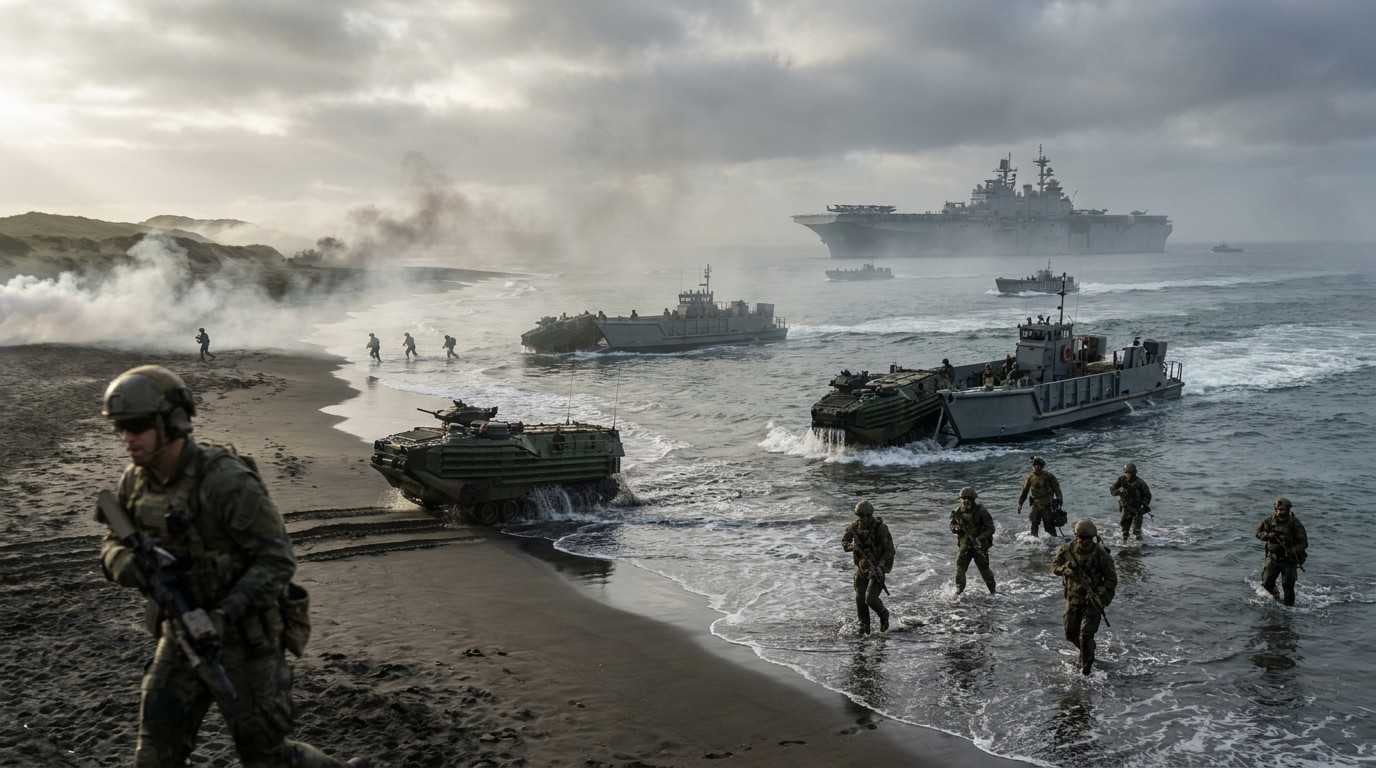
ROKS Marado (LPH-6112) is the second Dokdo-class amphibious assault ship of the Republic of Korea Navy.
ROKS Marado is the second and final ship of the Dokdo class, built by Hanjin Heavy Industries in Busan and commissioned in June 2021. Like its sister ship ROKS Dokdo, it carries marines, vehicles, landing craft and helicopters, and its command support system supports navy, army, marine and allied units taking part in an amphibious operation.
AEON carried out HMI improvements for the ship's command support system.
Technology trends
Written by AEON from public sources. It describes the field, not the project above.
An amphibious assault ship is as much a floating headquarters as a transport. Ships such as South Korea's Dokdo class embark staff from naval, ground and air forces and run the command and control that ties helicopters, landing craft and troops ashore into one operation. ROKS Marado, the second of the class, was commissioned in June 2021 with an upgraded sensor fit and a flight deck able to take the V-22 Osprey.
Multi-service command at sea is increasingly a networking problem. The US Navy's Project Overmatch, described as the service's contribution to the Pentagon's combined joint all-domain command and control effort, has been rolled out to carrier strike groups, amphibious ready groups and maritime operations centres. Its purpose is to let dispersed ships and staffs share data across services, so that an amphibious group is one node in a wider joint network rather than a self-contained command post.
Ashore, joint headquarters are becoming permanent. Japan established a standing Joint Operations Command in March 2025 to direct its ground, maritime and air forces across all domains in real time and to work alongside US forces, replacing earlier ad hoc arrangements. Permanent joint commands raise the expectation that a ship's command support system can exchange plans and a common picture with national joint headquarters and allied staffs, not only with the units it carries.
The largest change is in what flies from the deck. Turkey's TCG Anadolu, a landing helicopter dock, launched and recovered a Bayraktar TB3 drone in November 2024, and TB3s are intended to be a central part of its air wing, providing reconnaissance, strike and communications relay. South Korea is moving in the same direction: its navy plans to upgrade Dokdo and Marado for drone operations and manned-unmanned teaming command, and to build a larger drone-capable ship for service in the late 2030s. Amphibious ships are becoming hubs for uncrewed aircraft and surface vessels as well as helicopters and landing craft.
For the people aboard, this widens the job considerably. A command staff drawn from several services, and sometimes several nations, must now coordinate drone sorties, joint fires and network-shared information as well as the traditional ship-to-shore movement. Each service brings its own vocabulary and priorities, so command support systems need shared pictures that every staff can read, views suited to each role, and clear handover of control between ship and shore as an operation moves inland.