L-SAM-Ⅱ Operations & Engagement Control Centre UX Consulting
Also known as Long-range Surface-to-Air Missile
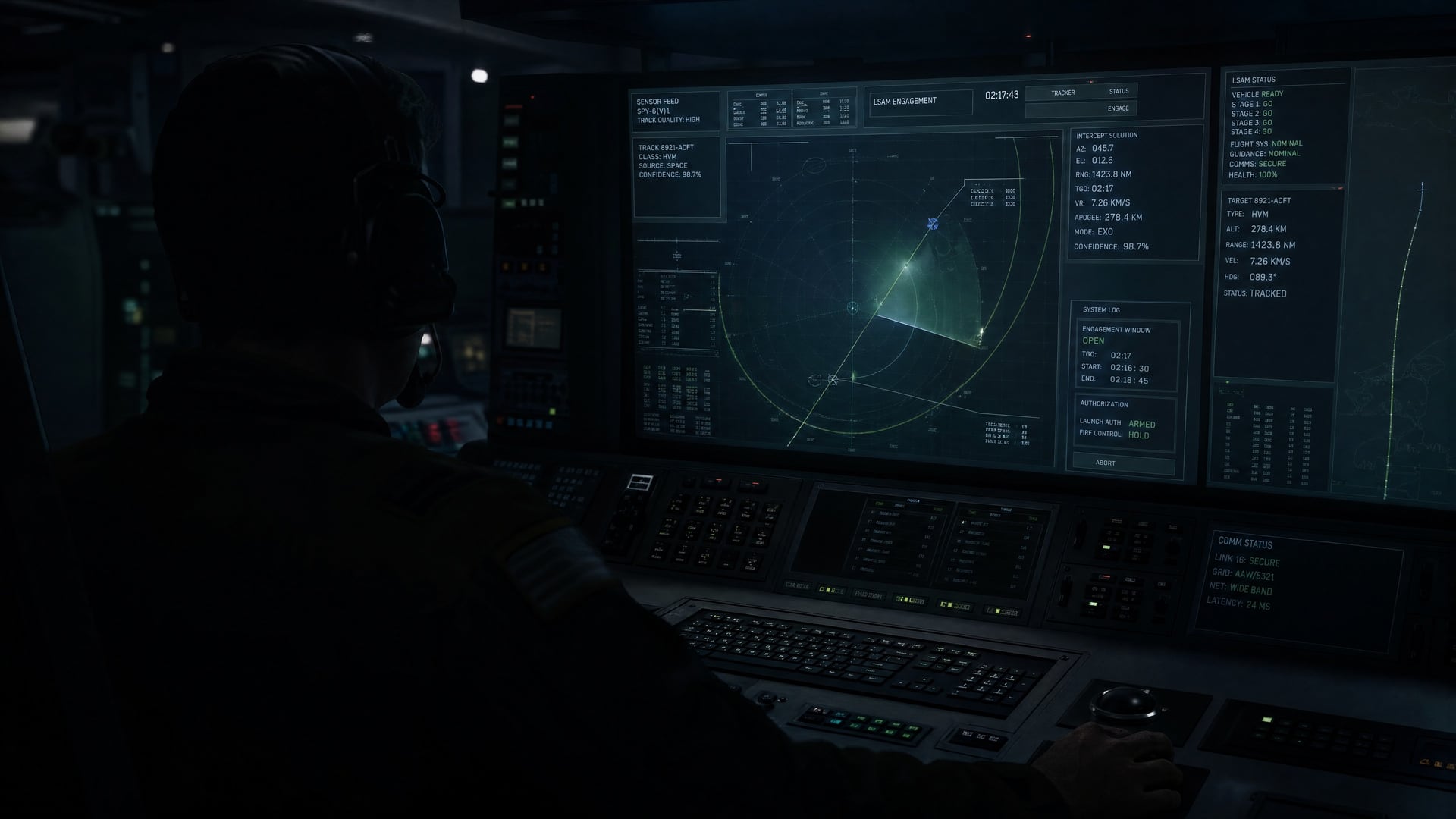
L-SAM-II is South Korea's follow-on long-range air and missile defence programme, intended to intercept threats at higher altitudes and longer ranges than L-SAM.
L-SAM-II (Long-range Surface-to-Air Missile II) is a South Korean development programme, led by the Agency for Defense Development, to extend the reach of the L-SAM system. It aims to intercept ballistic missiles at higher altitudes and longer ranges, and includes work on a glide-phase interceptor intended to counter hypersonic weapons. The Defense Acquisition Program Administration formally launched development in January 2025.
AEON provided UX consulting for the system's operations and engagement control centre.
Technology trends
Written by AEON from public sources. It describes the field, not the project above.
Upper-tier missile defence was built around ballistic trajectories: predictable arcs that can be tracked early and intercepted either in space or on the way down. Hypersonic glide vehicles break that model. After boost they manoeuvre in the upper atmosphere, too low for exo-atmospheric interceptors and too high and fast for most terminal systems, and their final target can remain uncertain until late in flight. The response, in several countries at once, is a new class of interceptor aimed at the glide phase itself.
The most prominent is the US Glide Phase Interceptor. Northrop Grumman was selected as prime contractor in September 2024, and in April 2026 the Missile Defense Agency expanded its contract to accelerate design work. Japan is a partner under a May 2024 agreement and is responsible for rocket motors and propulsion components. The interceptor is meant to launch from Aegis destroyers through the standard vertical launch system, with initial operational capability expected around the end of the decade.
Israel took an earlier step with Arrow 4, announced in February 2021 as a joint programme of the Israel Missile Defense Organization and the US Missile Defense Agency. Its winglets are intended to give it manoeuvrability inside the atmosphere, with hypersonic threats specifically in mind, and it is expected to replace Arrow 2 over time while Arrow 3 continues to cover the exo-atmospheric layer.
South Korea is pursuing the same capability within its own architecture. DAPA formally began L-SAM II development in January 2025, under the Agency for Defense Development and with around nineteen companies involved. The programme aims to intercept at higher altitudes and longer ranges than L-SAM, and its scope includes research on a glide-stage interceptor against hypersonic weapons and intercontinental ballistic missiles.
The interceptor is only half of the problem. A glide vehicle that manoeuvres for long periods must be tracked continuously across sensor boundaries, which is why space-based tracking layers and long-range ground radars are being developed alongside the missiles. Fire control also has to work with predictions that keep changing: the impact point, the intercept window and even the threatened area may all shift during an engagement. These programmes are as much about sensor fusion and battle management as about propulsion.
For operators, glide-phase defence compresses decisions and makes them less certain. Instead of a single predicted impact point, crews may see an evolving envelope of possibilities, and they will often need to coordinate with other layers, or with other services that own the sensors. Interfaces for this kind of engagement need to show uncertainty honestly, make handover between sensors and shooters explicit, and help crews recognise when a prediction has changed enough to warrant a new decision.