L-SAM Operations/Engagement Control Centre UX
Also known as Long-range Surface-to-Air Missile
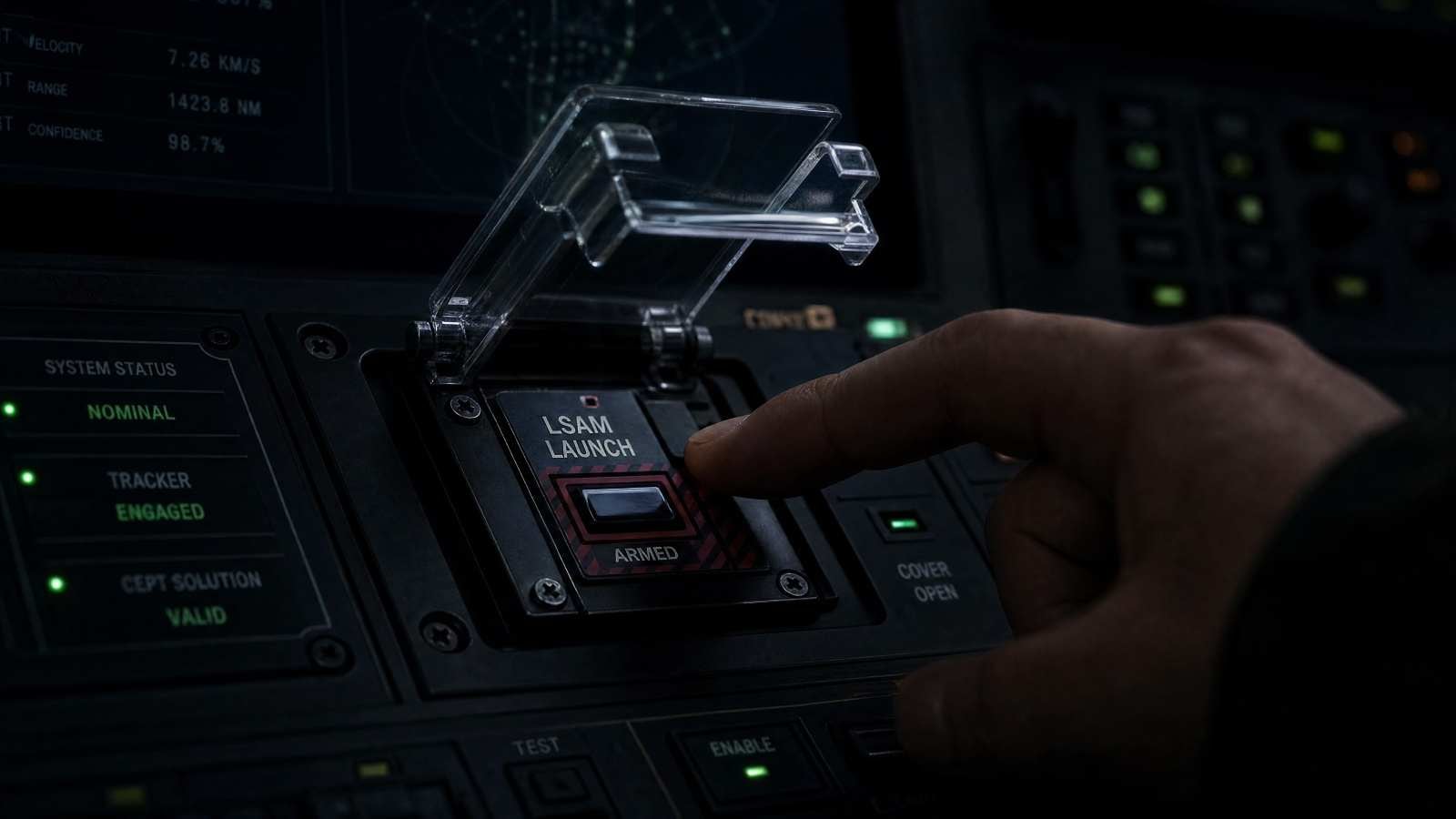
L-SAM is South Korea's long-range surface-to-air missile system, forming the upper layer of the country's indigenous air and missile defence.
L-SAM (Long-range Surface-to-Air Missile) is a South Korean air and missile defence system developed by the Agency for Defense Development together with domestic industry. It is designed to intercept ballistic missiles at altitudes above 40 km as well as aircraft, and forms the upper layer of the Korea Air and Missile Defense (KAMD) architecture, above the Patriot and Cheongung-II systems. Development was completed in 2024.
AEON provided UI/UX design for the multifunction console in the system's operations and engagement control centre.
Technology trends
Written by AEON from public sources. It describes the field, not the project above.
Upper-tier interceptors get the headlines, but the place where an engagement is actually run is the battle management centre, and it deserves as much attention as the missile. The Arrow system set an early template. Its Citron Tree centre, as described by Army Technology, fuses Green Pine radar tracks with other data, runs intercepts automatically against single or multiple threats, lets operators step in at every stage, and plots the predicted impact area and best intercept point on an electronic map. Automation by default, with a human able to override, remains the basic contract in most upper-tier systems.
What is changing is how far these centres reach beyond their own battery. In the United States, the Army has been working to bring THAAD under its Integrated Battle Command System rather than leaving it as a separate fire control island. In early 2024 it planned a test to push data through IBCS into THAAD's command and control and measure how much the interceptor's systems could absorb. The question is not only technical. Once an upper-tier battery can take tracks from any sensor on the network, its operators are no longer looking at one radar's picture but at a fused one, with all the questions of track quality and ownership that brings.
Europe is following a similar path with its own hardware. The SAMP/T NG programme gave the battery a new engagement module, the command element that links radar and launchers and can act either as a coordination node or as the heart of a fire unit. In December 2025 the system fired as a single fire unit in both its Italian and French configurations, at Salto di Quirra in Sardinia and at Biscarrosse, with Link 16 among its supported data links.
Across these programmes a few common directions are visible. Consoles are becoming general-purpose, multifunction workstations whose role is set by software, so that one position can serve surveillance, engagement or coordination as the situation demands. Software architectures are opening up, so that new sensors and interceptors can be added without rebuilding the operator environment. Track counts are rising with modern AESA radars, which shifts the burden from finding targets to deciding which of many deserve attention. And engagement timelines against ballistic targets remain short enough that the machine proposes and the crew disposes, often within seconds.
For operators, this means the console is less a window onto one weapon and more a seat in a network. The skills that matter shift towards judging automated recommendations, understanding where a fused track came from and how far to trust it, and keeping a coherent picture when several systems report the same object. Good human-machine interaction in this setting is about making the system's reasoning legible quickly, so that intervention is possible when it is needed and unnecessary when it is not.