LAMD — Operations Panel 3D Terrain Map UI/UX Consulting
Also known as Long-range Artillery Missile Defense · Korean Iron Dome
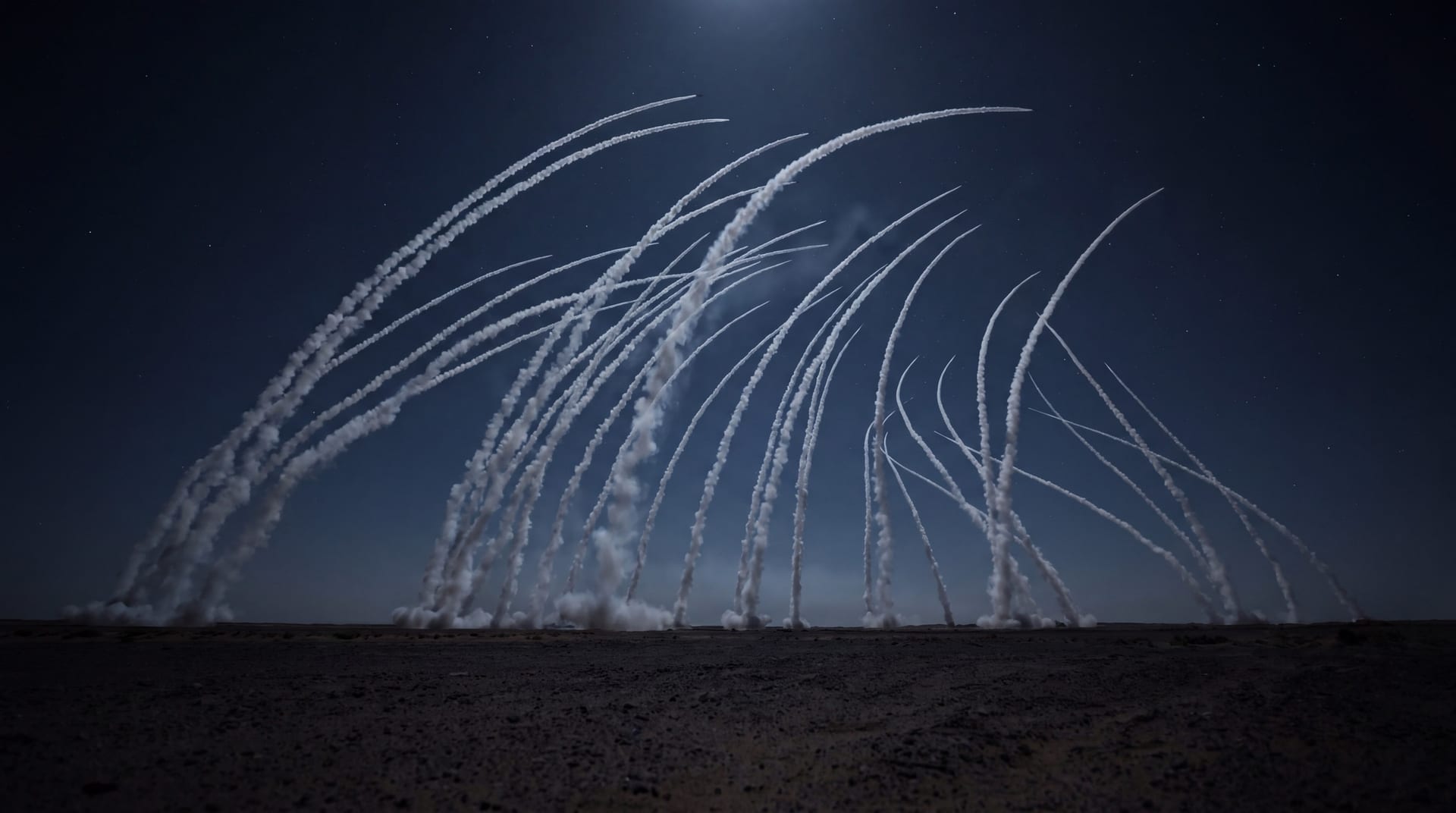
LAMD is Korea's low-altitude missile defence system, designed to intercept long-range artillery.
LAMD (Low-Altitude Missile Defence) is a weapon system designed to track and monitor dozens to hundreds of incoming artillery rounds in real time and to engage them within a short time. It is being developed to protect the capital area and major facilities against long-range artillery.
AEON provided UI/UX consulting for the three-dimensional terrain map on the system's operations panel, and produced a film presenting it.
Technology trends
Written by AEON from public sources. It describes the field, not the project above.
Rockets, artillery shells and mortar bombs are among the oldest threats on the battlefield and among the hardest to defend against. Flight times are short, volumes are high and each round is cheap, so the defender's challenge is less about any single intercept than about sorting a large number of tracks quickly and spending interceptors only where they matter.
The US Army's C-RAM system was an early answer, assembled rapidly for Iraq. It combined existing artillery and air defence sensors, a commercial warning system and a land-based version of the Navy's Phalanx gun, and protected bases in Baghdad and Balad; Northrop Grumman said in 2012 that it had given advance warning of more than two thousand attacks. That figure captures an often overlooked point: in counter-artillery defence, timely warning to the people under the trajectory can save as many lives as the intercept itself.
Israel's layered system carries the idea further. Iron Dome is known above all for selective engagement: its battle management estimates where each rocket will land and engages only those heading for defended areas. In December 2025 Israel's Ministry of Defense and Rafael delivered the first operational Iron Beam high-power laser, which had been tested against rockets, mortars and drones. It is meant to complement Iron Dome, David's Sling and Arrow, adding an option with a very low cost per shot at the bottom of the stack.
South Korea faces this threat at a different scale, with large numbers of artillery pieces and multiple rocket launchers within range of the capital region, where about half the population lives. In April 2026 the government said it would bring forward the LAMD prototype to 2029, two years earlier than planned. The system consists of a radar, a tactical communications element, launchers and interceptors, and is designed to counter simultaneous low-altitude attacks.
Across these programmes the display problem is converging. A counter-artillery engagement can involve dozens or hundreds of simultaneous tracks, each with a predicted impact point, a time to impact and a threat priority. The trend is towards situational displays that compute and prioritise automatically, show predicted impact areas against what is being defended, and let commanders see at a glance which rounds will be engaged and which will be allowed to fall.
For operators, the time available is measured in seconds, so the interface has to do much of the sorting. Crews need to trust the system's prioritisation while still being able to see what it is ignoring and why. Clear visual hierarchy, predictable alerting and a picture that stays readable as the number of tracks climbs are what make a high-volume defence workable for the people running it.