Learning Model Platform Service Design
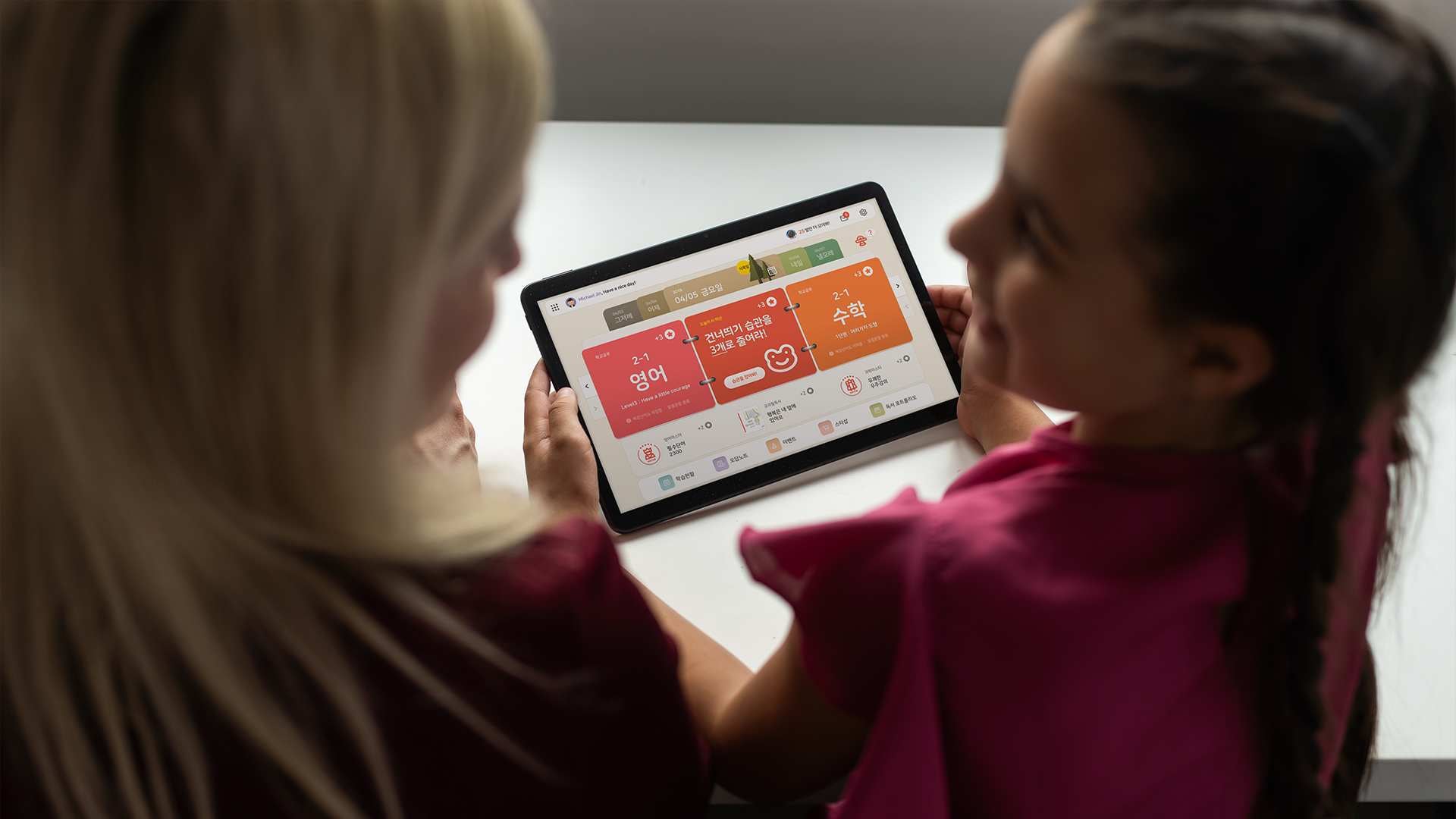
Children already tired of homework had to want to open it again tomorrow.
An AI learning platform for primary school children on a tablet, with parents watching the results.
Words like revision and preview belong to adults. So the plan was written in the language children actually use — yesterday, tomorrow — and we had to decide how much of a child's progress a parent should be shown.
Achievement and reward were built into the structure rather than added on top.
Technology trends
Written by AEON from public sources. It describes the field, not the project above.
Since the late 2010s, AI in children's learning has gone through two distinct phases. The first was adaptive learning: platforms that adjusted the difficulty and order of exercises according to a child's answers, usually delivered on a tablet with a companion app for parents. Korea's large home-learning companies moved early here, alongside a global wave of adaptive maths and literacy products. The second phase, from 2023, brought generative AI into the picture, and with it a different kind of interaction.
Khan Academy's Khanmigo is the best-known example of the newer approach: an AI tutor and teaching assistant designed to guide learners towards answers through questions rather than simply supplying them. The design choice responds to an obvious risk, that a capable chatbot will do homework instead of supporting it, and it has become a reference point for education products built on large language models.
Policy followed quickly. In September 2023 UNESCO published its first global guidance on generative AI in education and research, calling for protection of learners' data privacy, age-appropriate use guided by humans, and an age limit for children using such tools on their own. In the UK, the Information Commissioner's Age Appropriate Design Code sets fifteen standards for online services likely to be used by children, among them high-privacy default settings, limits on nudge techniques that push children to give up data or weaken their privacy, and a standard on parental controls. These frameworks bear directly on features that learning platforms depend on: profiling to personalise content, engagement mechanics, and monitoring tools for adults.
Design research with children has also moved on. Nielsen Norman Group's 2019 study of users aged 3 to 12 found that children had become considerably more proficient with websites and apps than in its earlier studies, while many designs still failed to address narrow age bands, since what suits a six-year-old rarely suits a ten-year-old. Gamification in the form of points, badges and streaks remains common, but its value depends heavily on how it is designed and where it is used, and reward schemes that rely only on external incentives can lose their pull over time.
For children, interaction is shifting from tapping through exercises to talking with a system that answers back. That makes tone, honesty about what the system is, and limits a young user can understand more important than before. For parents and teachers the central question becomes one of oversight: being able to see what an AI tutor said and why, not only the scores that came out of it. Products that keep learning in the child's hands while making adult oversight visible and understandable to the child are likely to earn the most trust.