LIG Nex1 Groupware & Integrated Support Enhancement UX/UI Development
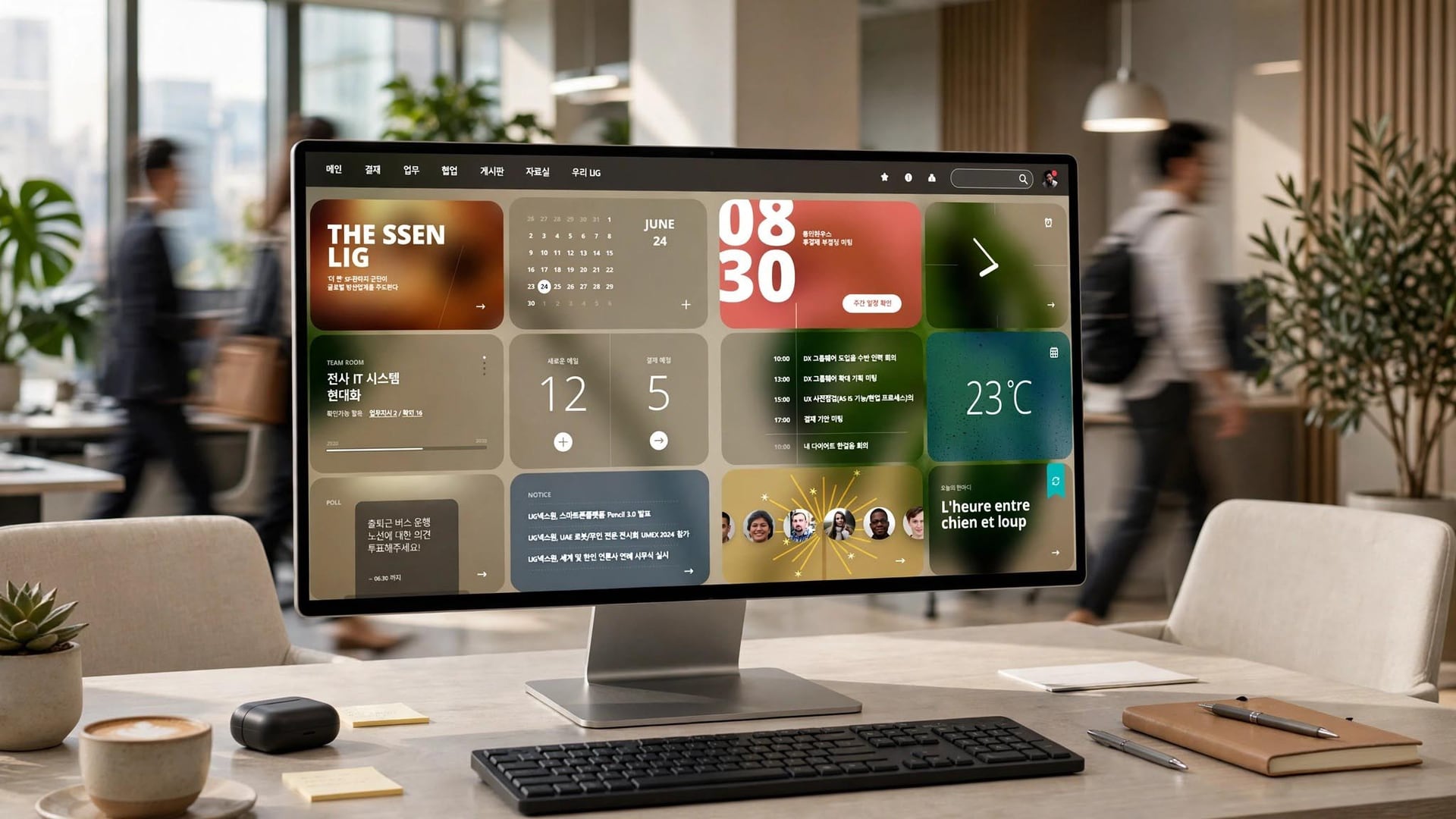
A groupware system more than a decade old, patched on request and never once rebuilt.
For over ten years it absorbed whatever individual departments asked for, one request at a time. The code underneath had become as difficult as the screens above it, and the age of the thing showed everywhere a person touched it.
The worst of it was the phone. A defence company keeps mobile access behind its own security boundary, so the little that could be done from a handset took several authentications to reach — and the people who needed it most were the ones travelling, furthest from a desk.
Integrated support, in the end, meant the mobile side: making a phone a real way into the system rather than a reduced copy of it. The users were every employee and officer in the company, so there was no group small enough to leave behind.
Technology trends
Written by AEON from public sources. It describes the field, not the project above.
Enterprise sign-in has been substantially rethought in the past few years. For a long time, protecting corporate systems meant accumulating checks: a password, then a one-time code, then a push approval, each added for good reason and each adding friction. Current security guidance treats much of that stack as weaker than it looks, and points instead towards fewer, stronger steps.
The clearest statement came from the US Cybersecurity and Infrastructure Security Agency. In October 2022 CISA described phishing-resistant MFA as the gold standard, ranking FIDO/WebAuthn and PKI-based methods above one-time codes and push prompts. It noted that codes can be phished and that plain push approvals invite push bombing, in which a user is flooded with requests until one is accepted. The same guidance has a practical edge for older estates: it asks organisations to list systems that cannot support modern MFA, connect them to enterprise single sign-on where possible, and otherwise plan their replacement.
NIST followed with its revised Digital Identity Guidelines, SP 800-63-4, finalised in July 2025. The authentication volume makes phishing resistance a defined property of cryptographic authenticators, requires services at its middle assurance level to offer at least one phishing-resistant option, permits syncable authenticators such as passkeys below the highest level, and keeps usability in view: no forced periodic password changes, no composition rules, password managers and pasting allowed, and an explicit warning about authentication fatigue.
The device side has changed too. Rather than treating a phone as either wholly corporate or wholly personal, Android's work profile creates a separate, IT-managed space for company apps and data on the same handset, with its own storage and administrator control over what may cross between the two sides. Combined with zero trust thinking, which evaluates each request rather than trusting the network it arrives from, this lets organisations extend more services to personal and company handsets without taking control of the whole device.
The cumulative effect is that strong security and short paths are no longer opposites. A single phishing-resistant sign-in, backed by a managed profile and device checks that run in the background, can replace several visible steps. What remains hard is organisational: deciding which older services to connect and which to rebuild, phasing roll-outs so that administrators and help desks go first, as CISA suggests, and making sure that a lost or replaced phone does not lock someone out of their working day.
For employees, the change should show up as fewer interruptions and clearer prompts. That depends on interfaces that ask for proof once and remember it sensibly, explain plainly when a further check is needed and why, keep work and personal spaces visibly distinct, and offer recovery that people can complete on their own.