Mediana Patient monitor (Hawk) UI/GUI Development
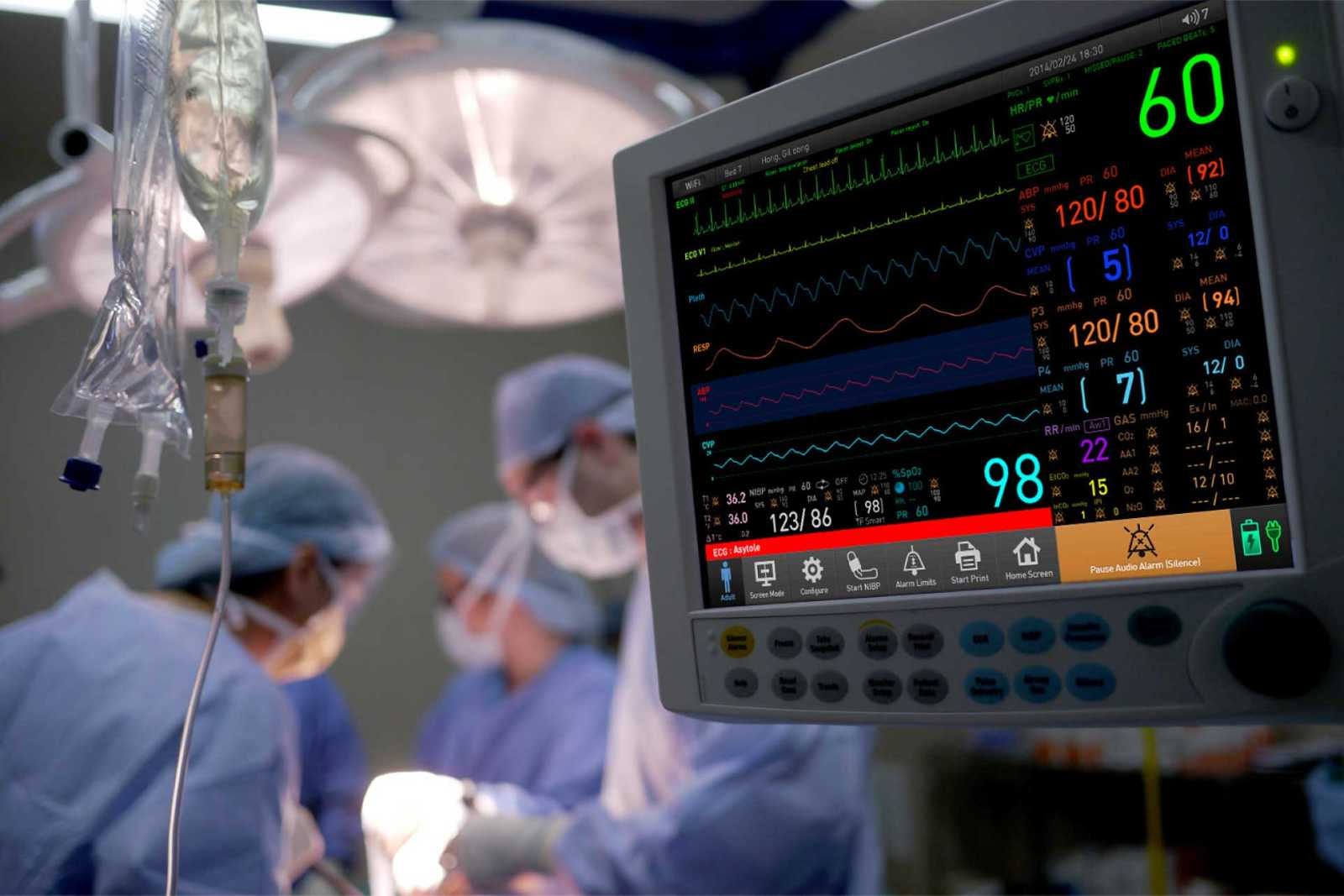
The ward already knew how to read a patient monitor. The risk in redesigning one is not that the new screen is worse — it is that it is different.
A patient monitor gets read by people who are not looking at it. A nurse crossing the ward takes a number in and keeps walking. A doctor glances at it mid-sentence. That reading is not learned from a manual — it accumulates over years, on whatever machine the ward happens to own, and a new design inherits all of it.
So the first decision was not what to change. It was what to leave alone. Which readings hold their position no matter what else moves. How an alarm reaches someone who is facing the other way. And where the existing way of working is genuinely inconvenient, as opposed to merely unfamiliar to whoever is redesigning it.
We kept the learned environment and changed only where the inconvenience was clear, one function at a time. Units, colours and symbols were set against international standards rather than preference. On a device like this a colour is not a matter of style — it is the thing someone acts on.
Technology trends
Written by AEON from public sources. It describes the field, not the project above.
Since the mid-2010s, the most consequential changes in patient monitoring have had less to do with new sensors than with how monitors interrupt people. Alarm fatigue, in which clinicians become desensitised to frequent and mostly non-actionable alarms, was by then a recognised safety problem. ECRI Institute put alarm hazards at the top of its annual list of health technology dangers in late 2013. The same year the Joint Commission in the United States approved a National Patient Safety Goal on clinical alarm safety, phased in from 2014, which required hospitals to make alarm safety an organisational priority, identify their most important alarm signals and, from 2016, put alarm-management policies and staff education in place.
That moved attention from the individual device to the alarm system as a whole: default limits, delays before an alarm sounds, which alarms escalate to a central station or a nurse's phone, and who is allowed to change the settings. Much of the work that followed concerned configuration and clinical practice as much as hardware.
The sounds themselves have changed too. IEC 60601-1-8, the international collateral standard for alarm systems in medical electrical equipment, received a second amendment in 2020. It drew on research led by Judy Edworthy at the University of Plymouth, which tested candidate sounds against the older melodic alarm set. According to the university's impact case study, that work showed auditory icons, alarm sounds that suggest their meaning instead of relying on abstract tones, performing better than almost all alternatives, and those icons were incorporated into the standard. Because hospitals replace equipment gradually, wards will carry both generations of sound for some years.
Connectivity is the other long-running thread. Monitors increasingly feed central stations, electronic records and mobile alerting systems, and the IEEE 11073 service-oriented device connectivity (SDC) family of standards aims at manufacturer-independent communication between point-of-care devices. Continuous monitoring has also been spreading from intensive care to general wards and, through wearable sensors, to patients at home. Each extension adds signals competing for the same limited attention, and the evidence on which combinations improve patient outcomes is still developing.
For clinicians, the trend moves the design problem from a single screen to the stream of alerts that reaches them across a shift, from bedside monitors, pumps, ventilators and handheld devices. Trust grows when an alert is rare enough to be believed and specific enough to act on, and when sounds, priorities and escalation paths behave consistently across equipment from different makers. Human factors work in this field is increasingly about the whole system of notifications rather than any one device.