Message PC App UI/GUI
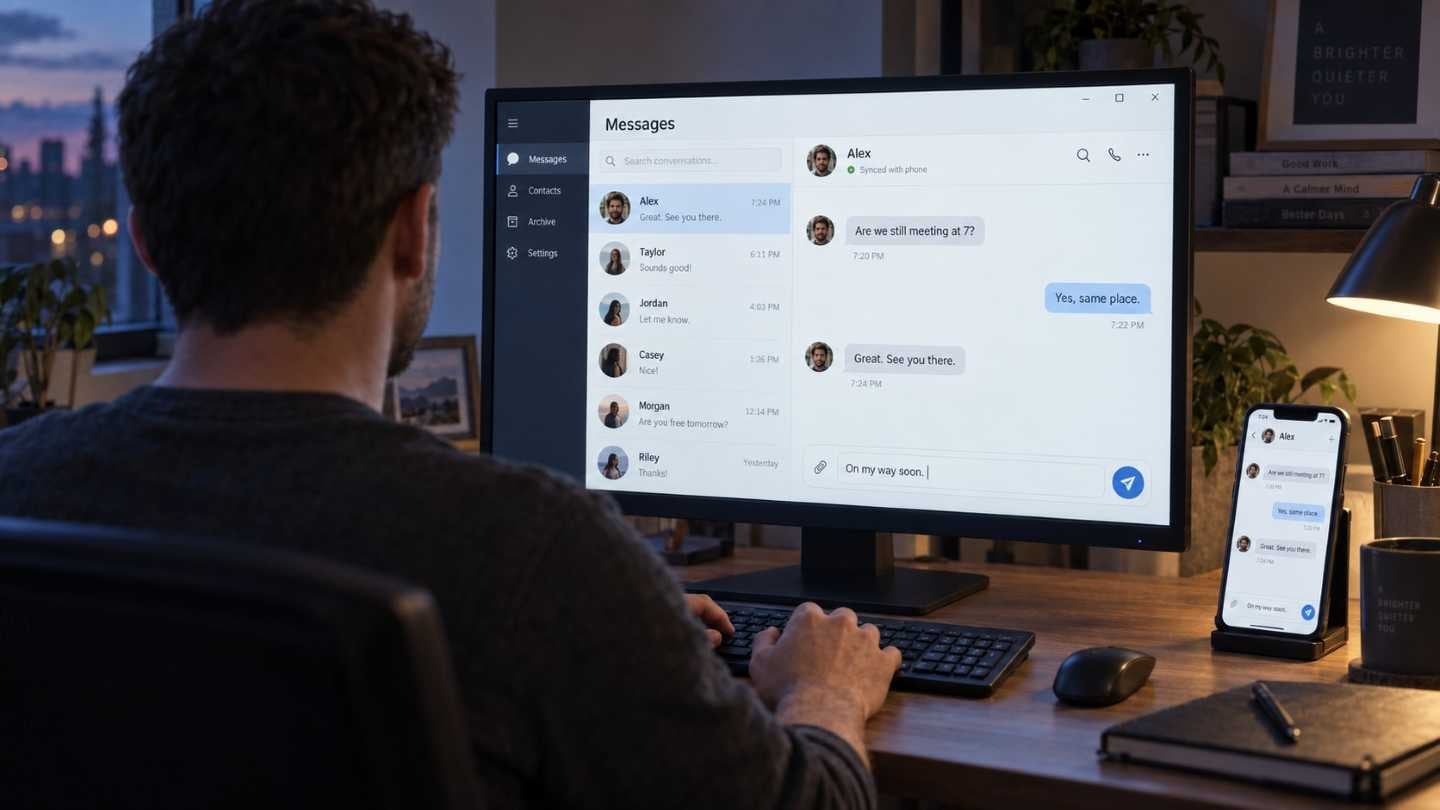
The same conversation, continued on a bigger screen.
Messages sent from a phone, read and answered on a PC. What has to stay identical is the thread itself — a conversation that looks like a different conversation on the other device is not continuous, whatever the data says. Interface and graphics developed together.
Technology trends
Written by AEON from public sources. It describes the field, not the project above.
Since the mid-2010s, sending a text from a computer has gone from a vendor-specific convenience to an expectation on every major platform. In 2016 the experience depended on which phone, operating system and carrier a person happened to use: iMessage already appeared across Apple's own devices, while on Android it varied from one manufacturer to the next. A decade later, the plumbing underneath has changed more than the screens on top of it.
Google moved first on the Android side, launching Messages for web in June 2018: a browser tab paired with the phone by scanning a QR code, relaying texts, stickers and images through the handset. Microsoft took a similar route with Your Phone, later renamed Phone Link, and in 2023 extended it to iPhones, though with clear gaps: no replies to group chats, no photos or video, and messages that only arrive while the phone is connected. Those limits illustrate a recurring pattern. A desktop client that relays the phone inherits every constraint of the link between them.
The larger story has been the protocol. RCS, the carrier-backed successor to SMS, spent years with patchy support while Google pushed it through its own Messages app. In 2024 Apple added RCS to iPhone Messages with iOS 18, bringing richer media and more dependable group chats to conversations with people who do not use Apple devices. For the first time in years, the two largest phone platforms shared a modern messaging baseline.
Security followed. The GSMA's RCS Universal Profile 3.0, published in 2025, defines end-to-end encryption built on the Messaging Layer Security protocol, and in May 2026 Apple and Google began rolling out encrypted RCS between iPhone and Android in beta, with a lock icon marking protected conversations and support depending on carriers. For companion apps on computers, that raises the bar: a conversation encrypted end to end has to remain so on every device allowed to display it, and pairing a new screen becomes a matter of trust as well as convenience.
For people moving between a phone and a computer, the significant change is that messaging is converging on shared standards rather than on any single vendor's app. That shifts the interaction questions toward transparency: showing which protocol a conversation is using, whether it is encrypted, which devices can read it, and which features will not be available on the screen in front of them. Most users never think about protocols, but they notice at once when something that worked on one device is missing on another.