MR-based Swarm Drone Operation & Control
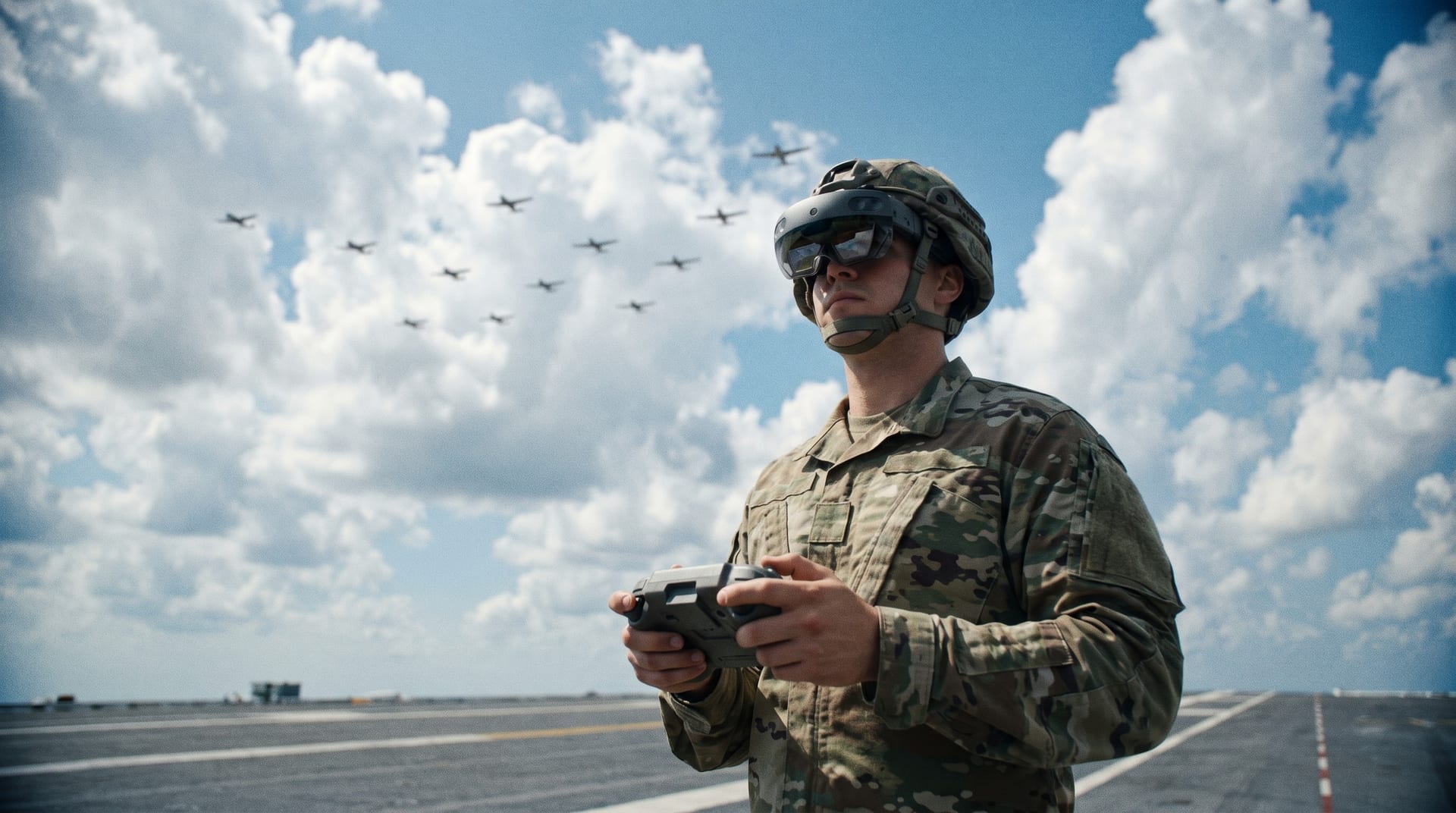
MR-based Swarm Drone Operation & Control is a mixed-reality interface for directing a swarm of drones as a coordinated group.
A drone swarm is a group of unmanned aircraft that coordinate with one another, so that they can be tasked as a single formation rather than flown one by one. Mixed reality (MR) combines a view of the real surroundings with computer-generated information, usually through a head-mounted display, and is one of several approaches being explored to let a small number of people supervise many vehicles.
AEON carried out UX design for LIG D&A's mixed-reality interface for operating and controlling a drone swarm.
Technology trends
Written by AEON from public sources. It describes the field, not the project above.
The central problem of swarm warfare was stated clearly by DARPA's OFFSET programme. Its aim was to let a small infantry unit use swarms of up to 250 air and ground robots in a city, and its premise was that nobody wants a platoon of soldiers each holding a joystick. At the final OFFSET field experiment at Fort Campbell in November 2021, more than a hundred robots mapped an urban site and located a target, directed by a single operator working with a swarm commander through tablet and virtual-reality interfaces.
What was an experiment in 2021 is now being tested with live weapons. In January 2026, at a range event at Camp Blanding in Florida, a single operator using Auterion's Nemyx swarm software assigned three strike drones to three separate targets. The human set the mission parameters and authorised the strike, and the software handled navigation, formation, deconfliction and terminal guidance. The test was an early event in the Pentagon's Swarm Forge effort, which pairs military units with commercial developers to iterate on autonomous tactics.
The display side has proved harder than the autonomy. The US Army's Integrated Visual Augmentation System, a HoloLens-derived mixed-reality headset, was meant to give every soldier a shared digital overlay. In July 2026 the Government Accountability Office reported that none of the roughly 10,000 IVAS units built would be fielded, after users reported headaches, eyestrain, nausea, poor low-light performance and added helmet weight. The effort has become Soldier Borne Mission Command, a rapid prototyping programme led by Anduril. For Project Convergence in summer 2026, L3Harris and Anduril planned to pair the ENVG-B night-vision goggle with Anduril's Lattice networking software, an approach that starts from a display soldiers already wear rather than a new headset.
Taken together, these programmes point the same way. Control is moving from piloting individual vehicles to stating intent for a group: an area to search, a target set, constraints and a time window, with the software working out who does what. Mixed and augmented reality appeal because a swarm is a spatial object, and placing its tasks and tracks on the operator's own view of the terrain avoids constant translation between a map and the world outside. But the IVAS experience shows that the wearable has to survive the field before any interface on it matters.
For the people involved, the main questions are about attention and authority. An operator supervising dozens of vehicles cannot watch each one, so the interface has to bring forward the few events that need a decision and keep the rest in the background. Weapons release must stay visibly under human control, and the operator needs to see at a glance what the swarm is doing on its own. Comfort, low-light legibility and weight are not secondary concerns; they decide whether the system gets worn at all.