Naval Combat System Seminar — CIC Multifunction Console UI/UX Research (Presentation)
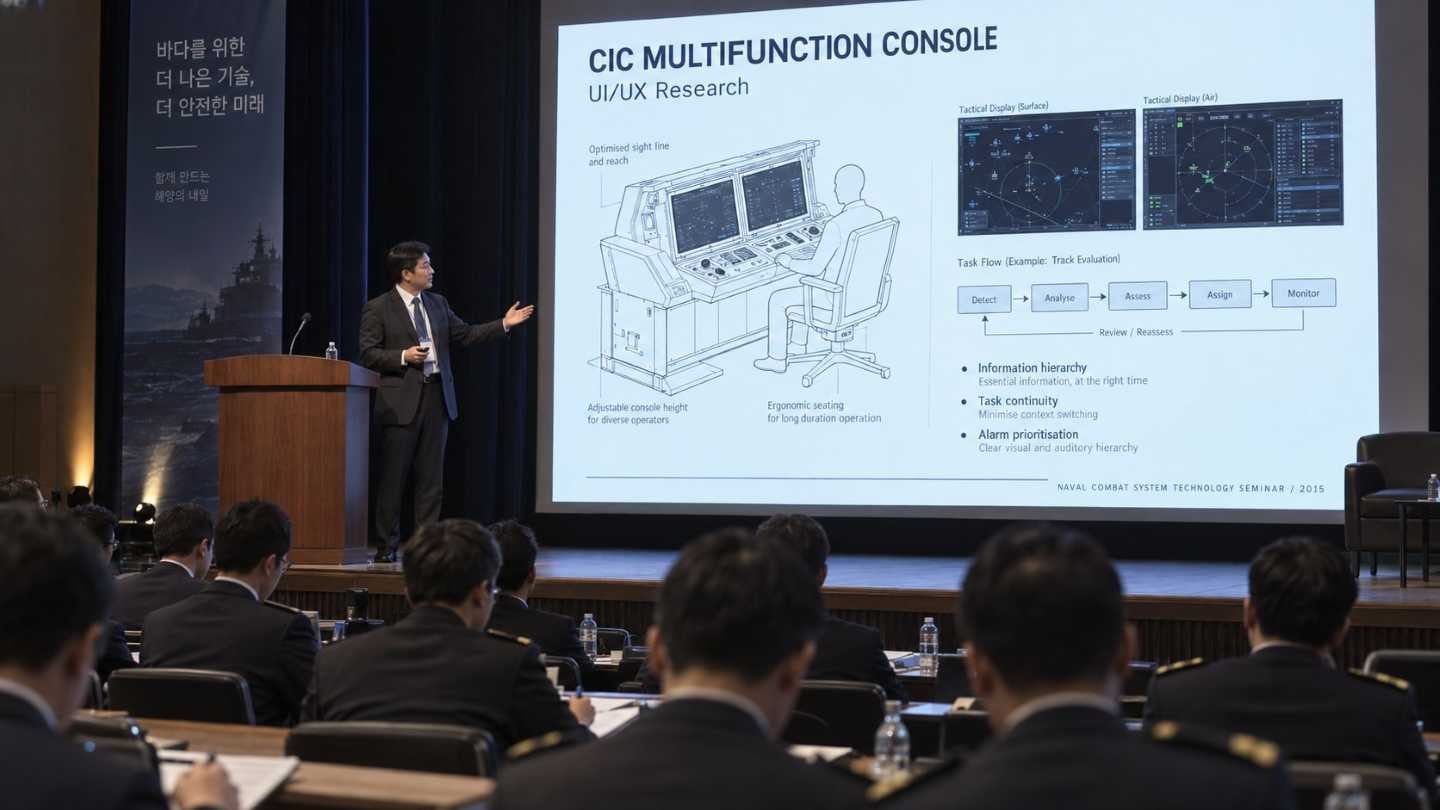
The combat information centre (CIC) is the compartment of a warship where sensor information is compiled into a tactical picture and the ship's weapons are directed, with multifunction consoles as its operator workstations.
The combat information centre, called the operations room in some navies, is where a warship's sensor data is gathered, evaluated and turned into the tactical picture from which the ship is fought. Its operator workstations are multifunction consoles: general-purpose terminals of the combat system that can take on different warfare roles through software rather than dedicated hardware.
AEON prepared and presented a research paper on the CIC multifunction console at the naval combat system technology seminar hosted by LIG Nex1 in 2015.
Technology trends
Written by AEON from public sources. It describes the field, not the project above.
The combat information centre began in the Second World War as a room where radar and radio reports were plotted by hand on boards and tables. From the 1960s, computer-based tactical data systems replaced the plotters with consoles, and ever since the console has been the point at which the combat system meets the sailor. Its history is a good guide to how naval combat systems themselves have changed.
The first big shift was from bespoke military hardware to ruggedised commercial technology. By 2004 Lockheed Martin and DRS had delivered the 4,000th AN/UYQ-70, a COTS-based display and computing system fitted to submarines, Aegis cruisers and destroyers, aircraft carriers, amphibious ships and the E-2C. One family of workstations across so many platforms meant common spares, common training and a common upgrade path.
The Common Display System that followed took the idea further. For Aegis modernisation and DDG 1000, CDS brought high-definition displays on commodity hardware such as blade servers running Linux, and Aegis engineers studied how to use the extra screen space without overloading operators. Its consoles were designed for surface ships, submarines and aircraft and could run applications at different security classifications from a single workstation. The display was becoming a general-purpose window onto networked processing rather than a terminal tied to one computer.
The current shift is in software. In June 2026 Lockheed Martin delivered Aegis BL9.C3.0, the first baseline enabled by the Navy's Integrated Combat System, with a re-architected display component and a platform-as-a-service framework for containerised applications, on a planned six-month cycle of updates and certification. European suppliers have moved the same way, pairing new console hardware with combat management software that can be reconfigured for different roles.
The direction is clear enough. Consoles are turning into thin clients on a shared network; roles are assigned by software rather than by the physical position of a workstation; and large shared displays, and in some ships handheld devices, supplement the individual console. The CIC is becoming less a room full of specialised terminals and more a configurable space.
For operators, this raises the stakes of interface consistency. When the same console can be an air-warfare position one hour and a surface-warfare position the next, and software arrives every few months rather than every few years, sailors need interfaces that behave predictably across roles, ship classes and versions. Cognitive load, alert management and the transfer of skills between ships become design problems in their own right, not afterthoughts to hardware.