Naval Combat System Seminar — Open Architecture Combat System Using Mainstream COTS, Promotional Film (Exhibit)
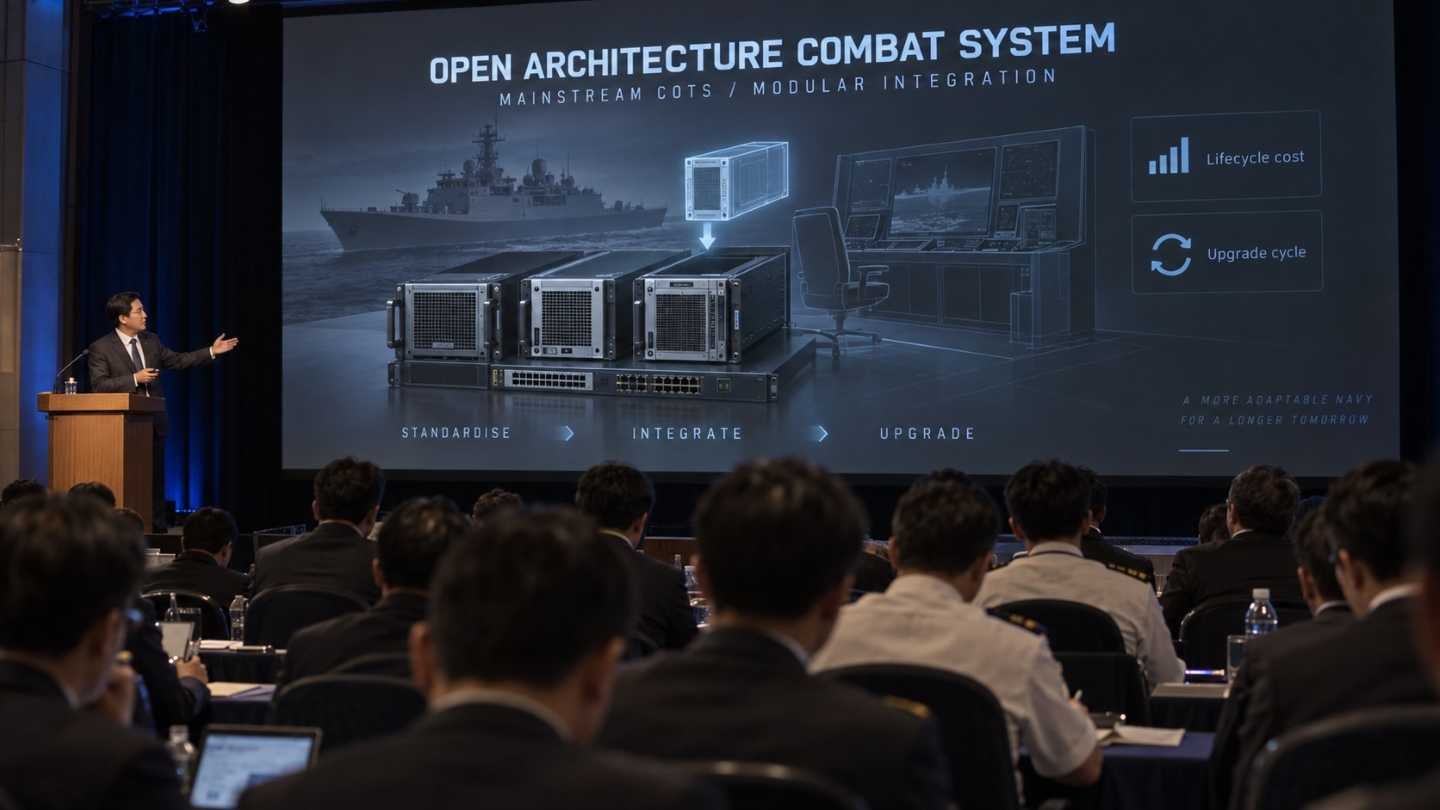
An open-architecture combat system is a naval combat system built from modular components with standard interfaces, allowing mainstream commercial off-the-shelf (COTS) computing to take the place of bespoke military hardware.
An open-architecture combat system separates software from hardware through published, standard interfaces and middleware, so that individual components can be replaced or upgraded without redesigning the whole system. Building such a system from mainstream commercial off-the-shelf (COTS) computing, such as servers, networks and displays, lets navies refresh hardware on commercial cycles and reduces dependence on bespoke military-specification equipment.
AEON produced a promotional film on an open-architecture combat system using mainstream COTS components, exhibited at the naval combat system technology seminar hosted by LIG Nex1 in 2015.
Technology trends
Written by AEON from public sources. It describes the field, not the project above.
For most of the Cold War, naval combat systems ran proprietary software on military-specification computers that were designed once and then maintained for decades. Open architecture reversed that logic. By separating software from hardware through standard interfaces and middleware, navies can buy computing from the commercial market, refresh it on commercial cycles and upgrade functions without redesigning the whole system.
Aegis is the best-documented example. The US Navy modernises it through paired software and hardware upgrades known as Advanced Capability Builds and Technology Insertions; a 2016 contract for ACB 16 and TI 16 covered replacing combat system computer hardware, middleware and firmware on existing cruisers and destroyers, and noted that earlier ACB upgrades had already moved to commercial off-the-shelf computers.
Virtualisation was the next step. In 2019 the Aegis Virtual Twin, a prototype of a virtual Aegis combat management system, controlled a live missile engagement from USS Thomas Hudner while running in rugged cases small enough to fit under a dining table. By 2024 USS Winston S. Churchill was running an entirely virtual Aegis Combat System and used it to intercept an air target, with installation planned on further ships and land-based test sites. And in June 2026 Lockheed Martin delivered the first Aegis baseline enabled by the Navy's Integrated Combat System, with a framework for containerised applications and a planned six-month update cycle across several ship classes.
Korea's naval combat systems have followed a similar arc. Hanwha Systems describes its Naval Shield baselines moving from open architecture with COTS and MOTS technology in Baseline 2.0, introduced in 2008, to high-performance computing and virtualisation in Baseline 3.0 from 2017, with real-time middleware based on the OMG DDS standard, and lists combat systems for destroyers, frigates and submarines of the Republic of Korea Navy as well as frigates for export.
Open architecture is not free. Commercial components go obsolete quickly, so navies must manage a constant flow of hardware changes; shared software libraries need disciplined configuration control; and a more connected, software-defined combat system widens the cyber attack surface. The prize is that new sensors, weapons and functions can arrive in months rather than years, and that one software base can serve several classes of ship.
For operators, the faster cadence matters most. When combat system software changes every few months, the interface changes with it, and crews need consistency across versions as much as new features. Human-centred design has to move at the speed of software delivery, with operator feedback built into each release rather than gathered once at the end of a programme.