New Wearable Project UI Development
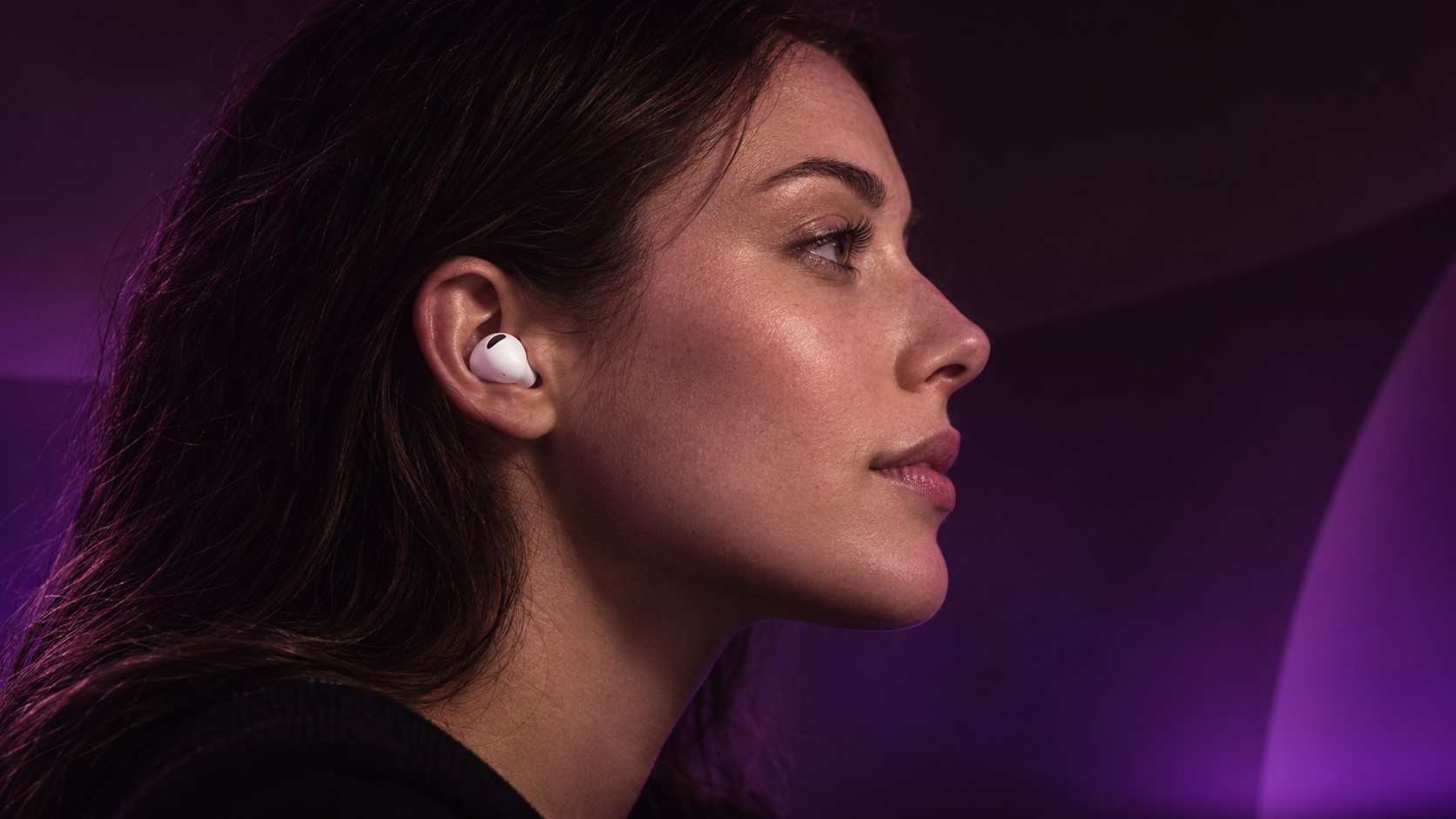
Two things worn at once, and neither of them is the phone. The earbuds have no screen, so the watch becomes the only place they can be seen.
Galaxy Buds2 and Galaxy Gear are both on the body, and the work was what passes between them. Everything about the earbuds a person might need to see has to appear somewhere other than the earbuds — which of them is connected, how much charge is left, what mode they are in. The nearest surface is the wrist.
A wrist screen is read in glances of about a second, so it cannot simply become a small second screen for the buds. What earns a place there has to be weighed against what could be a tone in the ear instead, and against what should wait for a screen large enough to deserve it.
The two channels are not interchangeable, because one of them is public. Raising a wrist is something other people see; a sound in the ear is not. Which of the two carries a given message is a decision about more than convenience.
UI development for the pairing, run in two phases across more than a year.
Technology trends
Written by AEON from public sources. It describes the field, not the project above.
Since the late 2010s, the earbud has turned from an accessory into a small computer in its own right. When Samsung's first Galaxy Buds arrived in early 2019, the company's watches still ran Tizen, and true wireless earbuds were judged mostly on fit, battery life and sound. Today's premium models carry their own processors, sensors and on-device machine learning, and the interesting question is no longer how to pair two gadgets but how several devices worn on one body should divide the work between them.
Platform consolidation set part of the stage. In 2021 Google and Samsung announced a unified wearable platform that folded Tizen's strengths into what became Wear OS 3, giving developers a single target and moving Samsung's watches onto the same software base as much of the wider Android watch market. Coordination between a watch, a phone and a pair of earbuds became something the platform was expected to handle, rather than something each manufacturer improvised.
Input, meanwhile, has been moving off the touchscreen. Apple's double tap gesture, which reached Apple Watch Series 9 and Ultra 2 in October 2023, lets the wearer pinch finger and thumb together twice to trigger the main action on screen, such as answering a call or snoozing an alarm, without touching the display. Samsung has since added a comparable double pinch to its own watch software. The following year Apple let AirPods Pro users nod or shake their heads to respond to Siri announcements, pitching it as a way to reply without speaking aloud. In both cases the body becomes the controller, and the screen becomes optional for the most frequent responses.
The most consequential change, though, is clinical. In September 2024 the US Food and Drug Administration authorised the first over-the-counter hearing aid software, allowing compatible AirPods Pro to act as a self-fitted hearing aid for adults with perceived mild to moderate hearing loss. A product bought for music and calls now also sits inside medical-device regulation, with the fitting carried out by its owner through a phone rather than by an audiologist. Features that once required dedicated equipment are increasingly arriving as a firmware update.
For the people wearing these devices, the practical result is that information and control are spread across several small surfaces, each tied to a different sense: sight on the wrist, sound in the ear, movement of the head and hand. Good interaction design here depends less on any single screen than on coherence across them. The same gesture should mean the same thing wherever it is made, confirmation should come through a channel the wearer is already attending to, and anything that touches health deserves clearer explanation than a control that skips a track.