OEM Navigation Map UI Design Specification Development
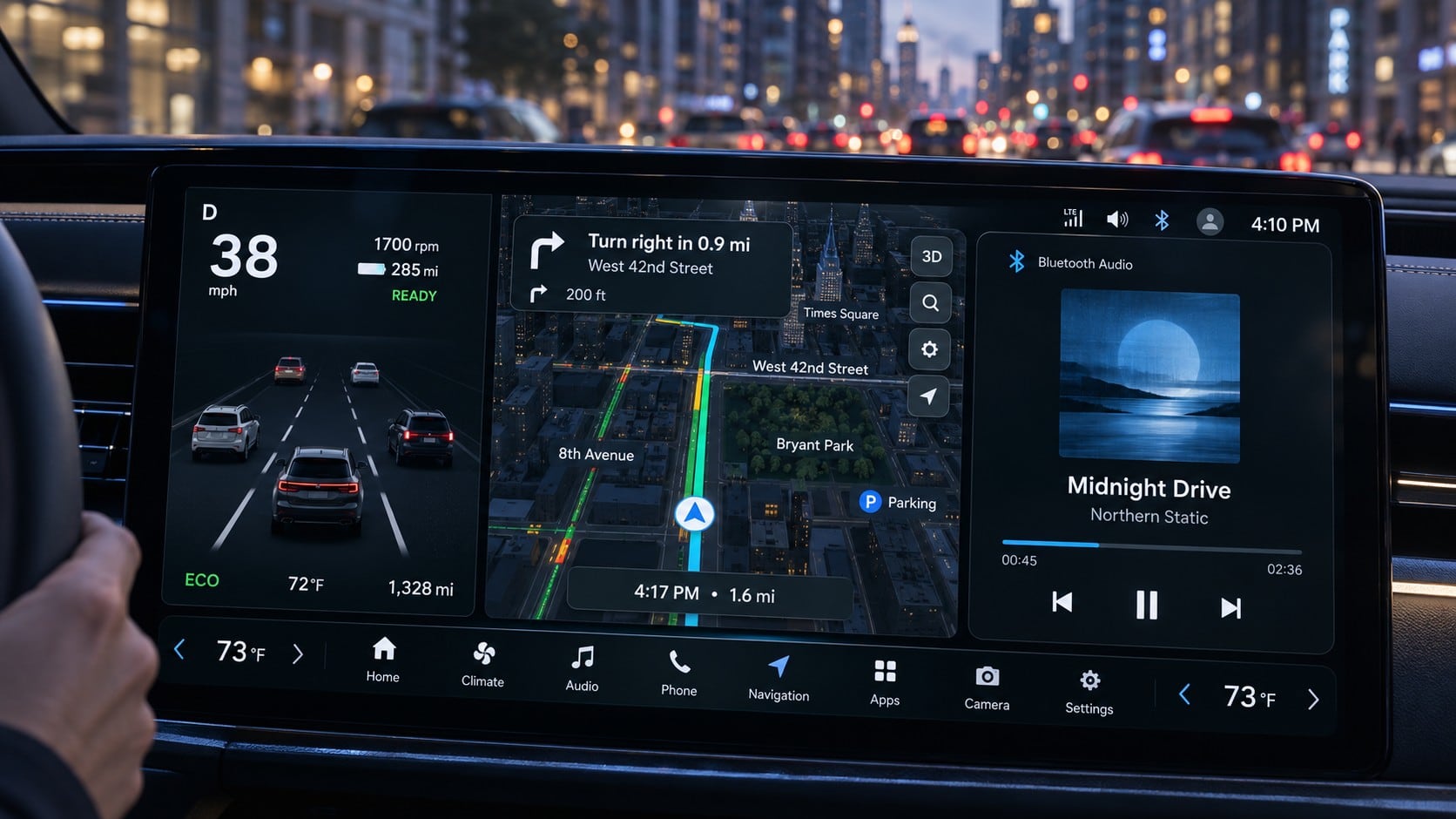
The specification is read by engineers building different cars for different countries. One document has to hold all of them.
A factory-fitted navigation screen is looked at while driving, and that fixes what may be on it. Beyond that nothing is fixed — model, region and year each move the specification.
So the real subject is not the map but how the variants are kept inside one document. How much is allowed onto the map, and where a difference is declared rather than duplicated.
Two-year contracts, revised against the development schedule. Working with the same organisation that long means the design principles are inherited rather than reopened, and what changes is written as change.
Technology trends
Written by AEON from public sources. It describes the field, not the project above.
For most of the history of in-car navigation, the speed limit shown on the map was a convenience. In Europe it has become safety data. Under the EU's General Safety Regulation, every new vehicle sold since 7 July 2024 has had to carry intelligent speed assistance (ISA) and a drowsiness and attention warning, among other systems. A figure that once sat quietly in a corner of the navigation screen now drives warnings the driver cannot easily ignore.
Where that figure comes from turned out to be the difficult part. The map supplier TomTom explained in 2021 that ISA type approval requires speed-limit data from both cameras and digital maps. Cameras misread signs or have their view blocked, and many limits are implicit, applying on entry to a residential area, or apply only to certain vehicle classes and are never signposted. The map fills those gaps, and the camera catches what the map has not yet learnt. Map attributes that were once judged by the quality of a route are now judged by whether a warning is right.
Consumer testing is raising the bar again. The 2026 Euro NCAP protocols extend ISA checks from the test track to real roads, so the accuracy of speed-limit information is assessed in actual driving, and top ratings require driver monitoring with continuous eye and head tracking. The European Transport Safety Council, which welcomed the changes, also notes that voluntary ratings are no substitute for legislation and wants them reflected in the next revision of the regulation.
The consequences reach the screen. The limit drawn on the map, the one in the instrument cluster and the one the car acts on must agree, or the driver meets a contradiction at the very moment they are asked to trust the system. Conditional limits, by time of day, weather or vehicle type, have to be shown without crowding a display meant to be read in a glance. Signage conventions and units vary between countries, and so do the rules about which conditions apply. And because driver monitoring now records where the driver is looking, long glances at a busy map are measured rather than assumed.
For drivers, the change is subtle but real: the navigation display is no longer only advice. It is part of a system that intervenes, and people judge such systems quickly. A warning that is right most of the time but wrong on a familiar road teaches drivers to switch it off. Interfaces that show what the car believes the limit to be, make clear when that belief is uncertain and keep alerts proportionate will earn more trust than ones that simply sound louder.