Premium Navigation UI Specification
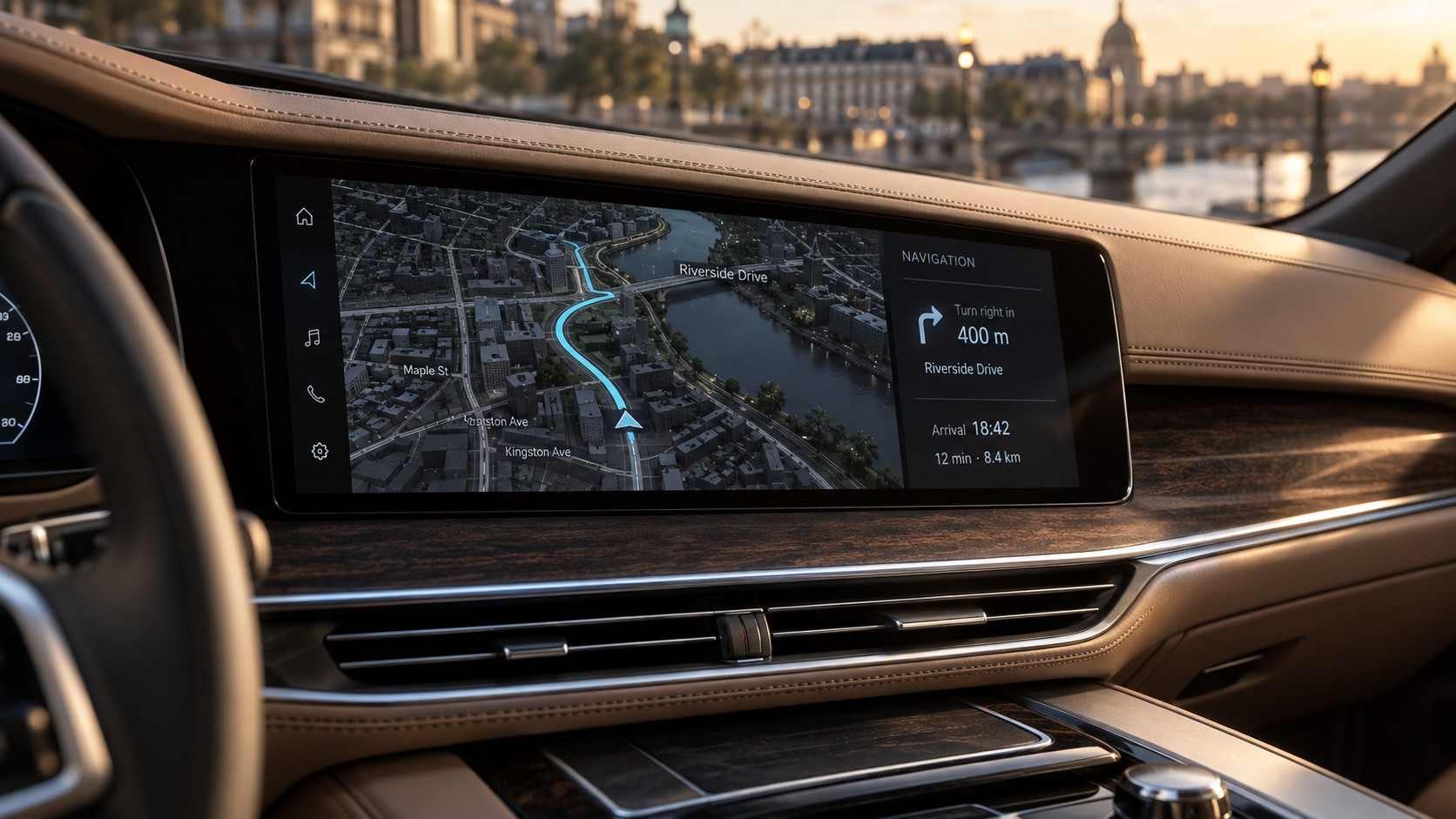
A new generation of the system. The driver's second of attention has not changed; almost everything else has.
More functions than the last generation, and export markets with their own road rules, languages and units.
A generation change is mostly a decision about what not to redo. What gets defined afresh, what is inherited, and where the regional differences are separated out so they do not spread through the whole specification.
We set the common structure first and managed the regional differences as derivations from it. Several people shared the work, so the specification's own conventions were agreed before any of it was written. Standard and premium annual programmes followed.
2 separate engagements on this line, 2017–2019.
Technology trends
Written by AEON from public sources. It describes the field, not the project above.
Since the late 2010s, the car dashboard has been through a full cycle. Carmakers spent the late 2010s and early 2020s replacing rows of buttons with ever larger touchscreens, some stretching across most of the dashboard. Screens were easier to change than physical tooling, could be revised through software updates and looked modern in a showroom. Climate, seat heating and, in some cars, functions used while driving moved into menus.
The counter-movement has now been written into safety ratings. Euro NCAP's 2026 protocols assess the placement, clarity and ease of use of essential controls, including physical buttons for commonly used functions, which consumer feedback suggests can reduce distraction. In October 2026 it published the first results under the new rules: indicators, wipers and washers, hazard lights, the horn and the eCall button are expected to work through a direct physical input rather than a touchscreen menu. The Audi Q7 scored 90% for driving controls and the Kia EV2 was praised for its controls, while the XPENG X9 managed 20% for its primary driving controls because it relies heavily on the central touchscreen.
The result is a hybrid cockpit rather than a return to the past. Hyundai's Pleos Connect, as reviewed by Jalopnik in September 2026, pairs a large centre touchscreen, a slim driver display and a head-up display with a row of physical toggles for climate, seat heating and ventilation and hazard lights, plus knobs for volume and tuning. The left third of the centre screen always shows driving information. The reviewer found the switches easy to use without looking away from the road, and the menus heavy on swiping.
For anyone planning a new generation of in-car software, the question has changed. It is less about how much can be placed on the screen and more about which functions deserve a fixed physical place, which deserve a fixed zone on the display, and which can live in menus. Information is now deliberately repeated across the driver display, the head-up display and the centre screen. Software can keep changing after sale while switches cannot, so the split between them has to be right at launch. Although Euro NCAP is a European programme, cars are increasingly developed for several markets at once, so its preferences are likely to shape cabins well beyond Europe.
For drivers, the lesson of the last decade is that predictability beats flexibility for the things done most often and in a hurry. A control that stays in the same place can be found by touch and memory; a menu item that moves with an update cannot. The best current cabins treat the touchscreen as the place for setting things up and browsing, and keep the actions a driver needs without warning within reach of a hand that never has to look.