Samsung Card Open Sharing Season20 Social Goods Project
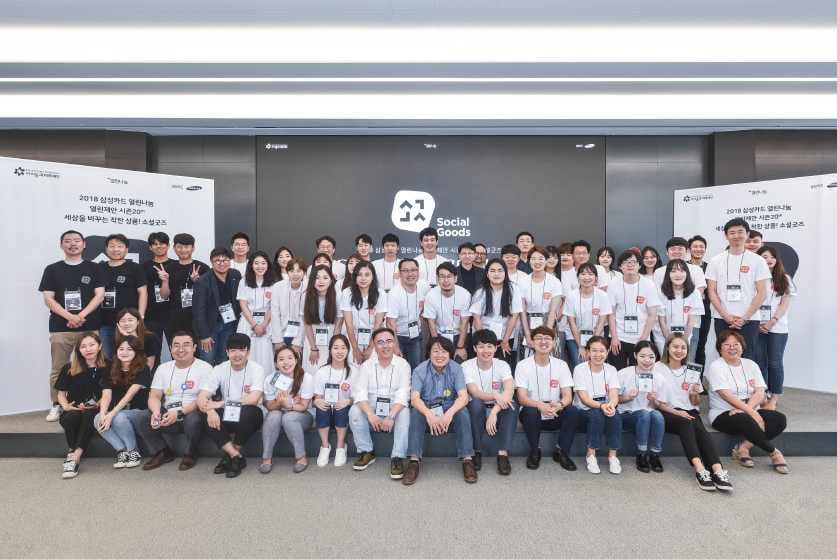
Young people with an idea, and no route from the idea to a shelf.
The programme took social-goods ideas through to products actually on sale.
Most of that is not design; it is the parts nobody plans for — finding mentors worth the young teams' time, running the talks and workshops, getting mock-ups made, and walking each team through what it takes to get listed in a shop.
Technology trends
Written by AEON from public sources. It describes the field, not the project above.
Since the late 2010s, the idea that a small enterprise can sell an ordinary product while pursuing a social purpose has moved from the edge of policy towards its centre. Korea was early. Its Social Enterprise Promotion Act came into force in 2007 and created a government certification route: the labour minister decides, after review by a support committee, which organisations qualify, and their status is published. Around that framework grew a layer of incubators, foundation programmes and corporate partnerships that try to turn a good idea into something that can be manufactured and sold.
International bodies have since written the same ambition into their own instruments. The OECD's Recommendation on the Social and Solidarity Economy and Social Innovation, adopted in 2022, asks governments to open public and private markets to these organisations, including through online marketplaces, and to encourage them to measure and report their impact. In April 2023 the UN General Assembly adopted a resolution on the social and solidarity economy, connecting it to decent work, social inclusion and the Sustainable Development Goals, and drawing attention to access to finance and markets.
The practical route from prototype to shelf has also shortened. Crowdfunding campaigns, marketplace storefronts and short retail placements let a young team test demand before committing to a full production run, and a product can find its first buyers without a distributor. What has not become easier is being believed. Shoppers meet a steady stream of goods that say they do good, and most have no way to check.
Regulators have started to address that gap directly. The EU's Directive (EU) 2024/825 adds a product's environmental or social characteristics to the things a trader can mislead consumers about, and its recitals give working conditions and contributions to social initiatives as examples of social traits. It also bans sustainability labels that rest neither on a certification scheme nor on a public authority. The rules have applied since 27 September 2026. The direction of travel is visible well beyond Europe: a social claim on a product is increasingly treated as a factual statement that can be tested, not as a tone of voice.
For the people who make and buy such goods, this changes what a product page or a package has to do. A story still draws attention, but it now has to sit next to something checkable: who certified the claim, what was measured, where the evidence lives. Interfaces that present impact need to make that evidence reachable in a step or two without burying the product itself, and to keep the visual difference between an audited label and a brand's own badge obvious. For small teams, the skill that matters is turning honest, limited facts into something a hurried shopper can read in a few seconds.