Smart Building Service UI/GUI Development
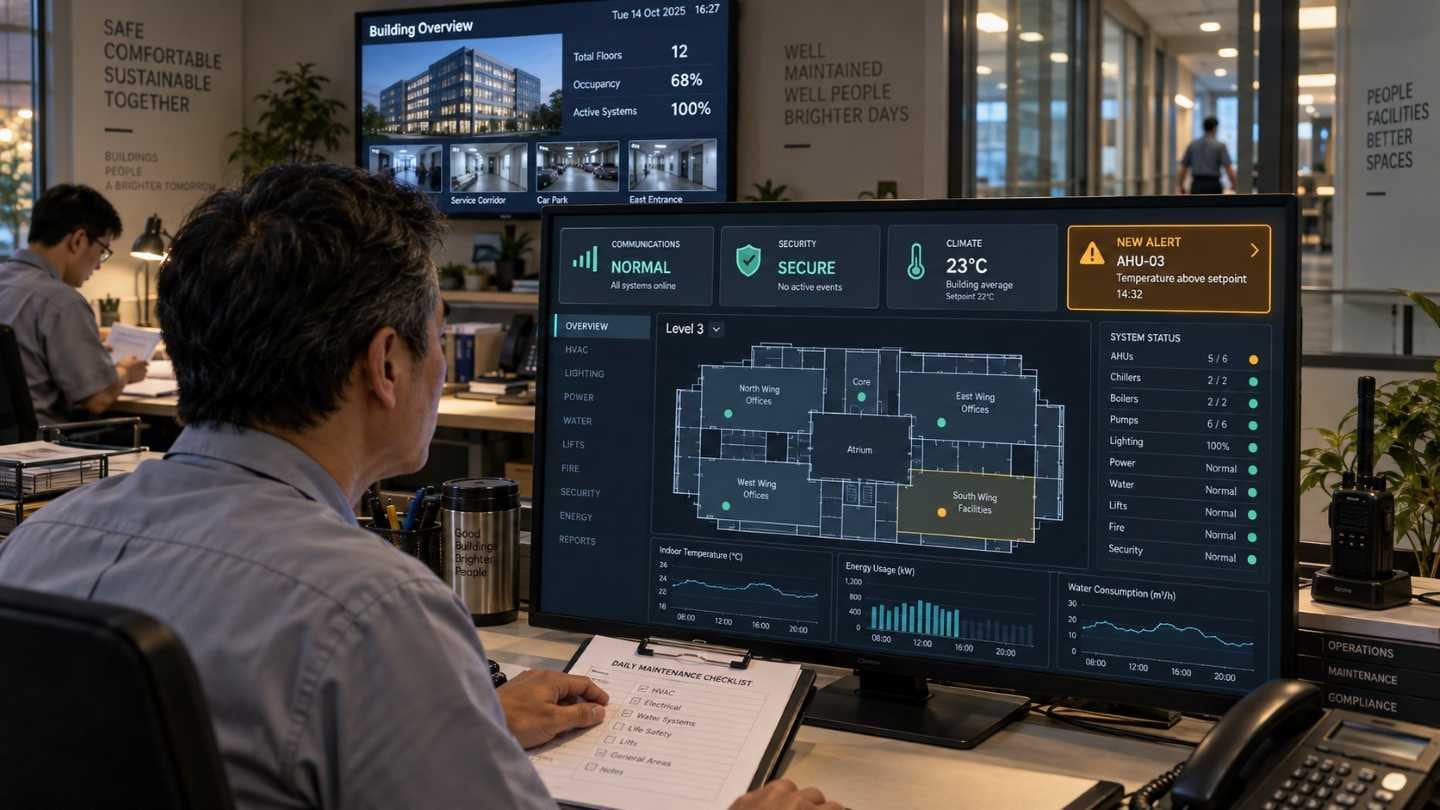
Three shifts a day, and not one of them spends its time watching the screen.
In a large building the manager has to see communications, security and climate in one place. Nobody can keep looking at it.
So the information divides in two: what must be legible whenever someone glances up, and what has to be caught in the instant it happens. They are different design problems and they compete for the same screen.
We gathered what the building's people needed and found difficult, then designed an interface that put visibility first because monitoring is what it is for. This engagement led on to the commercialisation of b.IoT.
Technology trends
Written by AEON from public sources. It describes the field, not the project above.
In the mid-2010s, integrating a large building's subsystems into a single operations platform was mostly argued as a matter of efficiency and staffing. A decade on, the same convergence is just as often discussed as an attack surface. Building systems that were engineered for isolated networks now share infrastructure with corporate IT, remote maintenance links and cloud services, and the boundary between facilities and cyber security has largely dissolved.
The case most often cited is a retail breach from 2013. According to reporting at the time, attackers entered the retailer's network with credentials stolen from a refrigeration and HVAC contractor, and the episode raised the question of why a contractor's access was not separated from payment systems. The building equipment itself was not the target, which is precisely why the story stuck: it showed that the plumbing of building operations could serve as a route into everything else.
Protocols have been catching up. BACnet, the dominant building automation protocol, gained a secure option known as BACnet/SC, which uses TLS with certificate-based mutual authentication and does away with broadcast traffic, so that devices can protect themselves on shared IP networks without separate VPN equipment. Adoption is gradual, since controllers stay in service for many years, but new specifications increasingly ask for it.
Vulnerabilities in building controllers continue to surface, and the official advice is consistent. A 2025 US advisory for one family of building controllers repeats the standard guidance to keep control devices off the internet and place them behind firewalls, isolated from business networks. Regulation is adding obligations on the supply side: the EU Cyber Resilience Act, which covers networked hardware and software, entered into force in December 2024, with manufacturer reporting duties in effect since 11 September 2026 and full requirements due in December 2027. Building operators are also absorbing practices from IT, including identity management for contractors, logging of configuration changes and, in larger organisations, operations centres that watch facilities and network security side by side.
For the people on shift in a building operations room, this means security events now sit alongside comfort complaints and equipment faults in the same working day. The interface has to show who changed what, from where and with what authority, and it has to make an unusual remote session as noticeable as an unusual temperature. At the same time, authentication cannot become so cumbersome that staff share logins to get through a night. Designing for accountable, individual access that still fits round-the-clock operations is now part of the usability brief, not an add-on to it.