Smart Home Accessibility UI Guideline Development
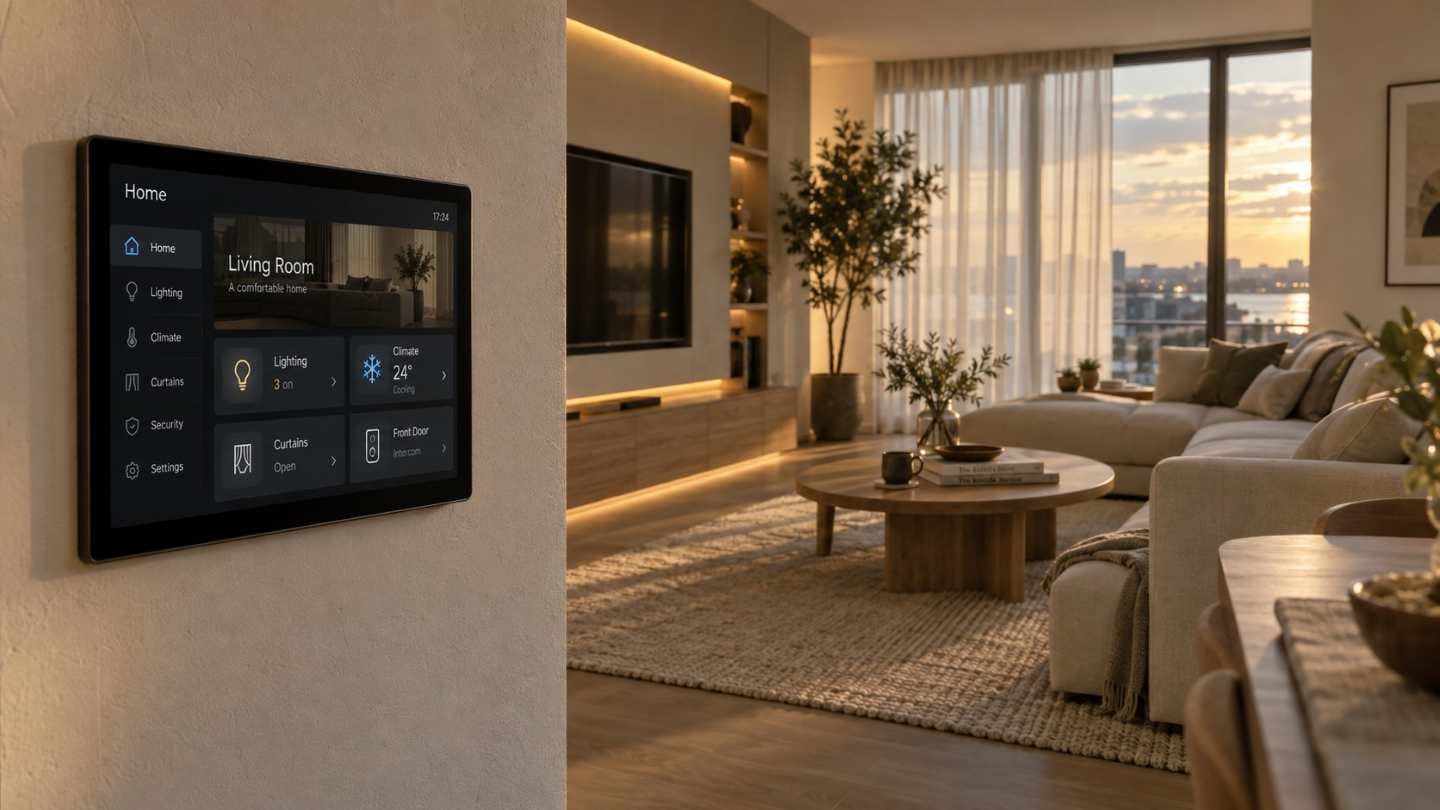
A smart home that only opens for people who can see it, hear it and reach it is not a smart home.
The service had to work for users with limited sight, hearing or movement.
Accessibility standards are written in general, and a house is not general. Contrast, type size and spoken guidance each mean something particular once the thing being controlled is a boiler or a door.
We took the standards and wrote them into the smart home context as UI guidelines. The scope grew during the work, and the contract with it.
Technology trends
Written by AEON from public sources. It describes the field, not the project above.
Since the late 2010s, the hardest accessibility questions in the home have been about where the interface actually is. Guidance was written for web pages and desktop software, while homes filled up with thermostats, locks, speakers and appliances controlled through a mix of small panels, phone apps and voice. The W3C has spent years adapting its rules to that reality. Its WCAG2ICT note, updated in December 2025 to cover WCAG 2.2, explains how the web criteria apply to non-web software and documents, and gives a section to closed functionality: products such as smart speakers, smart displays, smart TVs and IoT devices that do not let users attach their own assistive technology. It is candid that meeting the criteria alone will not make such software accessible, and it leaves hardware out of scope.
Law has moved, but selectively. The European Accessibility Act sets requirements for products placed on the EU market after 28 June 2025, yet its product list covers computers and their operating systems, payment and other self-service terminals, communications and audiovisual terminal equipment, and e-readers. Household appliances and smart-home devices are not named. Much of the connected home therefore still rests on voluntary practice, even where the phones used to control it fall under binding rules.
The other large change is interoperability. The Connectivity Standards Alliance released Matter 1.0 in October 2022, developed by more than 280 member companies including Amazon, Apple, Google and Samsung SmartThings, so that certified devices could work across brands and platforms. Matter 1.5, announced in November 2025, added cameras, a unified model for closures such as shades, gates and garage doors with more precise position reporting, and energy tariff and EV charging information. Each release widens the set of household functions that any compliant controller can read and operate.
That moves accessibility away from the individual appliance. If a lock, a blind and a thermostat can all be reached from the same phone, the accessibility of the home increasingly depends on the controller a person already uses, with its screen reader, switch access, voice input and display settings. Standardised device models help, because a closure that reports its exact position can be announced in words as well as drawn as an icon. The device itself still matters when the phone is out of reach, and for states that must be perceivable without any screen at all.
For residents with limited sight, hearing or movement, the promise is a home they can run through whichever interface suits them, rather than one learnt appliance by appliance. The risk is that responsibility falls between makers: the device maker assumes the app will cope, and the app assumes the platform will. Good smart-home design now means checking the whole chain, from the physical control to the spoken confirmation, as a single experience.