Smart Home Mobile App UX Prototype
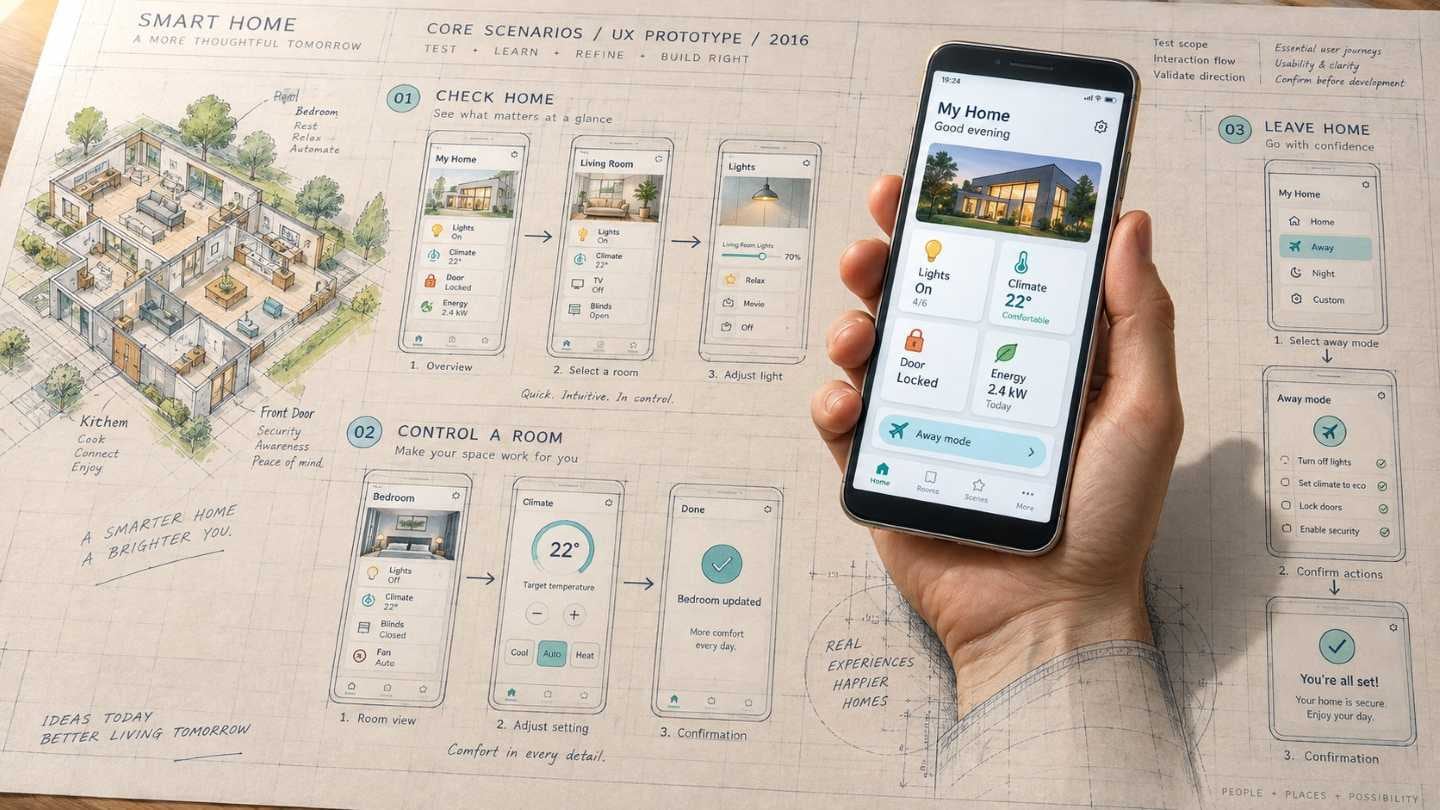
Checking the experience before committing to build it.
A prototype is defined by what it is allowed not to do, so scoping what would actually be tested came before making anything. We built the core scenarios far enough to run, and the direction could be judged on them.
Technology trends
Written by AEON from public sources. It describes the field, not the project above.
In 2016 the smartphone was the smart home's remote control. Most connected devices arrived with an app of their own, and platform apps such as SmartThings and Apple's Home, launched that autumn, tried to gather them into a single grid of tiles. Voice was only just entering the home: Amazon's Echo was spreading, and Google Home went on sale at the end of the year.
The early voice assistants promised more than they delivered. A 2018 Nielsen Norman Group study of Alexa, Google Assistant and Siri found their usability fell well short of what was promised: they handled simple, short requests but stumbled on complex ones, cut people off when they paused mid-sentence, and left users to work out exactly how a command had to be phrased. For the smart home, that meant voice worked best for brief, well-rehearsed commands, while anything more elaborate, such as schedules, scenes or conditional routines, was still built on a phone.
Generative AI has shifted that balance. Amazon's Alexa+, announced in February 2025, holds open-ended conversations, lets people create routines entirely by voice and can carry out multistep tasks on their behalf. Google's Gemini for Home, announced in August 2025, is gradually replacing Google Assistant on its speakers and displays and accepts compound requests with exceptions, such as switching off every light except those in one room. Configuration that once demanded an app is moving into conversation.
The interoperability work of the same period supports the change, since shared device standards give assistants a common description of what they are acting on. The phone app has not disappeared, but its role is changing: it is becoming less the place where every action happens and more the place where people set up, review and correct what the home does on its own or on a spoken instruction.
For residents, the move from tapping tiles to delegating tasks changes what good interaction looks like. When a system acts on a loosely worded request, people need to see what it understood, what it did and how to undo it; they need confidence about what a microphone or camera keeps; and households need ways to share control without one person's instruction silently overriding another's. Directness used to be the measure of a smart-home interface. Increasingly, the measure is legibility.