SoS Presentation Materials
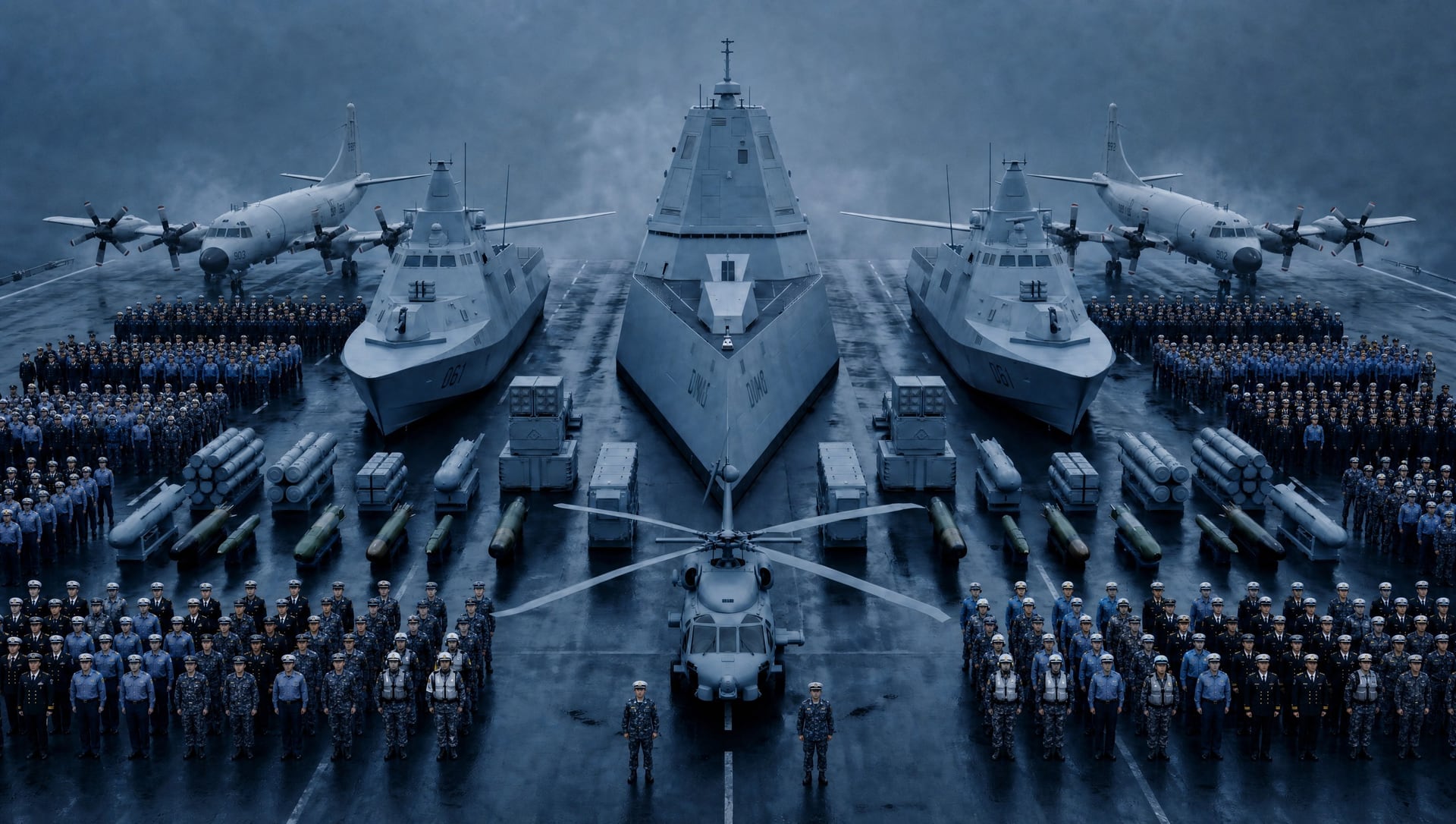
A System of Systems (SoS) is an approach in which independent platforms, sensors and weapons are networked so that they operate as one larger capability; in naval warfare it underpins concepts for distributed and manned-unmanned operations.
In naval operations, a System of Systems links ships, submarines, aircraft, unmanned vehicles and shore-based nodes through common networks and shared data, so that a sensor on one platform can cue a weapon or another sensor elsewhere. The approach is particularly relevant to anti-submarine warfare, where detection depends on combining sonars, sonobuoys, maritime patrol aircraft and helicopters over wide sea areas. The Republic of Korea Navy is pursuing it through its manned-unmanned combined combat concept, known as Navy Sea GHOST.
AEON planned and produced, as video and multimedia, presentation material for a Republic of Korea Navy academic conference proposing a System of Systems concept for naval operations, including anti-submarine warfare.
Technology trends
Written by AEON from public sources. It describes the field, not the project above.
The idea that a navy fights as a network rather than as a collection of ships is not new, but over the past decade it has hardened into doctrine. The US Navy's Distributed Maritime Operations concept spreads weapons and sensors across many more platforms so that the loss of any one does not break the whole. A Congressional Research Service report updated in January 2026 describes planned large unmanned surface vessels as adjunct weapon magazines and sensor platforms intended to help implement that concept, a reminder that the system of systems is now being built partly from hulls with no crew aboard.
Distribution only works if the pieces can talk to each other. Project Overmatch is the US Navy's effort to provide the networks, data architecture and tools that tie ships, aircraft and weapons together and connect them to the wider joint force. In 2024 the commander of US Third Fleet said Overmatch capabilities were already fielded on three carrier strike groups. The hard problem is less the radio link than the data: shared tracks, common formats, and software that can be updated at the pace of the threat.
South Korea is following a similar path at its own scale. The Republic of Korea Navy's manned-unmanned concept, Navy Sea GHOST, is moving from concept art to hardware. In late 2025 a consortium of HD Hyundai Heavy Industries, HJ Heavy Industries and LIG Nex1 agreed with ADD to build a verification platform for combat USV control and autonomy technologies. Navy plans discussed in 2025 envisage adapting the Dokdo-class amphibious ships for drone operations and building a dedicated drone carrier for service in the late 2030s.
The most telling recent demonstration came in August 2026, when Hanwha Systems and the navy ran a manned-unmanned mine countermeasures exercise at Busan. An AI-based command system turned natural-language instructions into a search plan and tasked unmanned surface and underwater vehicles, a crewed minesweeper and a UAV, with satellite links sharing the picture. Mine warfare and anti-submarine warfare share the same character: wide areas, faint signals and a premium on persistence, which is exactly where many distributed sensors can outperform a few exquisite platforms.
For operators, this shift changes the nature of command. A watch officer who once managed a single ship's sensors now supervises a web of crewed and uncrewed nodes, some far over the horizon and some acting with partial autonomy. The interface has to show not only where objects of interest are, but how confident the network is about them, which node supplied each piece of evidence, and what each unmanned asset is currently permitted to do. As AI tools begin to propose plans, the human task becomes judging and adjusting those plans quickly, and that depends on designs that make machine reasoning legible without burying the operator in detail.