Special Operations Support System Command & Control Screen Consulting
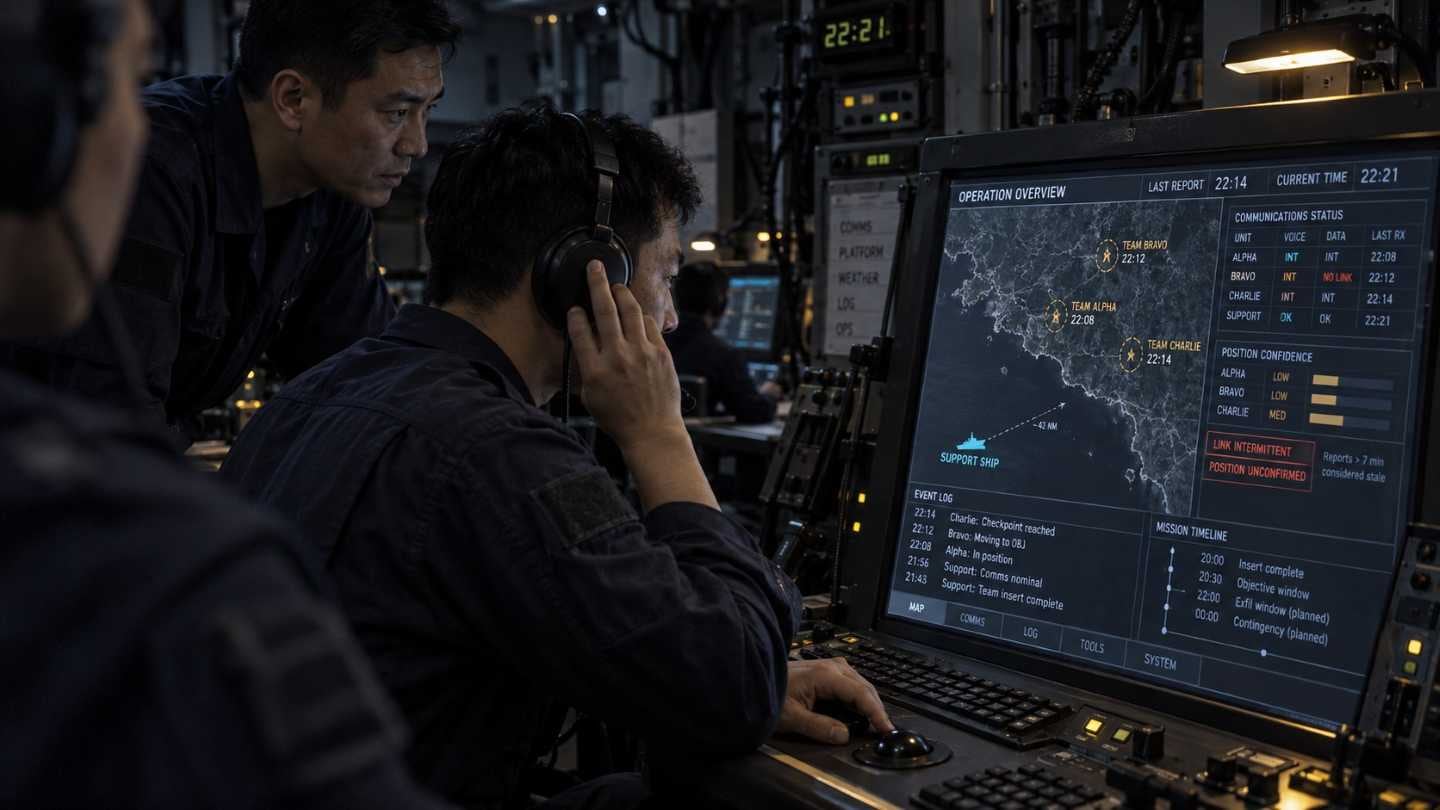
The special operations support system is a shipboard system that supports special operations conducted from the sea.
Maritime special operations are launched from ships or craft at sea, which carry the teams, boats and equipment and serve as their base during an operation. A shipboard special operations support system provides command and control for such operations, keeping the ship and the units it deploys connected.
AEON provided HCI consulting on the command and control display of the special operations support system.
Technology trends
Written by AEON from public sources. It describes the field, not the project above.
Special operations from the sea depend on three things working together: fast craft, a parent platform, and the command and control that links them to each other and to forces ashore. In the United States, Naval Special Warfare boat teams operate the Combatant Craft Medium, a low-observable armoured boat used to insert and extract special operators in medium-threat environments. In August 2025 US Special Operations Command awarded ReconCraft an agreement to build an engineering development model of its successor, the CCM Mk 2.
The craft themselves are turning into strike and sensing nodes. SOCOM has tested a retractable eight-cell launcher on a CCM firing ALTIUS-700 loitering munitions, with the Mk 2 designed to carry such a launcher. Loitering munitions can scout ahead of a raid, provide fire support to boarding teams, or be handed off to forces ashore, which ties a small boat into a much wider targeting network. The US Navy has since sought industry information on loitering munitions for the craft under its Maritime Launched Effects Increment 1 effort.
Sensors and uncrewed partners are following. At SOF Week in May 2025, SOCOM's maritime programme office said it plans to fit forward-looking infrared sensors across its medium, heavy and assault craft and wants a fleet of autonomous uncrewed surface vessels by fiscal 2027, alongside interest in electronic warfare payloads. The war in the Black Sea, where uncrewed surface vessels have been used against a conventional navy, has sharpened attention on small, expendable craft that can scout, decoy or strike ahead of crewed boats.
The parent platform is changing too. The US Navy's expeditionary sea bases, such as USS Lewis B. Puller, are converted from a commercial tanker design and host helicopters, small boats and uncrewed vehicles, with upgrades planned to support special operations forces. A large, relatively inexpensive hull positioned offshore can act as a staging base, a maintenance hub and a command post for dispersed teams. The common thread across these programmes is connection: craft, drones, the parent ship and headquarters ashore need to share a picture over links that must stay hard to detect.
For operators, maritime special operations remain physically punishing. Small crews work at high speed, at night and in heavy seas, so information has to be readable at a glance and controls usable with gloves and limited attention. Adding loitering munitions and uncrewed vessels gives the same crews more to manage, while the staff aboard the parent ship must follow several dispersed teams over intermittent links. Interfaces that separate what needs action now from what can wait will determine whether these new capabilities help or overload the people using them.