Standard Gen 5 Navigation
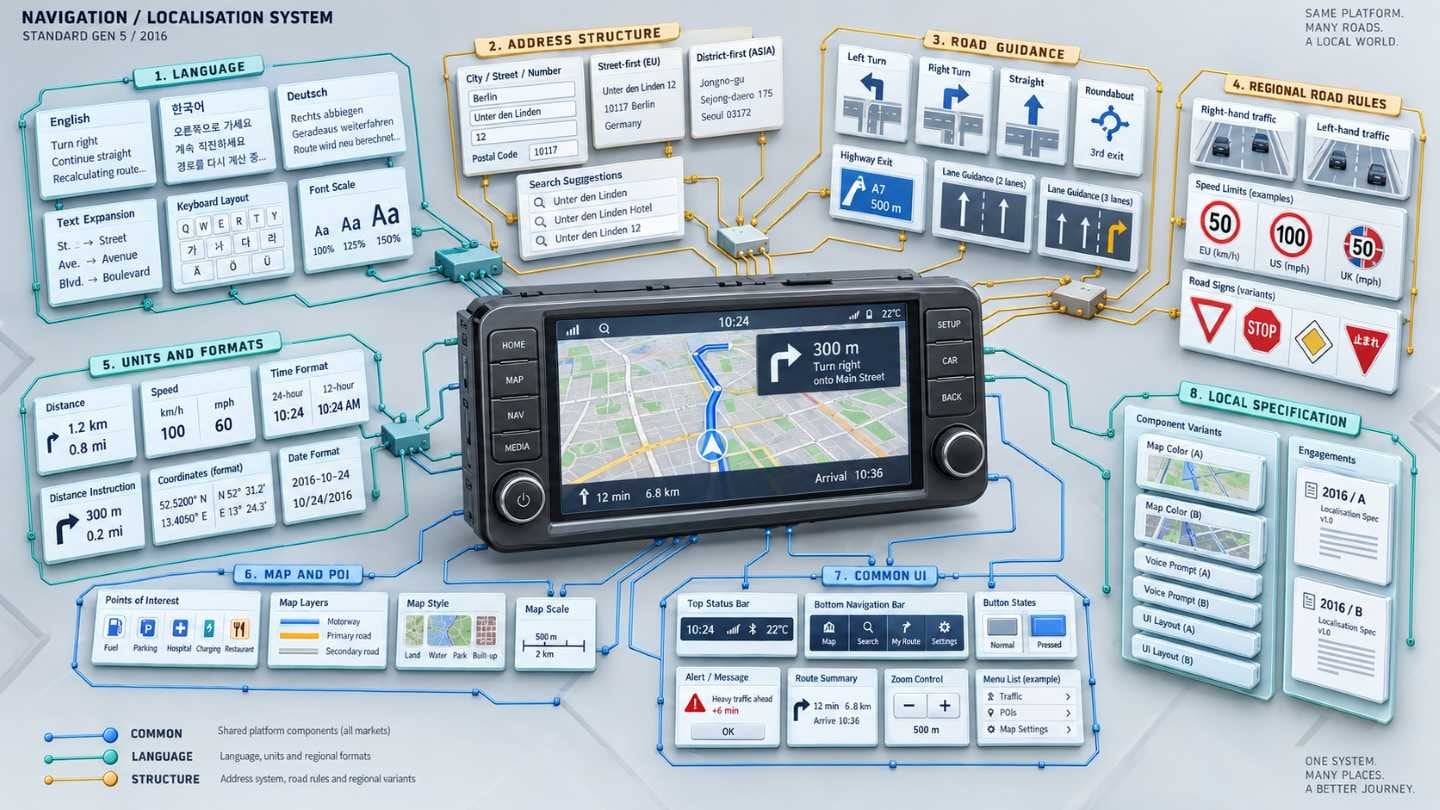
Another language, another address system, another set of road rules. A screen built for one country does not simply translate.
Localisation divides into two piles: the words, and the structure. Confusing them is how a specification either bloats or breaks — everything treated as structure means a second product, everything treated as words means a screen that lies about the roads.
Working from the common Standard Gen 5 design, we pulled out what the local conditions actually change and wrote those into the specification.
2 separate engagements on this line in 2016.
Technology trends
Written by AEON from public sources. It describes the field, not the project above.
Since the mid-2010s, the navigation screen in a car has changed hands more than once. In 2016 most embedded systems still shipped with a regional map database installed at the factory and refreshed, if at all, during a dealer visit or from a USB stick. Phone projection through Apple CarPlay and Android Auto was spreading quickly, and for many drivers the phone rather than the car became the navigator they trusted.
Carmakers have since answered in opposite directions. In 2023 General Motors said it would phase out CarPlay and Android Auto in its electric vehicles in favour of built-in software based on Google's Android Automotive, keeping the dashboard under its own control. Others opened the door wider. When Apple began rolling out CarPlay Ultra in May 2025, a version that extends the phone's interface into the instrument cluster and to controls such as climate and radio, Hyundai, Kia and Genesis were among the makers Apple named as committed to it.
Embedded navigation has meanwhile caught up on freshness. Hyundai's ccNC cockpit now receives map updates over the air every month, including new roads, changed routing and local speed limits, downloading only the relevant sections in the background while the car is driven. The map has turned from a file shipped with the car into a service that keeps changing, and that alters what localisation means: local speed limits and routing can now follow a country's changes instead of freezing at the model year.
Maps also remain national infrastructure, and that shapes navigation as much as language does. South Korea is a sharp example. Having refused Google's requests to take detailed map data abroad in 2007 and 2016, the government approved a request in February 2026 only under conditions, including processing on servers in the country, government review before export, use limited to navigation and the removal of military and security sites. Any platform that wants to guide drivers across borders has to live within rules of this kind.
Testers have turned their attention to the driver's hands and eyes. Euro NCAP's 2026 protocols score how easily basic functions can be operated, and its first results in October 2026 favoured cars that keep indicators, wipers, hazard lights, the horn and the emergency call button on physical controls, while a model that relies on its touchscreen for basic functions scored poorly on that measure.
For drivers, the result is that the dashboard is no longer one product but a meeting point between the carmaker, the phone platform and the map supplier. That raises the bar for consistency: the same instruction should look and sound the same wherever it appears, and controls that matter in an emergency should stay where a hand can find them without a glance. Localisation now lives in the whole interaction rather than in a map file, and it has to survive a steady stream of updates from more than one source.