Submarine Combat System UX Consulting
The Jang Bogo class comprises nine diesel-electric submarines of the German Type 209 design in service with the Republic of Korea Navy.
The Jang Bogo-class (Type 209) submarines were delivered to the Republic of Korea Navy between 1993 and 2001, with all but one built in South Korea. A capability upgrade programme has modernised the boats' combat system, sonar and periscope, taking the combat system of the Navy's later Type 214 submarines as its base.
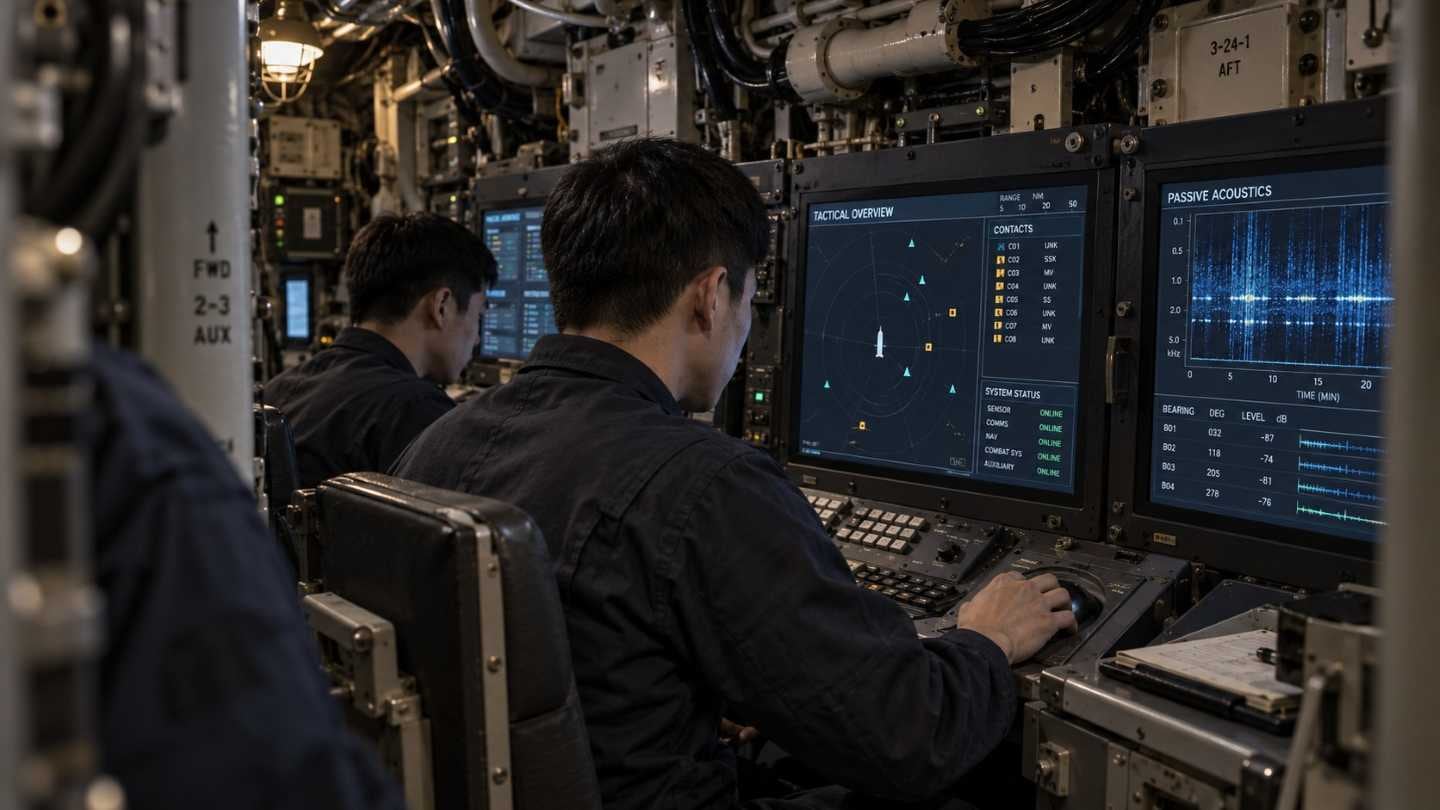
AEON provided HCI consulting for the combat system interface of the upgraded submarines.
Technology trends
Written by AEON from public sources. It describes the field, not the project above.
Submarines routinely outlive their electronics several times over, so the combat system upgrade has become a normal stage in a boat's life rather than an exception. South Korea's Jang Bogo-class boats show the pattern: ROKS Jung Woon returned to service in August 2024 with a locally built combat system, an improved periscope and a new towed sonar, after modernisation work by Hanwha Ocean, extending the useful life of a hull built in the late 1990s.
The US Navy turned this into a continuous process with AN/BYG-1, the combat control system used across its attack and ballistic-missile submarines and in Australia's Collins class. Rather than waiting for long refits, the programme refreshes hardware with commercial processors through periodic technology insertions and delivers software in biennial advanced processor builds, with the tactical control and weapons control elements developed in parallel. Commercial hardware and a regular cadence keep processing power close to the state of the art and let new sensors and algorithms reach the fleet in years rather than decades.
European builders have moved the same way. Germany and Norway's Type 212CD boats will carry ORCCA, a combat system from kta naval systems, a joint venture of TKMS, Atlas Elektronik and Kongsberg; in December 2025 Kongsberg signed for its share of the system for six boats, four German and two Norwegian. When it was unveiled, ORCCA was presented as modular, able to take subsystems from customer countries and to bring data from many onboard systems to one multifunction console. For export customers that modularity matters, because navies want to integrate national sensors and weapons and keep control of upgrades.
The next step is in signal processing. The AUKUS partners have pooled sonar data from their P-8 aircraft in a shared environment to train AI tools that filter out biological noise such as whales and shrimp, so that operators can concentrate on man-made sounds. The same reporting noted that the US already uses a similar tool aboard an attack submarine and that the partners intend eventually to extend these tools to submarines and surface ships. Machine learning is being aimed first at the most labour-intensive part of undersea warfare: sorting genuine contacts from a noisy ocean.
For crews, these trends change the nature of the work. Sonar operators and fire-control parties will increasingly receive machine-generated cues and classifications, and their trust depends on seeing why a contact was flagged, how confident the system is, and how to check it against the underlying data. Frequent software builds also mean that interfaces evolve during a crew's time aboard, so consistency between versions and clear explanation of what has changed become part of keeping a submarine ready for patrol.