System Air Conditioner Wired Remote
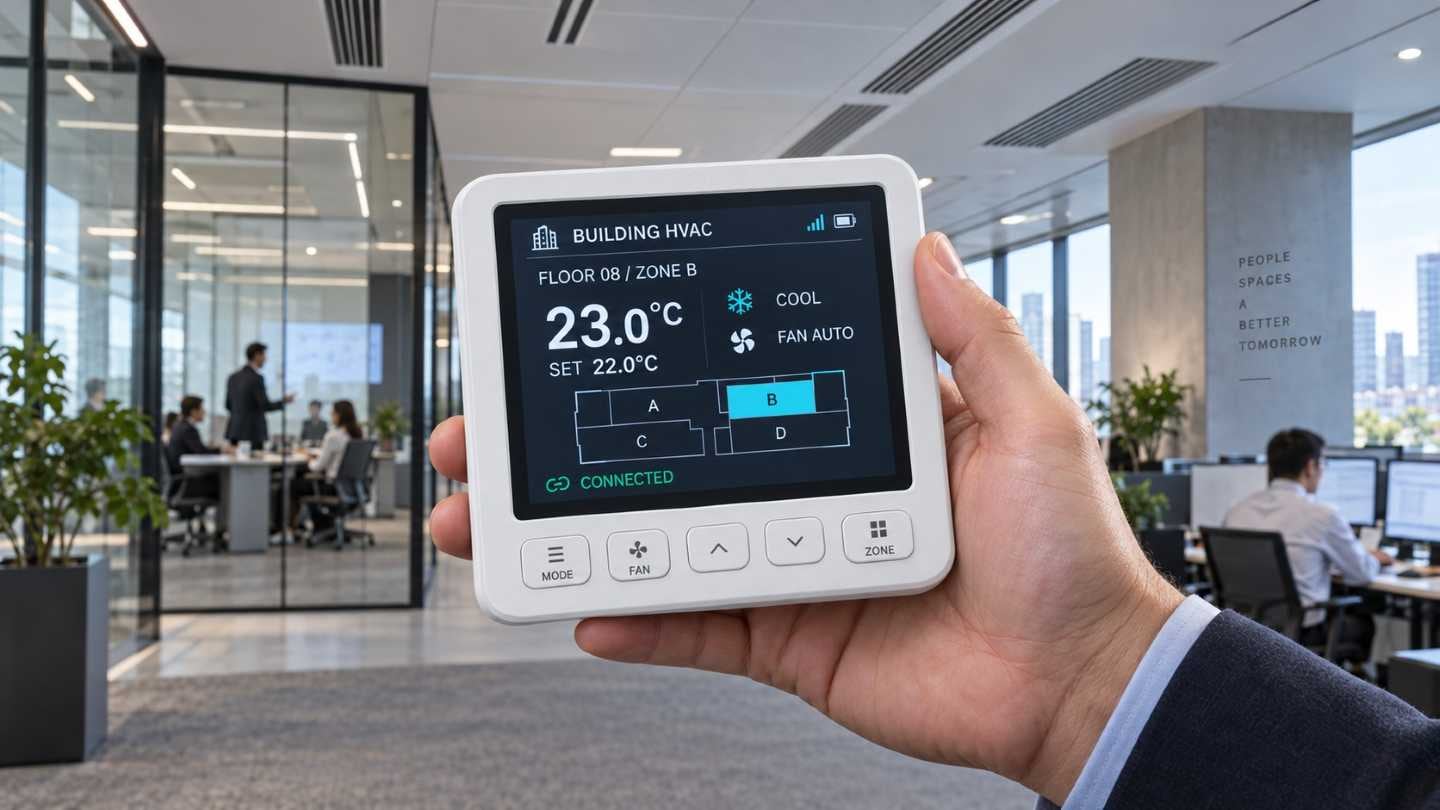
It is screwed to a wall in an office. Everybody touches it and nobody has read the manual.
A wired remote for a system air conditioner is shared property — in a shop, an office, a corridor.
On a screen that small, the default view is the product. Which of operation, temperature and mode is simply there, and how the administrator's settings are kept away from whoever is passing.
Building on the earlier graphics and visual identity work, we filled in the detail screens and the exceptions that commercialisation asks for.
2 separate engagements on this line, 2016–2017.
Technology trends
Written by AEON from public sources. It describes the field, not the project above.
Since the late 2010s, the wired wall controller has outlived several predictions of its disappearance. Smartphone apps, voice assistants and cloud dashboards all arrived, yet commercial air-conditioning and heat pump systems still ship with a panel on the wall. It needs no account or network to work, it sits where people already look for it, and building codes and installers rely on it as the dependable local interface. What has changed is the job that panel is asked to do.
The first change is heating. In its 2022 global outlook, the International Energy Agency described heat pumps as the central technology for low-carbon heating, with EU sales up by about 35 per cent in 2021. Equipment once sold mainly for cooling is now expected to carry a building through winter as well, so the controller has to make sense of defrost cycles, auxiliary heat, flow temperatures and schedules that follow electricity tariffs rather than office hours.
The second change is the refrigerant. Europe's revised F-gas rules, adopted in 2024, bar new equipment that relies on fluorinated gases where workable alternatives exist, and set 2035 as the end point for split air conditioning and heat pumps. The industry's interim answer, lower-impact refrigerants such as R-32 and R-454B, is mildly flammable, and the safety standard UL 60335-2-40 requires leak detection above a charge limit, with detection switching on the indoor fan to dilute any escaped refrigerant. A sensor fault, too, keeps the fans running until it is replaced. These are states an occupant may notice without understanding, and the wall panel is often the only place they can be explained.
The third change is that the panel is no longer the only controller. Matter, the smart-home standard, added thermostat presets and scheduling in version 1.4, alongside energy-management device types that include heat pumps. Commercial systems have their own equivalents through building management integrations. In practice a setpoint may be scheduled in an app, overridden at the wall and then nudged by a demand-response signal from the grid, all within an afternoon.
For the people who touch these controllers, the design problem has moved from operating a machine to understanding a system. Someone standing at the wall needs to know why the unit is doing what it is doing: whether a schedule, a remote user, a grid event or a safety function is in charge, and whether their own input will hold. Clear statements of system-initiated states, consistent behaviour across the app and the wall, and safety messages written for people who are not technicians are becoming as important as the temperature figure itself.