UAV Ground Control System UI/UX Development
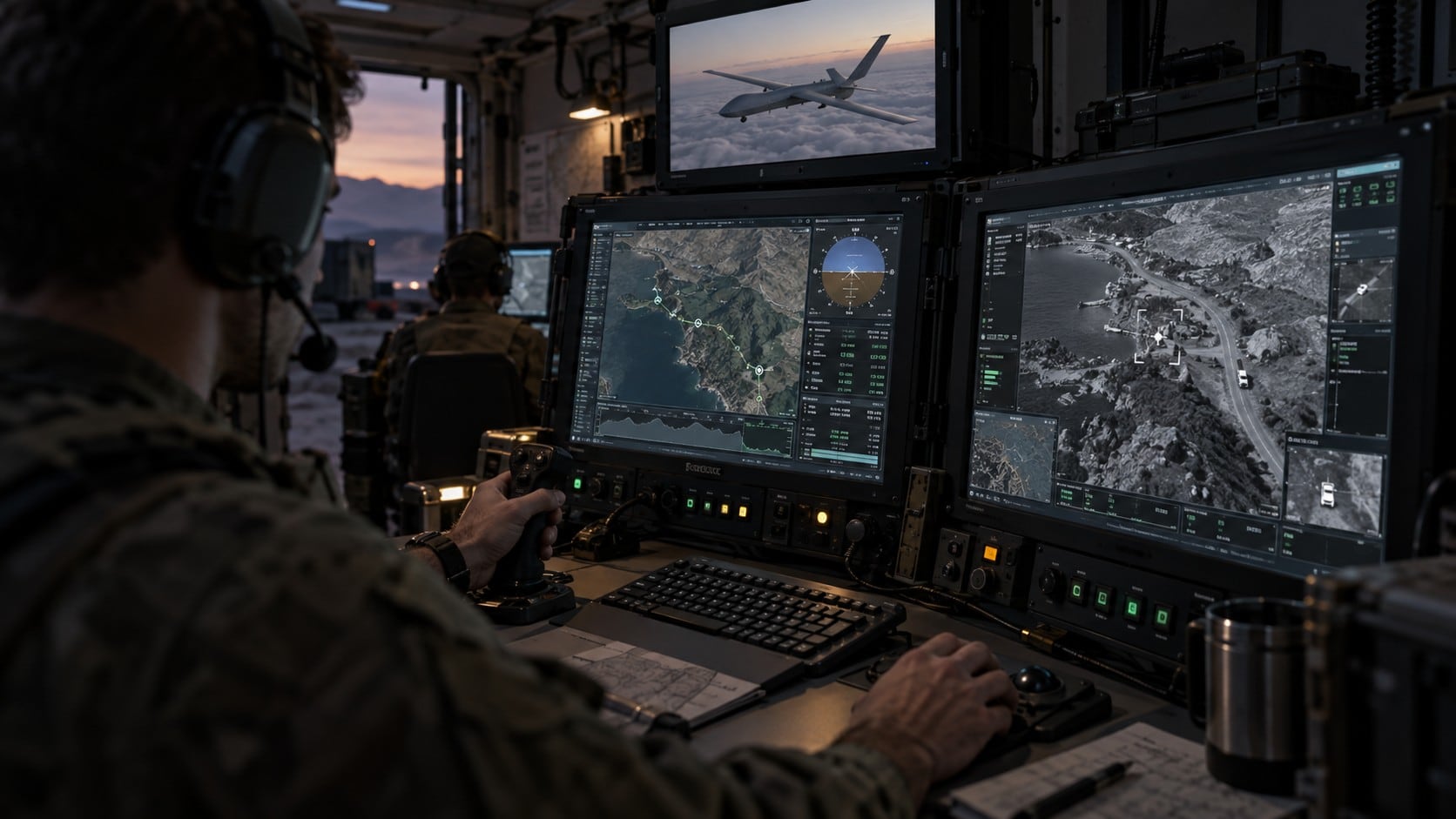
A UAV ground control station multifunction console is the operator station from which several unmanned aerial vehicles are commanded and monitored.
A ground control station (GCS) is the land-based facility from which unmanned aerial vehicles are commanded and through which their flight data and sensor feeds are received. A multifunction console lets operators handle vehicle control, payload operation and mission monitoring from one workstation, and newer stations are designed to manage more than one aircraft at a time. Within NATO, the interfaces between control stations and air vehicles are standardised under STANAG 4586.
AEON developed the UI/UX for LIG D&A's ground control station multifunction console for operating multiple UAVs.
Technology trends
Written by AEON from public sources. It describes the field, not the project above.
For most of the drone era, one aircraft meant one crew and one control station, usually supplied by the aircraft's maker. NATO tried to loosen that link early. STANAG 4586 sets out standard interfaces between UAV control systems, air vehicles and wider command systems, so that a station built by one nation or company can work with another's aircraft at agreed levels of interoperability. The standard itself is careful to say that compliance enables interoperability but does not guarantee it; operator proficiency and concepts of operation still decide what works in practice.
The bigger change now is the ratio of people to aircraft. In December 2023 US Air Force Special Operations Command and General Atomics showed a single crew controlling three MQ-9A aircraft from one workstation using a government-owned control suite. The aircraft took off under separate ground stations, were handed to the single workstation once airborne, and were passed back for automatic landings. AFSOC presented it as a way to reduce manpower.
The Air Force is applying the same idea to its Collaborative Combat Aircraft. Its Autonomy Government Reference Architecture is a government-owned interface between mission autonomy software and the aircraft. In February 2026 the service reported that Collins Aerospace software had flown a semi-autonomous mission on General Atomics' YFQ-42A for more than four hours, following commands from a ground operator, with Shield AI software due to fly on Anduril's YFQ-44A. The stated aim is to avoid being locked into one vendor's software. The Army is moving the control node into the air as well: at Project Convergence Capstone 6 in July 2026 an H-60M Black Hawk launched and controlled several air-launched effects at the same time.
Ukraine shows the same need at the low end. Front-line operators there often carry several different controllers because each drone maker supplies its own. In April 2026 the Ministry of Defence announced a universal ground control station for fibre-optic drones, built to a common standard agreed with manufacturers, to replace them.
The pattern across these efforts is consistent: the control station is separating from the aircraft. Governments want to own the interfaces, run several vehicle types from one console, and change autonomy software without rebuilding the station. That favours open architectures, common message sets and modular software.
For operators, the role changes from flying to supervising. A person responsible for several aircraft cannot hold every detail at once, so the console has to manage attention: showing the state of each vehicle at a glance, raising alerts in order of urgency and making handovers between stations explicit. When different aircraft and autonomy packages share one console, a consistent interaction model becomes a safety issue, because an operator under pressure should not have to remember which vehicle behaves which way.