UI Design Consulting (Naval Acoustic Information Management System (NAIMS))
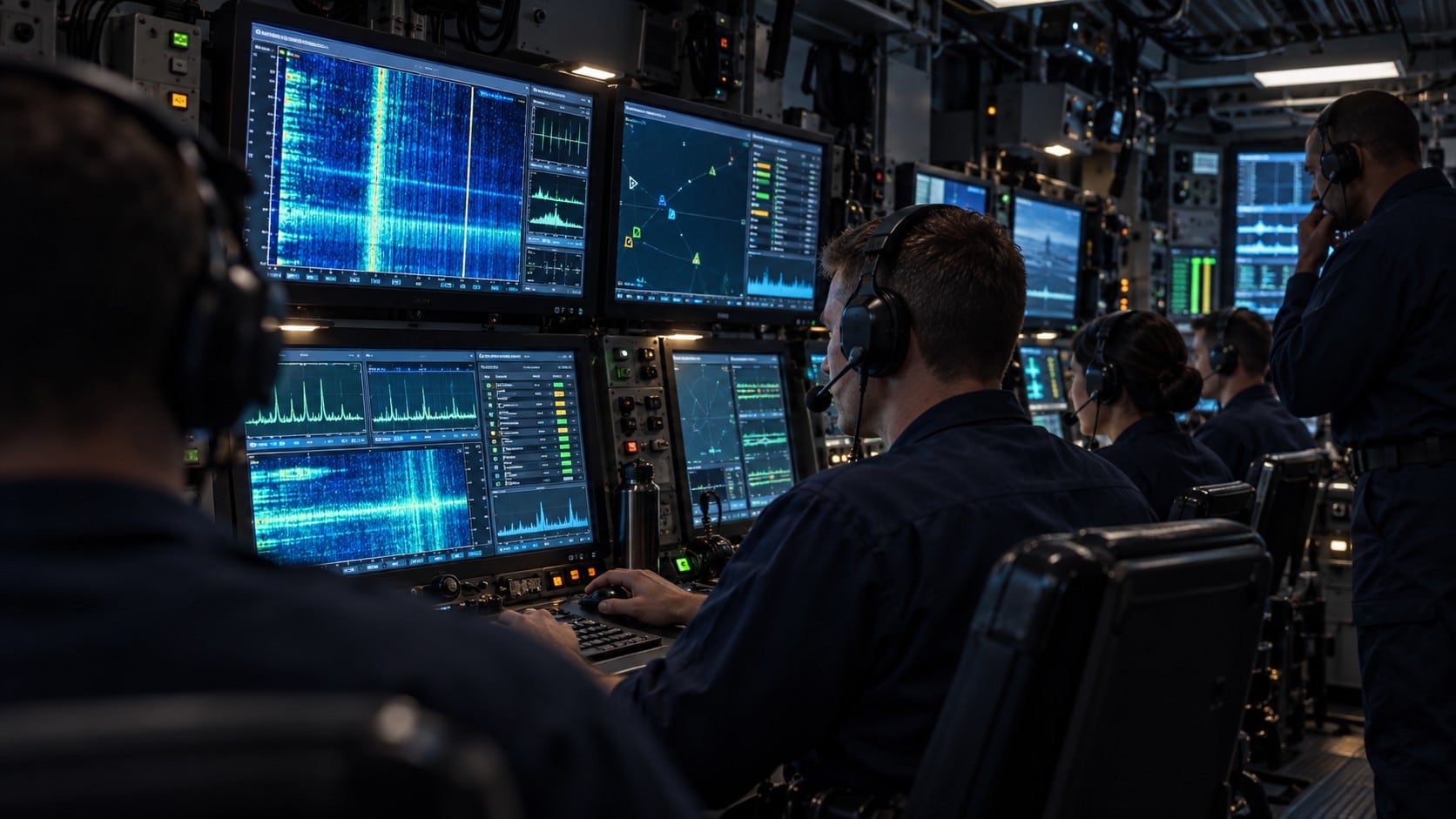
The Naval Acoustic Information Management System (NAIMS) is a system for managing acoustic information collected by surface ships and submarines.
The Naval Acoustic Information Management System (NAIMS) manages acoustic information collected by surface ships and submarines. Acoustic information of this kind underpins the detection and classification of contacts in anti-submarine and undersea warfare, and a managed store of it supports analysis, training and the upkeep of reference data.
AEON provided UI design consulting for the system.
Technology trends
Written by AEON from public sources. It describes the field, not the project above.
Acoustic data is the raw material of undersea warfare. Sonar operators classify contacts by comparing what they hear, and what they see on frequency and time displays, with signatures gathered over years of collection, and navies guard those libraries closely. What is changing is volume. Towed arrays, hull sonars, sonobuoy fields and a growing number of uncrewed sensors now produce more acoustic data than human analysts can review, and the response almost everywhere is machine learning.
The most visible programme is the trilateral AUKUS effort. In 2024 the partners described an AI tool for their P-8 maritime patrol aircraft that recognises biological noise, from whales to shrimp, and removes it from operators' displays, backed by a secure shared environment into which the three nations contribute P-8 sensor data. Fielding has been uneven: as of June 2026 the UK Ministry of Defence told Parliament that the algorithms had not yet flown on RAF P-8s, although Britain draws on data and lessons from partner deployments.
In the United States the emphasis has moved from building a classifier to keeping it current. During RIMPAC 2026, Lockheed Martin and the US Navy demonstrated SensorMAX aboard MH-60R helicopters working sonobuoy fields; when a new contact appeared, operators labelled its signature, retrained the model in under five minutes and sent a small update back to the aircrew. The significance lies less in the algorithm than in the loop: the acoustic database stops being a static reference and becomes training data that is revised during an operation.
Britain's approach stresses rapid insertion. The Royal Navy's ASW Spearhead programme has given the Sonar 2087 towed array a new operator interface and uses a separate platform on which crews can trial new functions and revert to the original system, with AI and machine-learning detection explored in exercises alongside industry. The common thread across these programmes is spiral development driven by operator feedback rather than long, fixed procurement cycles.
This puts new weight on how acoustic information is managed. Labelled recordings, their provenance, the conditions under which they were collected and the versions of models trained on them all need to be stored, traced and, increasingly, shared between allies under strict release rules. In practice the information-management layer is becoming as important as the processing chain that sits on top of it.
For operators, the job is shifting from listening to supervising and curating. A sonar operator who labels a new signature is now also training the system, and an analyst reviewing a machine classification has to judge how far to trust it. Interfaces that show why a classifier reached its conclusion, display confidence honestly and keep the raw signal within reach will decide whether these tools reduce workload or simply move it elsewhere.