Warrior Platform BLOCK-I UX Consulting
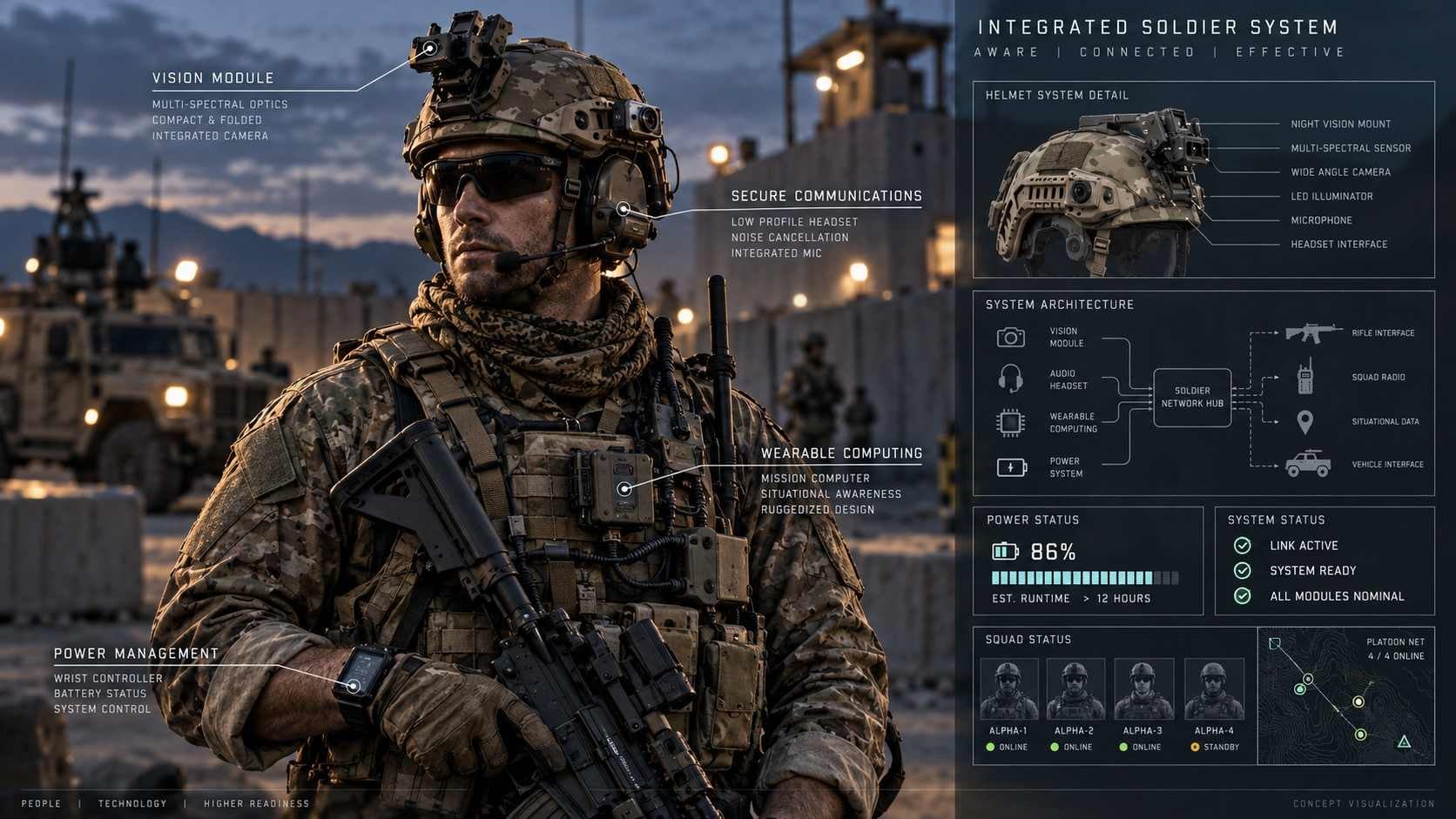
Warrior Platform is the Republic of Korea Army's soldier modernisation programme, covering individual equipment, wearable devices and the systems they report into.
The programme aims to equip each soldier to function as an independent combat platform, with items ranging from helmets, body armour and combat uniforms to sights and communications equipment. It is being introduced in phases as part of the Army's wider modernisation of its combat units, with Block-I as the initial increment.
AEON provided hardware and software UX consulting for Warrior Platform Block-I.
Technology trends
Written by AEON from public sources. It describes the field, not the project above.
Almost every major army has tried to turn the infantry soldier into a networked node, and the history of these programmes is a lesson in how hard it is to put computing on a human body. Weight, power, heat and cognitive load all limit what a soldier can carry and actually use under fire, and each new device competes with the rifle, the radio and the soldier's own eyes for attention.
The US Army's experience is the most public. The Integrated Visual Augmentation System, a HoloLens-derived headset, was meant to fuse night vision, maps and targeting into a single heads-up display. According to the Congressional Research Service, users reported headaches, eyestrain, nausea and poor low-light performance, and in July 2026 the GAO reported that none of the roughly 10,000 units developed would be fielded. The successor, Soldier Borne Mission Command, is being prototyped by Anduril and Rivet; Anduril says it has built manufacturing capacity for thousands of systems, with a production decision possible in fiscal 2028.
European programmes have taken a more incremental route. France's FELIN combined optronics, compact radios and an information terminal around the soldier and his weapon. Germany is digitising its infantry through IdZ-ES: a 2025 framework contract with Rheinmetall upgrades existing platoon systems to a digital standard able to exchange data with Boxer and Puma vehicles. Buying the platoon, rather than the individual, as the unit of procurement reflects a view of the soldier as one element of a larger networked system.
South Korea's Warrior Platform follows a similar philosophy. The Army describes it as equipping each soldier to act as an independent combat platform, with items from helmets and body armour to sights and communications equipment introduced in phases. The newest element across all these programmes is the small drone: unmanned aircraft and their video feeds are becoming standard squad equipment, and the soldier's display increasingly has to show what the drone sees as well as where friendly forces are.
The lesson of two decades of soldier modernisation is that the human is the limiting component. Displays that work in a laboratory can fail at night, in rain, with gloves on and while running. Information that helps a platoon commander can overwhelm a rifleman. The systems that succeed tend to deliver less information but the right information at the right moment, tolerate being ignored when the soldier is busy, and are tested with troops early enough for their feedback to change the design rather than merely to document its problems.