Lead Time
An AI-enabled integrated sustainment system. You keep the forces of a whole country supplied while an AI forecasts what each unit will need and moves it before anyone asks. The same war is run three ways at once, so you can see what each decision is worth.
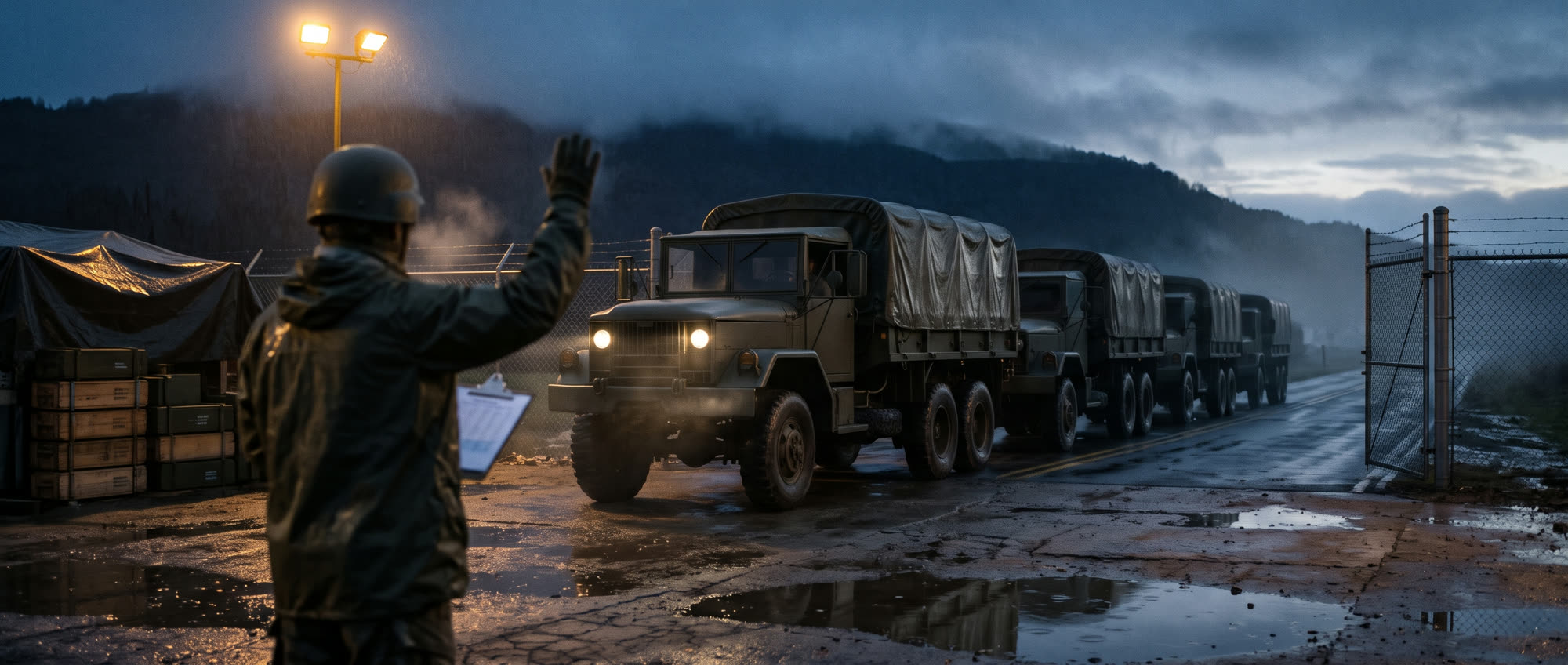
What does it look like when the system is right before anyone has asked?
Why we built it
Sustainment is the part of an operation that is decided hours before it shows. A battery that runs out of interceptors at noon was lost at dawn, when the truck that should have been on the road was still waiting for a request.
Lead Time puts an AI in that gap. It forecasts what every unit will fire, works back through the real time the road takes, and says what has to leave now. Most of the time it is right, and the simulator is built to show that plainly: the same war is run three ways at once. Yours, the AI on its own, and the old way, where a unit asks when it is running low.
The interesting moment is not when the AI is wrong. It is when it is right and the person in the chair is not yet convinced.
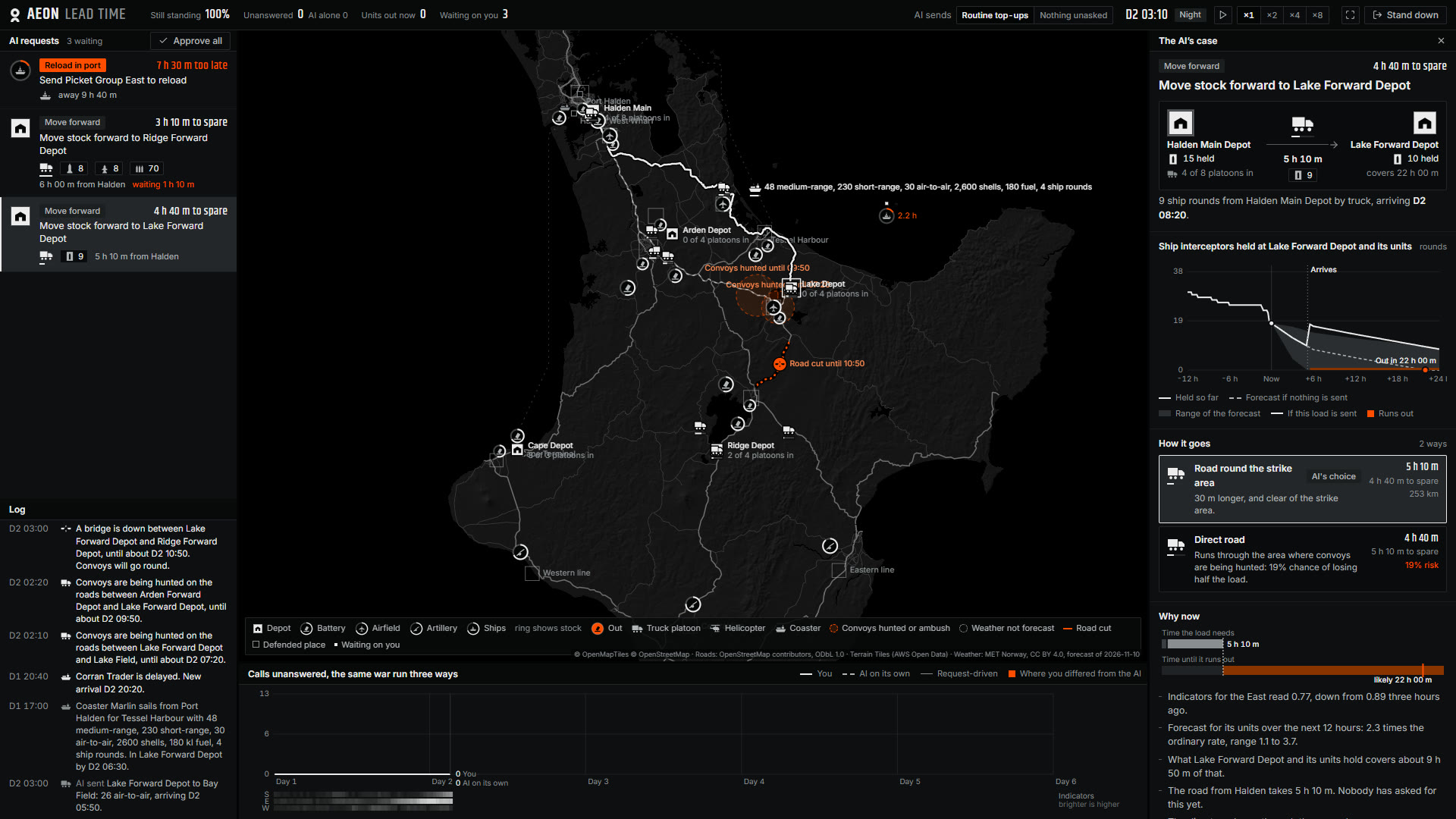
So every request carries its case: the forecast with its range, the time the load needs set against the time the unit has left, the road it chose and the ways it turned down. Direct, round the area where convoys are being hunted, by helicopter, by sea, or wait for the road to clear. You can approve, send part, hold, or send it another way. Where you differ from the AI, the review plays both choices forward and shows what the difference was worth.
The roads are real roads. The hills, the coast and the five-day forecast are real too. And then things happen that nobody could plan for: an ambush that waits unseen for the first convoy to pass, a bridge gone with no warning, fog that was in no forecast.
A plan is only as good as the ten minutes after it breaks.
What you do in it
- The whole supply picture at once: five depots, twenty-three units, truck platoons and helicopters, and seven kinds of stock from interceptors to fuel.
- A trained forecast: a small neural network reads what has been fired and what intelligence reports, and gives a low, likely and high figure for the hours ahead.
- It works back from the moment a unit would run dry through how long the road takes, and says what has to leave now.
- Real roads, hills and weather: convoys drive the real road network, helicopters fly round the high ground, and two coasters work the coast. A real five-day forecast grounds aircraft and slows roads.
- It chooses how each load goes: the direct road, a road round an area where convoys are being hunted, a helicopter, a ship, or waiting for the road to clear. The ways it did not choose are shown beside the one it did.
- Things nobody can plan for happen: an ambush that waits unseen for the first convoy to pass, a bridge lost with no warning, weather that was not in the forecast. When one does, the AI plans again in the same ten minutes and turns convoys already on the road.
- You decide: approve, send part, or hold. Before you hold, it tells you what holding would mean.
- The review sets every decision where you differed against the choice the AI made, with everything afterwards handled the same way.
Scenario
Meridia, the same fictional country as Second Watch, with the same batteries and airfields under the same names. The Ostrel Union decides for itself where to press and when. Nothing runs to a timetable: build-ups can be seen coming, and some come to nothing.
One figure
How it connects
- Second WatchThe same country. Lead Time supplies the batteries and airfields that Second Watch fights with, under the same names and in the same places. What is left in the magazines when you stop is saved in an exchange format made for both.
- Harrow LineHarrow Line counts the minutes from sensor to effect. Lead Time counts the hours before that, the ones that decide whether there is anything to fire.
- SoundingSounding lets you set how far the AI may go alone. Lead Time keeps that and adds the bill: what each override cost, or saved.
- Aveline ShieldAveline Shield first compared plans as spreads of outcomes instead of single guesses. Lead Time compares whole ways of running a war the same way.
Why a design firm builds simulators
AEON designs the screens people use to watch, decide and act: control rooms, command posts, consoles. The work begins in the field, beside the people who hold those seats. It is usually shown afterwards as documents and still pictures of screens.
A still picture of a control screen shows what is on it. It cannot show what happens when forty things change at once and one of them matters.
So we build the screen as something that runs. Each simulator in Labs is a whole working system in a browser: a world that moves by itself, sensors that see only part of it, an opponent that follows no script, and a person in the chair who has to decide with what the screen gives them.
Since AI entered these systems the question has changed shape. It is no longer only whether the operator can find the information. It is who decides, on what evidence, and in how much time.
We think that question is settled on the screen, not in the model.
Each simulator takes one part of it. What should be fused before a person sees it. How far a machine may act alone. What an override costs. How anyone can tell, afterwards, who was right.
None of them reproduces a system we have delivered. The states, forces and numbers are invented. Where something is real, the ground, the weather, recorded civil flights, the roads, we say so and say where it came from. This is our own study of the problem, made so that it can be tried instead of described.
At a glance
- Forces
- Notional. Fictional states, units and equipment values. Not based on any real system
- Geography
- Real roads, terrain and weather under invented names. Sea lanes are computed over real water, not taken from shipping records
- AI
- Trained on simulated campaigns and checked on ones it never saw. Not a large language model. Runs in your browser
- Comparison
- Your run, the AI on its own, and a request-driven baseline face the same enemy hour for hour
- Data
- OpenStreetMap roads · Terrain Tiles · MET Norway forecast
- Open data
- Contains information from OpenStreetMap, made available under the Open Database License (ODbL).Download the road graphAbout the fileLicence
- Screen
- Desktop only. Runs in full screen
- Language
- English
This simulator is a design study. Forces, states and events are invented; it does not depict any system AEON has delivered.
Verify to open Labs
Labs simulators are shown to verified visitors from organisations. Enter your work email and we will send a six-digit code.