Second Watch
An AI-enabled integrated air defence system. You hold the watch over a whole country while an AI identifies, ranks and assigns, and an enemy plans for itself and learns. There is no script: it runs until you stand down.
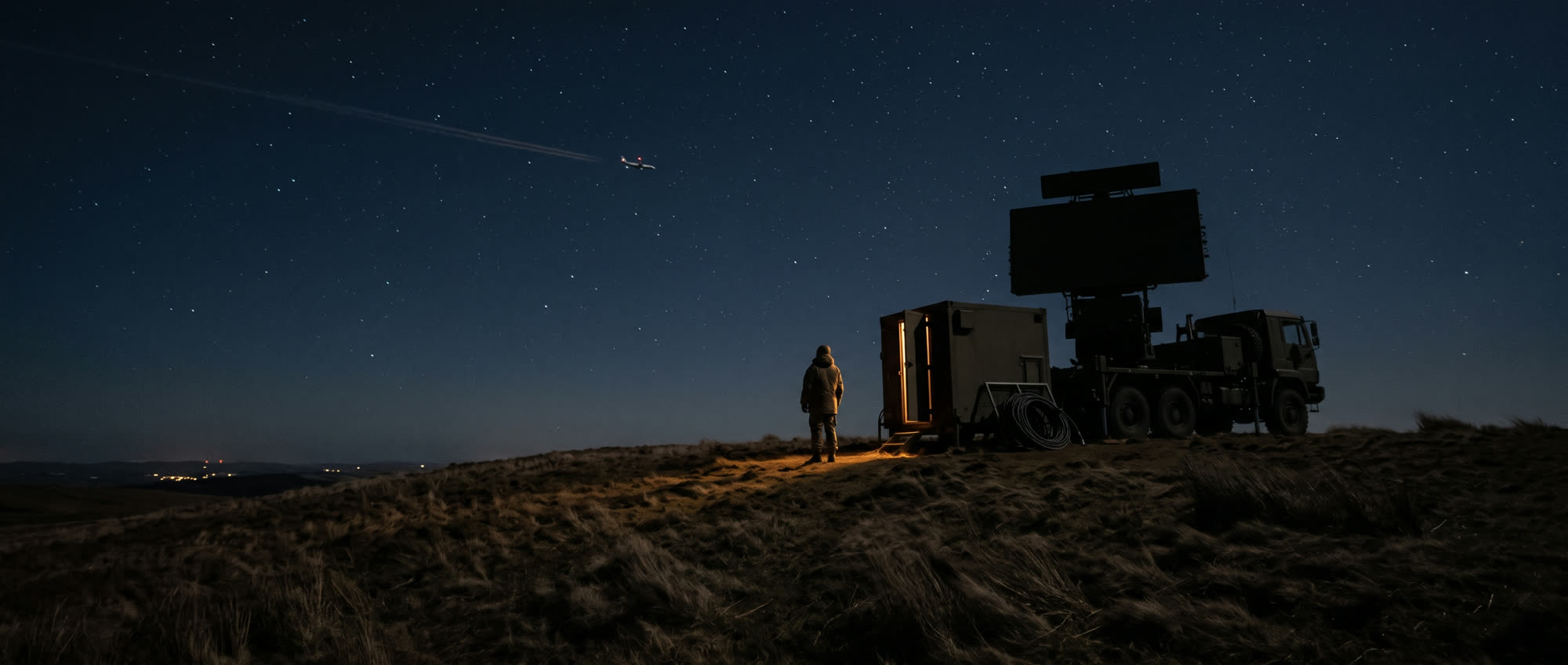
How much should a machine be allowed to do when it has never seen this before?
Why we built it
Air defence is short of time by design. A drone swarm, a cruise missile and an airliner with a failed transponder can share one screen in the same minute, and each mistake costs something different.
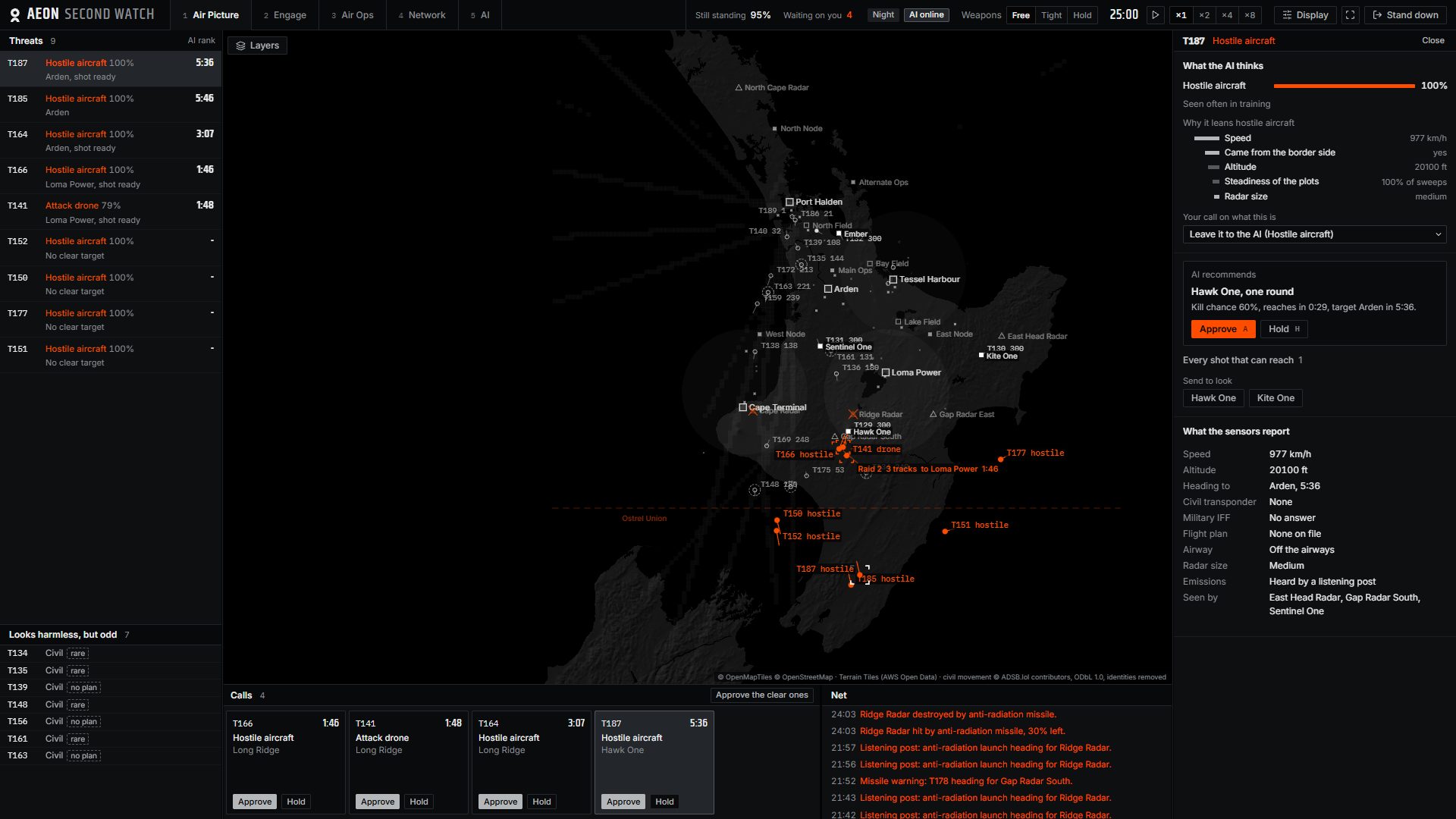
Second Watch gives you the air defence of a whole country and an AI that identifies, ranks and assigns. The AI is real in the small sense that matters. It learned civil traffic from recorded flights. It gives odds and reasons. And it says when it has rarely or never seen anything like the thing in front of it.
Its mistakes are not planted. The enemy finds them.
As the opponent loses, it starts to fly shapes the AI was never trained on: a decoy that moves like a fighter, a drone as slow as a flock of birds, a stolen civil code. For each kind of weapon you set whether the AI advises, fires unless you stop it, or fires. Then you find out whether that setting was wise.
It is also a test bench for the screen itself. The same watch can be stood again with one thing about the display changed, where the reasons sit, how the list is sorted, whether you are told by voice, and the two results compared.
An AI that says “I have not seen this” is asking for a better screen, not only a better model.
What you do in it
- The whole system at once: radars, early warning aircraft, batteries, fighters, a tanker, drone jamming, command nodes and the civil airspace, in one picture.
- A trained AI: a small classifier that learned civil traffic from real recorded flights. It gives odds and reasons, and says when it has rarely or never seen anything like this. Threat ranking and weapon assignment are computed on top of it.
- You decide how much it may do: for each kind of weapon, manual, advise, fire unless vetoed, or fire. Anything it finds risky still comes to you.
- Its mistakes are not planted: as the enemy loses, it adopts shapes the AI was never trained on. You only find out when someone looks, or at the review.
- Real conditions in the run: radars see over real terrain, today's weather and daylight change what works, satellite passes follow real orbits, and airways come from where airliners really fly.
- Review and test: replay the watch with what you saw set against what was true, or take short watches with one thing on the screen changed and compare your own results.
Scenario
Two fictional states, Meridia and the Ostrel Union, over real terrain under invented names. Recorded civil traffic keeps flying, with every identity removed. The enemy chooses each raid from its own stock: drone swarms, cruise and ballistic missiles, decoys, jamming and radar hunting. Nothing runs to a timetable, and radars you leave on get hunted.
One figure
How it connects
- Lead TimeThe same country, seen from the supply side. Every round Second Watch fires is a round Lead Time has to replace, over real roads, before the next raid.
- SoundingBuilt in the same week from the same idea: autonomy is a setting the operator owns, and there is a report card afterwards. Sounding’s AI is hand-set tables. Second Watch’s is trained, which is why it can be surprised.
- Aveline ShieldAveline Shield posed the dilemma once: an airliner goes silent while a strike is inbound. Second Watch makes it the permanent condition of the watch.
- SortieSortie asks how you know a learned policy is good before it flies. Second Watch is what it looks like after, when the answer matters.
Why a design firm builds simulators
AEON designs the screens people use to watch, decide and act: control rooms, command posts, consoles. The work begins in the field, beside the people who hold those seats. It is usually shown afterwards as documents and still pictures of screens.
A still picture of a control screen shows what is on it. It cannot show what happens when forty things change at once and one of them matters.
So we build the screen as something that runs. Each simulator in Labs is a whole working system in a browser: a world that moves by itself, sensors that see only part of it, an opponent that follows no script, and a person in the chair who has to decide with what the screen gives them.
Since AI entered these systems the question has changed shape. It is no longer only whether the operator can find the information. It is who decides, on what evidence, and in how much time.
We think that question is settled on the screen, not in the model.
Each simulator takes one part of it. What should be fused before a person sees it. How far a machine may act alone. What an override costs. How anyone can tell, afterwards, who was right.
None of them reproduces a system we have delivered. The states, forces and numbers are invented. Where something is real, the ground, the weather, recorded civil flights, the roads, we say so and say where it came from. This is our own study of the problem, made so that it can be tried instead of described.
At a glance
- Forces
- Notional. Fictional states, units and equipment values. Not based on any real system
- Geography
- Real terrain under invented names. Open map data
- AI
- Trained on real flights for civil traffic and on generated examples for the rest. Not a large language model. Runs in your browser
- Model
- Textbook formulas
- Data
- ADSB.lol history (ODbL) · Terrain Tiles · OpenStreetMap · MET Norway (CC BY 4.0) · CelesTrak · NOAA SWPC · raid sizes from Massive Missile Attacks on Ukraine, P. Ivaniuk (CC BY-NC-SA 4.0)
- Open data
- Contains information from ADSB.lol flight history, made available under the Open Database License (ODbL).Download the derived dataLicence
- Screen
- Desktop only. Runs in full screen
- Language
- English
This simulator is a design study. Forces, states and events are invented; it does not depict any system AEON has delivered.
Verify to open Labs
Labs simulators are shown to verified visitors from organisations. Enter your work email and we will send a six-digit code.