Sortie
A bench for training drone flight policies. Plan a flight over real ground with fictional drones, sweep it through thousands of changing conditions, and look only at the flights that went wrong.
How do you know a learned policy is good before it flies?
Why we built it
Every other simulator here puts an AI beside an operator. Sortie looks at the step before: the bench where a flight policy is trained and judged.
The usual answer is an average. This policy completes 94 percent of its flights. Sortie is built on the opposite habit.
Look only at the flights that went wrong.
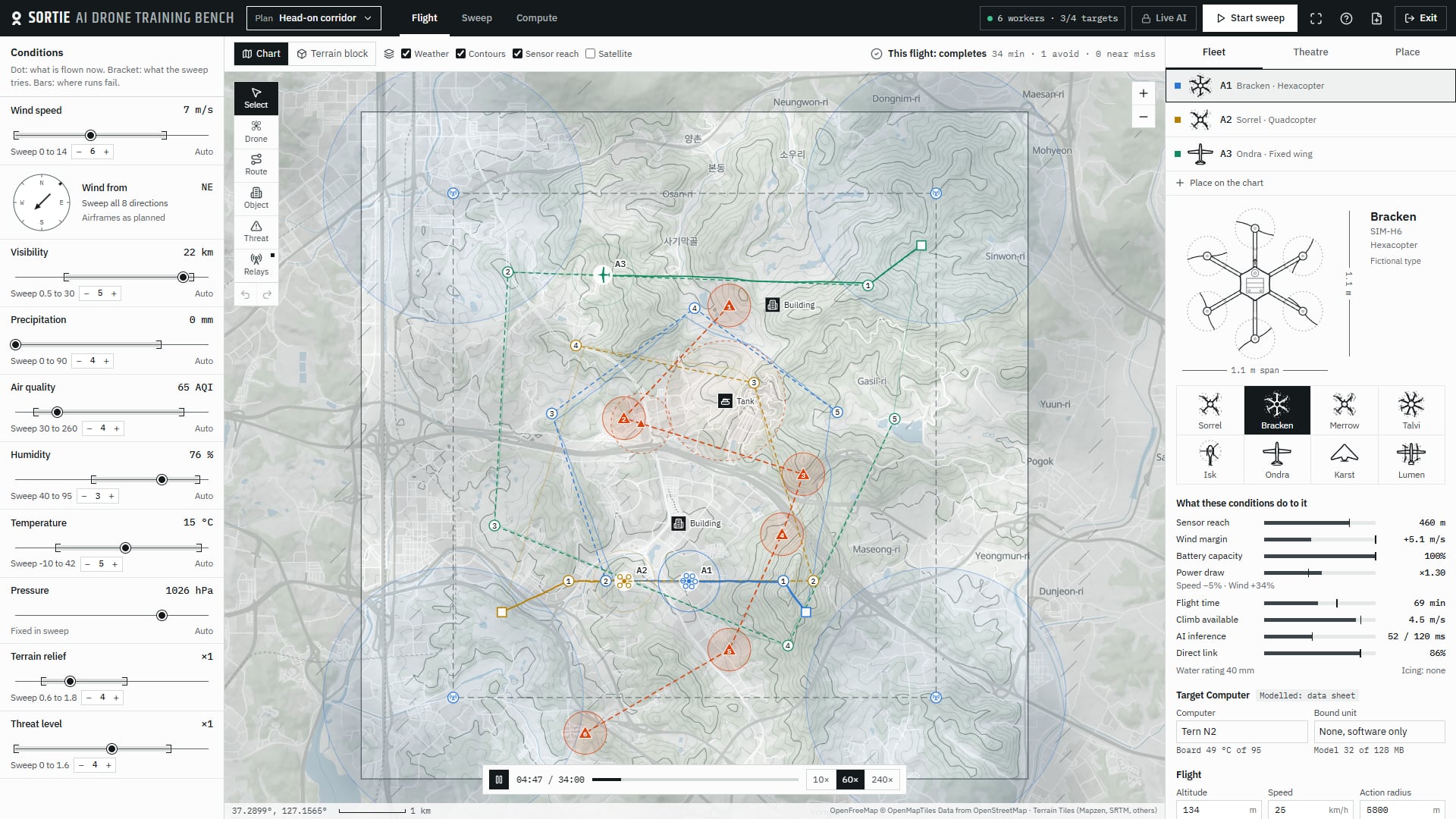
A condition is a range, not a value. One slider sets what is flown now, what the sweep will try, and shows where runs fail. Open a failed flight and it is not a replay but an experiment: change one condition and fly it again, with the original track still on the chart. A table says which single change would have finished the flight.
Learning is measured by yield on the same 300 flights inside the limits of the aircraft. Flights the aircraft could never have completed are left out, because they teach nothing.
A score that includes the impossible flights flatters nobody and informs nobody.
Training and deployment are kept apart. A model moves from training through software and bench tests to approval, and only then to an aircraft. It is also the one light screen in the series, on purpose: a tool used in an office, in daylight, for hours.
What you do in it
- Conditions as ranges: one slider sets the value flown now, the range the sweep will try, and shows where runs fail.
- Instant re-fly: change the wind, move a waypoint or swap the airframe, and the flight runs again in milliseconds with its track and performance figures updated.
- Investigation as an experiment: open a failed flight, change one condition and fly it again. The original track stays on the chart, and a table shows which single change would have finished the flight.
- Learning measured by yield: the same 300 flights within the limits of the aircraft are flown again with the current policy. Flights past those limits are left out.
- Training and deployment kept apart: a job queue, bench boards and model versions move from training through software and bench tests to approval. Boards and servers are simulated.
Scenario
The sample project flies three plans over real ground, starting with a head-on conflict in a shared corridor. Drones, routes, objects, threats and relays are placed by clicking on the chart, and the whole project can move to another place on the map.
One figure
How it connects
- Second WatchSecond Watch is what a trained model looks like in service, when an opponent goes looking for what it never learned.
- Harrow LineHarrow Line flies drones as assets on an operations map. Sortie is the bench they would have come from.
- Aveline ShieldAveline Shield compared plans by running them many times. Sortie runs a policy many thousands of times and keeps only the failures.
Why a design firm builds simulators
AEON designs the screens people use to watch, decide and act: control rooms, command posts, consoles. The work begins in the field, beside the people who hold those seats. It is usually shown afterwards as documents and still pictures of screens.
A still picture of a control screen shows what is on it. It cannot show what happens when forty things change at once and one of them matters.
So we build the screen as something that runs. Each simulator in Labs is a whole working system in a browser: a world that moves by itself, sensors that see only part of it, an opponent that follows no script, and a person in the chair who has to decide with what the screen gives them.
Since AI entered these systems the question has changed shape. It is no longer only whether the operator can find the information. It is who decides, on what evidence, and in how much time.
We think that question is settled on the screen, not in the model.
Each simulator takes one part of it. What should be fused before a person sees it. How far a machine may act alone. What an override costs. How anyone can tell, afterwards, who was right.
None of them reproduces a system we have delivered. The states, forces and numbers are invented. Where something is real, the ground, the weather, recorded civil flights, the roads, we say so and say where it came from. This is our own study of the problem, made so that it can be tried instead of described.
At a glance
- Aircraft
- Fictional. Eight airframe types, none a real product
- Compute
- Simulated. Boards and servers are modelled
- Geography
- Real. Open map data, relocatable
- Data
- OpenFreeMap · Terrain Tiles · EOxCloudless 2016 · Nominatim
- Screen
- Desktop only. Runs in full screen
- Language
- English
This simulator is a design study. Forces, states and events are invented; it does not depict any system AEON has delivered.
Verify to open Labs
Labs simulators are shown to verified visitors from organisations. Enter your work email and we will send a six-digit code.