Sounding
An AI-assisted control system for a stretch of sea. You stand a three-day watch over ships, aircraft, submarines and seabed sensors, and decide how far the AI may go alone.
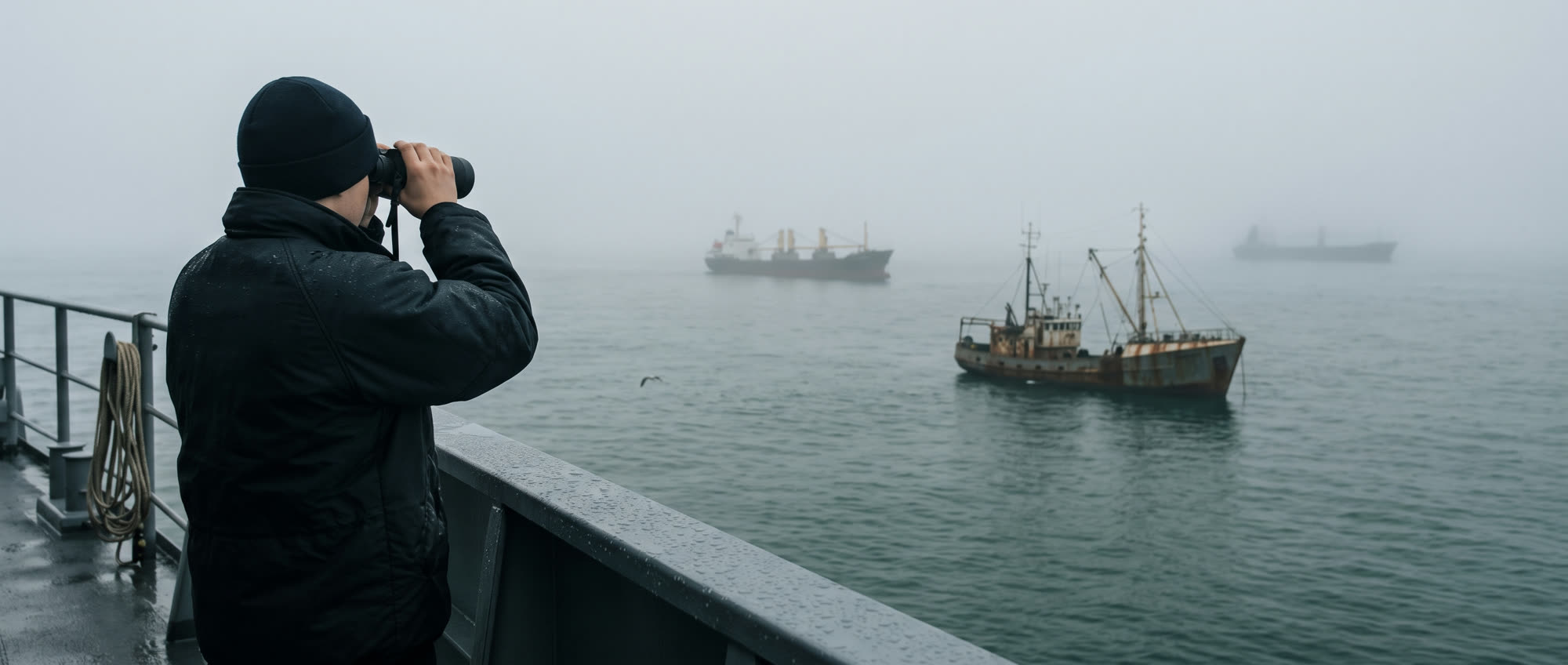
What is a picture worth when the picture itself can be wrong?
Why we built it
At sea almost nothing announces itself truthfully. Reports arrive from radar, sonar, satellites, intercepts and ships’ own transponders with no names on them, and something has to decide which reports are the same ship.
Sounding does that matching for real, so it fails the way real matching fails. Two ships that pass close can swap identities. A false position can stand on the screen as a track with nothing under it. A merchant laying mines reads as a merchant.
Every layer of help is also a layer that can mislead.
You stand a three-day watch that begins in peacetime, with fishing boats, a ship in distress and someone switching their transponder off. For each thing the AI does, fusing, identifying, watching behaviour, pairing weapons, planning sensors, you decide how far it may go alone. Dismiss one kind of alert often enough and it learns to raise fewer of them, including the real ones.
Only afterwards does the simulator show what was true: how often the AI was right, how many disguised ships it caught, whether your overrides helped.
During the watch you have only the screen. That is the point.
What you do in it
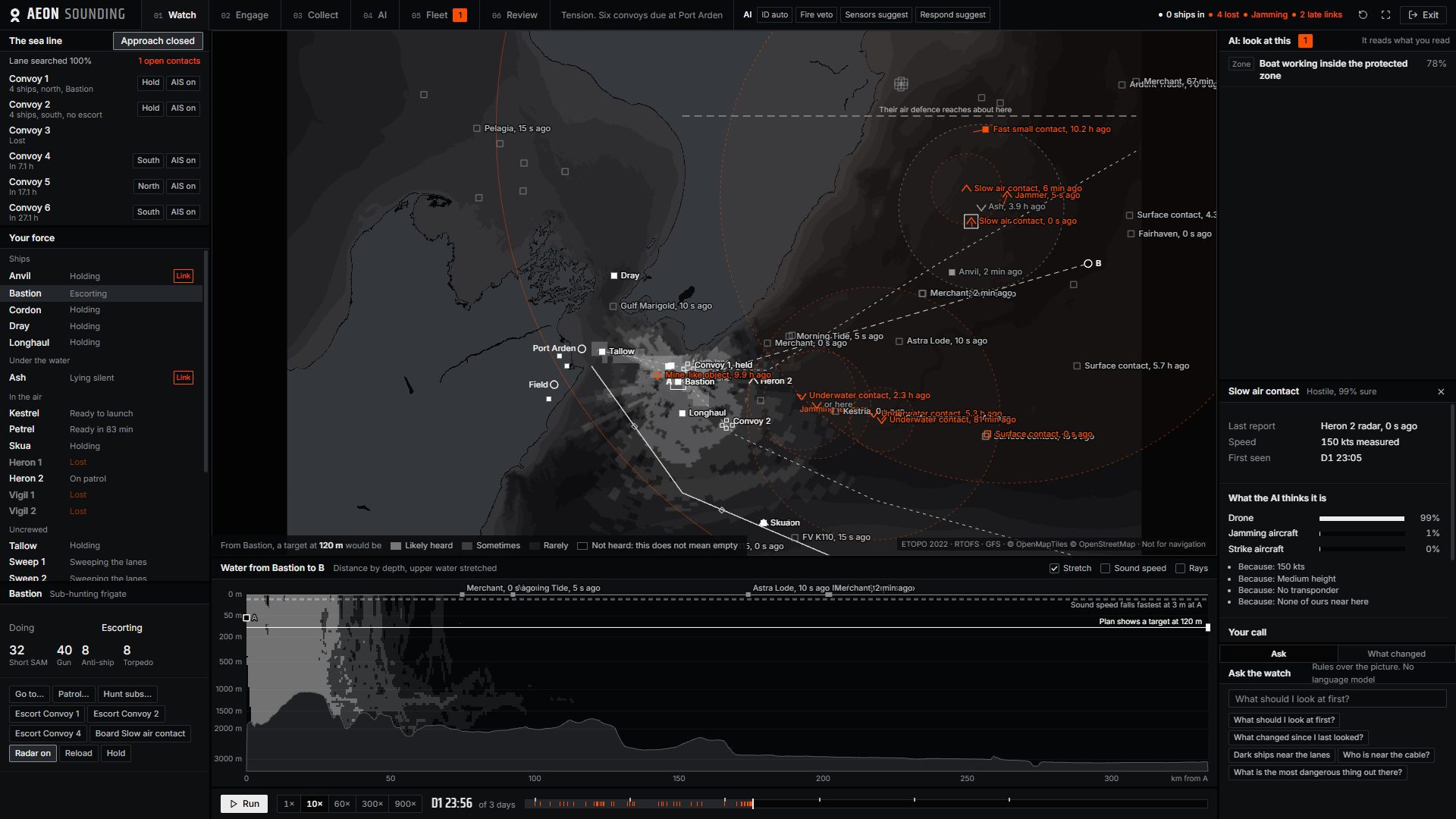
- Track fusion: radar, sonar, satellite, intercept and AIS reports arrive with no names on them and are matched into one track each. The matching is real, so two passing ships can swap and a false AIS position can stand as a track with nothing under it.
- Identification with its reasons: each contact carries probabilities and the features that moved them. A merchant laying mines reads as a merchant, and one of your own helicopters with a failed transponder reads as a drone.
- Behaviour watch: dark ships, AIS with no radar return, boats sitting on the cable, ships stopped together, fishing in a closed zone. Alerts are ranked by score, and dismissing a kind teaches it to raise fewer of them, including the real ones.
- One chain for every target: air, surface, underwater and land targets go through the same six steps. The AI pairs air threats with shooters. Whether it needs approval, can be stopped for 30 seconds or fires at once is your setting, and so is how sure it must be. Strikes on ships, submarines and land always wait for a person.
- Sensor planning: a map of where nobody has looked, weighted by what matters. Aircraft and satellites go to the worst gap if you allow it. It knows where the gaps are, not where anything is.
- Afterwards, how right it was: what you believed beside what was true, how often the AI was right, how many disguised ships it caught, and whether your overrides were right. None of this is available during the watch.
Scenario
It begins in peacetime: traffic, fishing boats, a ship in distress, someone switching their AIS off. Six convoys are due at a port across three days. A fictional opposing state has its own commander with no script, who acts only on what its scouts, intercepts and AIS tell it, so where you place your force changes what it does next.
One figure
How it connects
- Second WatchThe same question moved from the sea to the air, with a trained model in place of hand-set tables.
- Aveline ShieldAveline Shield showed fusion as a finished picture, with a confidence on each track. Sounding opens the fusion up and lets it go wrong.
- Harrow LineBoth run every target, whatever it is, through one chain of steps, and both let weather and physics decide what a sensor can see.
- Lead TimeLead Time takes the idea of autonomy as a setting and adds what each override cost.
Why a design firm builds simulators
AEON designs the screens people use to watch, decide and act: control rooms, command posts, consoles. The work begins in the field, beside the people who hold those seats. It is usually shown afterwards as documents and still pictures of screens.
A still picture of a control screen shows what is on it. It cannot show what happens when forty things change at once and one of them matters.
So we build the screen as something that runs. Each simulator in Labs is a whole working system in a browser: a world that moves by itself, sensors that see only part of it, an opponent that follows no script, and a person in the chair who has to decide with what the screen gives them.
Since AI entered these systems the question has changed shape. It is no longer only whether the operator can find the information. It is who decides, on what evidence, and in how much time.
We think that question is settled on the screen, not in the model.
Each simulator takes one part of it. What should be fused before a person sees it. How far a machine may act alone. What an override costs. How anyone can tell, afterwards, who was right.
None of them reproduces a system we have delivered. The states, forces and numbers are invented. Where something is real, the ground, the weather, recorded civil flights, the roads, we say so and say where it came from. This is our own study of the problem, made so that it can be tried instead of described.
At a glance
- Forces
- Notional. Fictional states, units and equipment values
- AI
- Runs in your browser on the same reports you see. Hand-set tables and rules, no trained model and no language model
- Geography
- Real seabed under invented names. Open map data
- Model
- Published formulas for sound in water
- Data
- NOAA ETOPO 2022 · RTOFS · GFS and GFSwave · satellite passes computed from CelesTrak and Space-Track.org (USSPACECOM) orbital data · OpenStreetMap
- Screen
- Desktop only. Runs in full screen
- Language
- English
This simulator is a design study. Forces, states and events are invented; it does not depict any system AEON has delivered.
Verify to open Labs
Labs simulators are shown to verified visitors from organisations. Enter your work email and we will send a six-digit code.